Encuentros virtuales en vivo: sรกbado 18 julio, 14:00 EST

ยกGracias por unirse a nuestra sesiรณn hoy!

Nuestro texto fue โ€œAl bordeโ€ย de Gloria Fuertes, publicado a continuaciรณn.

Vamos a escribir:ย โ€œEscribe acerca de estar al borde.โ€

Se alienta a los participantes a compartir lo que escribieron a continuaciรณn (โ€œDeja una respuestaโ€), para mantener la conversaciรณn aquรญ, teniendo en cuenta que el blog, por supuesto, es un espacio pรบblico donde no se garantiza la confidencialidad.

ยกCuรฉntenos mรกs sobre su experiencia en este taller completando esta breve encuesta!

Por favor, รบnase a nosotros para nuestra prรณxima sesiรณn en espaรฑol:ย Sรกbado, 1 de agosto a las 2 pmย EST, con mรกs veces listadas en inglรฉs en nuestra pรกgina deย sesiones grupales virtuales en vivo.


Al borde - Gloria Fuertes

Soy alta;
en la guerra
lleguรฉ a pesar cuarenta kilos.
He estado al borde de la tuberculosis,
al borde de la cรกrcel,
al borde de la amistad,
al borde del arte,
al borde del suicidio,
al borde de la misericordia,
al borde de la envidia,
al borde de la fama,
al borde del amor,
al borde de la playa,
y, poco a poco, me fue dando sueรฑo,
y aquรญ estoy durmiendo al borde,
al borde de despertar.

Laboratori Di Medicina Narrativa: sabato 18 luglio dalle 16 alle 17.30

Siamo stati molto lieti di avervi qui con noi!

Abbiamo letto insieme la poesia “Ex Voto” di Eugenio Montale (allegato al termine di questa pagina)ย ย 

In seguito, abbiamo usato il prompt “Era o non era…”.

Condivideremo ulteriori dettagli della sessione nei prossimi giorni; vi invitiamo a rivisitare questa pagina nei prossimi giorni!

Invitiamo i partecipanti del laboratorio a condividere i propri scritti nella parte “blog” dedicata alla fine della presente pagina (“Leave a Reply”). Speriamo di creare, attraverso questo forum di condivisione, uno spazio in cui continuare la nostra conversazione!

Stiamo raccogliendo impressioni e breve feedback sui nostri laboratori di medicina narrativa su Zoom!

Questo breve questionario (anonimo, e aperto a chiunque abbia frequentato almeno un laboratorio) รจ molto importante per noi, e ci permetterร  di elaborare sul valore dei nostri laboratori e sul ruolo dello spazio per riflettere e metabolizzare il momento presente. Vi preghiamo quindi di condividere le nostre riflessioni con noi!ย 


Ex voto
ย 
Eugenio Montale, โ€œSaturaโ€, 1971
ย 
Accade
che le affinitร  dโ€™anima non giungano
ai gesti e alle parole ma rimangano
effuse come un magnetismo. รˆ raro
ma accade.

Puรฒ darsi
che sia vera soltanto la lontananza,
vero lโ€™oblio, vera la foglia secca
piรน del fresco germoglio. Tanto e altro
puรฒ darsi o dirsi.

Comprendo
la tua caparbia volontร  di essere sempre assente
perchรฉ solo cosรฌ si manifesta
la tua magia. Innumeri le astuzie
che intendo.

Insisto
nel ricercarti nel fuscello e mai
nellโ€™albero spiegato, mai nel pieno, sempre
nel vuoto: in quello che anche al trapano
resiste.

Era o non era
la volontร  dei numi che presidiano
il tuo lontano focolare, strani
multiformi multanimi animali domestici;
forsโ€™era cosรฌ come mi pareva
o non era.

Ignoro
se la mia inesistenza appaga il tuo destino,
se la tua colma il mio che ne trabocca,
se lโ€™innocenza รจ una colpa oppure
si coglie sulla soglia dei tuoi lari. Di me,
di te tutto conosco, tutto
ignoro.

Narrative Medicine Book Club: Magic Mountain, Week 8

Week 8: This week’s pages were my favorite in the book so far. From the examination of Director Behrens’ paintings and in particular his portraitย of Madame Chauchat, leading Castorp to expound on the link between science and art, how they “blend togetherย because they have actually always been just one thing,” and into his new interest in studying human anatomy and the question of “what is life”…to that incredible pages-long rumination on life and on human anatomy all the way down to the molecular level. Wow! The writing here is nothing short of transcendent. Too many passages to quote; this last chapter, “Research,” is for me reason alone to read this entire book. Who’s with me??

ย 
For next week: Read to section “Walpurgis Night” in Chapter 5


Wirtualna Grupa Narracyjna: Czwartek 16 lipca, 18:00 CET

Dziฤ™kujemy wszystkim, ktรณrzy wziฤ™li udziaล‚ w dzisiejszej grupie narracyjnej!

Wspรณlnie uwaลผnie przeczytaliล›my, dostฤ™pny poniลผej, fragment โ€žBajki o Raลกceโ€ Oty Pavla w tล‚umaczeniu Justyny Wodzisล‚awskiej.

Inspiracja do kreatywnego pisania brzmiaล‚a: โ€žNiezwykล‚a codziennoล›ฤ‡โ€.

Istotnym elementem pracy dzisiejszej grupy byล‚ gatunek literacki tekstu โ€“ bajka. Jej struktura znalazล‚a odzwierciedlenie w dynamice grupy, ktรณra zdawaล‚a siฤ™ dฤ…ลผyฤ‡ do rozpoznania moraล‚u. Rรณwnieลผ niedosล‚ownoล›ฤ‡ zdarzeล„, ktรณre skล‚adaล‚y siฤ™ na fabuล‚ฤ™ byล‚a tematem dyskusji grupy. Wskazywano na to, jak โ€žmajstrowanie pociech pรณล‚ na pรณล‚โ€ stawaล‚o siฤ™ zdarzeniem magicznym, pstrฤ…g jawiล‚ siฤ™ niczym mityczny stwรณr, a podziaล‚ miฤ™dzy chล‚opcami i dziewczynkami zaczynaล‚ odzwierciedlaฤ‡ konkurencjฤ™ sportowych druลผyn. Poczฤ…tek pracy odbywaล‚ siฤ™ w atmosferze bliskoล›ci i towarzyszyล‚o mu poczucie niezwykล‚oล›ci codziennoล›ci. Waลผny okazaล‚ siฤ™ rรณwnieลผ sam gest czytania, ktรณry staล‚ siฤ™ dla grupy wyrazem zaopiekowania. Gล‚os niezgody, ktรณry pojawiล‚ siฤ™ w trakcie interpretacji tekstu wywoล‚aล‚ obserwowalnฤ… zmianฤ™ nastroju. Spowodowaล‚o to pojawienie siฤ™ licznych zgล‚oszeล„ do wypowiedzi, ktรณre wywoล‚aล‚y potrzebฤ™ ich uszeregowania, co przypominaล‚o rozproszenie dzieci w trakcie gรณrskiej wycieczki. Komentarze uczestnikรณw byล‚y peล‚ne rozkojarzeล„, przypominaล‚y chwilowe impresje i niepowiฤ…zane ze sobฤ… spostrzeลผenia. Wypowiedzenie wprost podziaล‚u spowodowaล‚o osล‚abienie wraลผenia wspรณlnego wฤ™drowania, doprowadzajฤ…c do poczucia kล‚ฤ™bienia siฤ™ w miejscu. Warto zaznaczyฤ‡ rรณwnieลผ, ลผe zarรณwno pierwszej, jak i drugiej czฤ™ล›ci towarzyszyล‚o poczucie nieล›miaล‚oล›ci, jakby niepewnoล›ci celu wฤ™drowania, ktรณre zdawaล‚o siฤ™ byฤ‡ niewypowiedzianฤ… potrzebฤ… przewodnika. Pewnฤ… zmianฤ™ przyniosล‚a jedna z odpowiedzi na inspiracjฤ™. Okazaล‚a siฤ™ ona jakby deskฤ… ratunku dla rozproszonej grupy, przynoszฤ…c ulgฤ™, spokรณj, takลผe dziฤ™ki jej humorystycznemu wymiarowi. Tekst ten wprowadziล‚ teลผ do rozmowy kategoriฤ™ cudu, wokรณล‚ ktรณrego rozwinฤ™ล‚y siฤ™ liczne refleksje, bฤ™dฤ…ce jakby moraล‚em bajki dotyczฤ…cym (nie)zwykล‚oล›ci codziennoล›ci lub, jak wypowiedziaล‚a to jedna z osรณb, niedziennoล›ci cozwykล‚oล›ci. Motyw wฤ™drรณwki zostaล‚ odczytany rรณwnieลผ w perspektywie metagrupowej โ€“ caล‚y cykl wirtualnych grup narracyjnych zostaล‚ nazwany przez uczestnikรณw wspรณlnฤ… wyprawฤ…, ktรณra rรณwnieลผ okazjonalnie pojawiajฤ…cym siฤ™ osobom dawaล‚a poczucie bycia wล‚ฤ…czonym we wspรณlny proces.

Zapraszamy do udziaล‚u w kolejnych sesjach, ktรณrych terminy podane sฤ… na polskiej podstronie Wirtualnych Grup Narracyjnych. Najbliลผsza grupa odbฤ™dzie siฤ™ 21 lipca (wtorek) o godzinie 18:00 โ€“ zarejestruj siฤ™ juลผ dziล›.

Wszelkie pytania oraz proล›by o organizacjฤ™ indywidualnych grup narracyjnych dla Waszych zespoล‚รณw moลผna przesyล‚aฤ‡ na adres: narrativemedicine@cumc.columbia.edu oraz humanistykamedyczna@cm.uj.edu.pl.

Do zobaczenia niebawem!


Ota Pavel

Bajka o Raลกce
(fragment)

W niewielkim mieล›cie Frenลกtรกt pod Radhoลกtฤ›m, poล›rรณd beskidzkich lasรณw, ลผyล‚ sobie szewc Oldล™ich Raลกka. Pojฤ…ล‚ za ลผonฤ™ Bedล™iลกkฤ™ i miaล‚ z niฤ… czworo dzieci. Dwie cรณreczki, Vฤ›rฤ™ i Ladislavฤ™, oraz dwรณch synkรณw, Zdenka i Jirkฤ™. Trzeba byฤ‡ nie lada sztukmistrzem, ลผeby zmajstrowaฤ‡ pociechy tak pรณล‚ na pรณล‚.

(โ€ฆ)

W bล‚ฤ™kitnawe niedziele tata zabieraล‚ dzieci w gรณry. Bล‚ฤ™kitnawa niedziela to taka, gdy niebo jest bล‚ฤ™kitne i pล‚ynฤ… po nim tylko obล‚oki jak biaล‚e baranki, i przeganiajฤ… ciฤ™ลผkie chmurzyska, co czasem siusiajฤ… na Matkฤ™ Ziemiฤ™. Lasy takลผe niebieszczejฤ…, peล‚ne wonnych drzew, pachnฤ…cych ลผywicฤ…. I wszystko wokรณล‚ jest tajemnicze niczym w zamku czarodzieja. A potoki sฤ… najbardziej niebieskie ze wszystkiego: w bล‚ฤ™kicie ultramaryny. Wysoko, w gรณrze potoku, puszczasz ล‚รณdeczkฤ™ z papieru, a u podnรณลผa, gdy zaczyna laฤ‡ jak z cebra, po rozpฤ™dzonej rzece gna parowiec.

Maล‚y Jirka staล‚ nad ultramarynowym potokiem i obserwowaล‚ nieznanego stwora. Stwรณr pล‚ynฤ…ล‚ pod wodฤ… i czasem wyskakiwaล‚. Prฤ™ลผyล‚ siฤ™ tak, ลผe byล‚o widaฤ‡ jego czerwone i czarne cฤ™tki. Tata opowiedziaล‚ Jirce, ลผe to zwierzฤ™ to ryba โ€“ pstrฤ…g. Taka ryba, ktรณra nie siedzi tylko na zapiecku ani nie ukrywa siฤ™ zawsze za kamieniem, ale ลผyje gล‚รณwnie w bystrej wodzie. Ryba, ktรณra pokonuje wodospady i zdobywa gรณry. Ryba skoczek: potrafi lataฤ‡.

A pstrฤ…g jakby go usล‚yszaล‚, przeciฤ…ล‚ powietrze i wskoczyล‚ do wodospadu. Zniknฤ…ล‚ w biaล‚ym wirze wody czy moลผe poleciaล‚ wysoko w bล‚ฤ™kitne niebo? Czy nie bawi siฤ™ w chowanego z biaล‚ymi barankami?

Tata Raลกka wchodziล‚ na szczyty zawsze pierwszy. A za nim gฤ™siego szล‚y jego dzieci. Raz, dwa, trzy โ€“ to my, chล‚opcy. Cztery, piฤ™ฤ‡, szeล›ฤ‡ โ€“ teraz my, dziewczyny. Wฤ™drowali przez malinowe zaroล›la, przez ล‚ฤ…ki peล‚ne granatowych goryczek, przez pola czerwonych poziomek. Mijali ลผmije, ktรณre podnosiล‚y ล‚ebki i zerkaล‚y, kto taki siฤ™ tu krฤ™ci. Raลกkowie musieli dotrzeฤ‡ aลผ na wierzchoล‚ek. Wyลผej iล›ฤ‡ juลผ nie byล‚o moลผna, bo wyลผej byล‚o juลผ tylko niebo. Ojciec tak to zachwalaล‚:

โ€“ Tu oddycha mi siฤ™ najlepiej. To jest dopiero, mocium panie, powietrze. ลagodniejsze niลผ w warsztacie i jeszcze lepsze niลผ w Syberii.

Potem pozbieraล‚ wszystkie dzieci wokรณล‚ siebie i powaลผnie im oznajmiล‚:

โ€“ Gdy przyjdziecie tu w swoim czasie same, dostrzeลผecie pod sklepieniem nieba skraj ล›wiata. A jak bฤ™dziecie pracowite, odnajdziecie tam swoje szczฤ™ล›cie.

Na niebie nie byล‚o ani jednej chmurki: to byล‚ zล‚oty dzieล„. Kiedy padaล‚o, a czarne owce sikaล‚y z nieba bez ustanku, dzieล„ byล‚ srebrny. Dzieล„ czarny to taki, kiedy tata miaล‚ mnรณstwo pracy, a dzieci musiaล‚y siedzieฤ‡ w domu. A w tamtym zล‚otym dniu, o ktรณrym opowiadamy, mama wyciฤ…gnฤ™ล‚a z zawiniฤ…tka buchty. Byล‚y to woล‚oskie buchty z kapustฤ…. A w blaszance przyniosล‚a sล‚abฤ… kawฤ™ zboลผowฤ…. Dzieci i doroล›li zapeล‚nili brzuszki, popili kawฤ… i powฤ™drowali z powrotem do Frenลกtรกtu. Byli szczฤ™ล›liwi, a tata Oldล™ich ล›piewaล‚ na caล‚y gล‚os:

Bo myล›my Woล‚osi
i kaลผdy z nas przyzna:
Morawska Woล‚oszczyzna
to nasza ojczyzna…

przeล‚oลผyล‚a z jฤ™zyka czeskiego Justyna Wodzisล‚awska

[Fragment โ€žBajki o Raลกceโ€ Oty Pavla w przekล‚adzie Justyny Wodzisล‚awskiej pochodzi z ksiฤ…ลผki โ€žBajka o Raลกce i inne reportaลผe sportoweโ€ wydanej przez Wydawnictwo Dowody Na Istnienie w 2016 roku.]


Live Virtual Group Session: 12pm EDT July 15th 2020

32 participants gathered today from around the world to explore the form, tone, voice and resonance of the poem โ€œMonet Refuses the Operation,โ€ written by German-American poet Lisel Mueller. After introductions and a 10-second silence/centering, the group heard the poem read aloud twice (once as text only and then again while looking at an image of Rouen Cathedral, by artist Claude Monet.)

Initial questions of โ€œWho is speaking? What do we know? What do our senses tell us?โ€ provided momentum for a discussion of identity (could be Monetโ€ฆor anyone), doctor/patient intersubjectivity (what is real vs. a โ€œdoctorโ€™s realโ€), vulnerability (as an aging artist), and the illusion of reality (even with fixed points of reference).  We recognized that there is comfort in the idea that itโ€™s ok to change, that there is a beauty in aging beyond whatโ€™s a baseline โ€œnormalโ€ toward a perhaps-better โ€œnon-normal.โ€  Reality, it was said, is in the eye of the individual, and this vision of the artist seems to manifest itself in the poem about Monet as well as in his painting.

Our conversation settled into an exploration of tone (humorous?), reactions (some positive, others negative), form (โ€œline breaks are illusions of borders, of thoughtsโ€), and conflict (impressionism vs. realism).  The artist-patient urgency in the poem (โ€œYou say/I tell youโ€) informed our appreciation for the poem itself as art and our commitment to it as listeners/readers: what do we as individuals bring to the poem?

Participants wrote to the prompt โ€œWrite about a time you saw things differently.โ€ One writer described herself as having been โ€œstuck in quicksandโ€ not being able to budge until she recovered a memory of โ€œcolor singing in my soul.โ€ย  Another began a poem in the shadow of the Mueller text: โ€œMy son, your heart . . . .โ€ย  And our readings came full circle when our last writer, mirroring the text discussion that began with a reflection on aging, took us all the way back to a childhood vision of sweets.

Participants are warmly encouraged to share what you wrote below (โ€œLeave a Replyโ€), to keep the conversation going here, bearing in mind that the blog of course is a public space where confidentiality is not assured.

Also, we would love to learn more about your experience of these sessions, so if youโ€™re able, please take the time to fill out a follow-up survey of one to two quick questions!

Please join us for our next session Monday, July 20th at 6pm EDT, with more times listed on our Live Virtual Group Sessions page.

We look forward to seeing you again soon!


Monet Refuses the Operation by Lisel Mueller

Doctor, you say there are no haloes
around the streetlights in Paris
and what I see is an aberration
caused by old age, an affliction.
I tell you it has taken me all my life
to arrive at the vision of gas lamps as angels,
to soften and blur and finally banish
the edges you regret I donโ€™t see,
to learn that the line I called the horizon
does not exist and sky and water,
so long apart, are the same state of being.
Fifty-four years before I could see
Rouen cathedral is built
of parallel shafts of sun,
and now you want to restore
my youthful errors: fixed
notions of top and bottom,
the illusion of three-dimensional space,
wisteria separate
from the bridge it covers.
What can I say to convince you
the Houses of Parliament dissolve
night after night to become
the fluid dream of the Thames?
I will not return to a universe
of objects that donโ€™t know each other,
as if islands were not the lost children
of one great continent. The world
is flux, and light becomes what it touches,
becomes water, lilies on water,
above and below water,
becomes lilac and mauve and yellow
and white and cerulean lamps,
small fists passing sunlight
so quickly to one another
that it would take long, streaming hair
inside my brush to catch it.
To paint the speed of light!
Our weighted shapes, these verticals,
burn to mix with air
and changes our bones, skin, clothes
to gases. Doctor,
if only you could see
how heaven pulls earth into its arms
and how infinitely the heart expands
to claim this world, blue vapor without end.

Lisel Mueller, "Monet Refuses the Operation" from Second Language.
Copyright ยฉ 1996 by Lisel Mueller. 

Live Virtual Group Session: 6pm EDT July 13th 2020

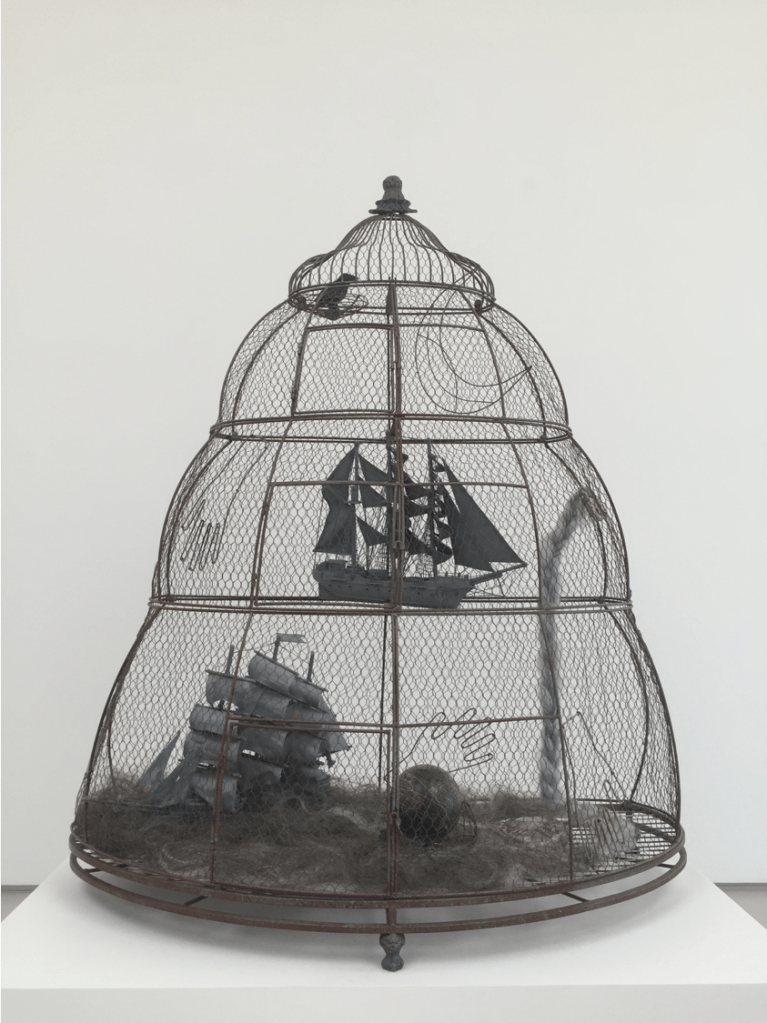
With participants from around the U.S., Canada, the U.K. and India, we jumped into a discussion of the assemblage, โ€œThe Destiny of Latitude and Longitudeโ€ by Betye Saar.ย  Participants began by observing what they saw in the piece, noting the shape of the cage, which for some evoked the image of a beehive and for others had very feminine resonances, of a breast or of an antebellum hooped skirt.ย  The sailing vessels opened up a lot of speculation, recalling the pirate ship inย Peter Panย and the world of childhood imagination; at the other end of the spectrum, some saw the history of the Middle Passage, of slave ships.ย  The dangling piece of rope suggested bondage, the lynching noose, and, for some, a lost promise of escape.ย  The hands reaching out in different directions were seen as โ€œasking for helpโ€ or “reaching out to lift up.โ€ ย The facilitators noted that the artist, Betye Saar is African American, and that this piece (from 2010) was part of a series of works all contained in cages of different shapes.ย  The discussion turned to the art of assemblage, the repurposing of objects, a thing known in one context that is transformed when placed in a new context.ย  The African-American artistic tradition of re-purposing found objects was noted.ย  The surprising and marvelous experience of the piece, some suggested, was in part accounted for by the beauty and charm of the objects, including the rather innocent rendering of a crescent moon, ย the toy-like ships, and the small bird seeking, it seems, a way out of the cage, in such startling combination with the hints at the horrors of the Slave Trade.ย  One participant observed that the piece made her feel like she couldnโ€™t breathe. ย ย 

The prompt was:ย Describe an object you own that says something about your or your familyโ€™s history,ย and the responses were wonderful and varied, fig trees, a bronzed golfball, a desk lamp, a genetic marker for twins. ย There was also an interesting and unexpected common thread of references to grandparents that manifested in the writing that was shared.

Participants are warmly encouraged to share what you wrote below (โ€œLeave a Replyโ€), to keep the conversation going here, bearing in mind that the blog of course is a public space where confidentiality is not assured.

Also, we would love to learn more about your experience of these sessions, so if youโ€™re able, please take the time to fill out a follow-up survey of one to two quick questions!

Please join us for our next session Wednesday, July 15th at 12pm EDT, with more times listed on our Live Virtual Group Sessions page.

We look forward to seeing you again soon!


Laboratori Di Medicina Narrativa: sabato 11 luglio dalle 16 alle 17.30

Siamo stati molto lieti di avervi avuti con noi!

Abbiamo letto insieme la fiaba Rosaspina dei fratelli Grimm, una rielaborazione piรน breve di La bella addormentata nel bosco di Charles Perrault. I partecipanti sono rimasti colpiti dalla possibilitร  di mettere in connessione un testo cosรฌ fantasioso con la realtร  della cura. Abbiamo parlato del tempo, dellโ€™attesa, del coraggio, della speranza, del sogno. Qualcuno ha fatto notare la dimensione perturbante delle fiabe, che ci colpiscono fin da bambini ma vengono rielaborate in modo diverso nellโ€™etร  adulta. Altri hanno interpretato il sonno e il risveglio come una metafora dello spirito che entra in una fase dormiente per poi accedere a una nuova consapevolezza. Abbiamo anche riflettuto sullโ€™idea di โ€œlieto fineโ€.ย 

Poi, abbiamo scritto ispirati dalla frase: โ€œCโ€™era una voltaโ€ฆโ€. Alla luce dei testi, abbiamo riflettuto sugli elementi dello spazio, del corpo e del tempo, ma anche sulla tripartizione dellโ€™io nella scrittura autobiografica e in particolare diaristica, dove le figure del narratore, del protagonista e del primo lettore si sovrappongono. Si รจ dunque parlato della scrittura come strumento umano per soffermarsi e interpretare il mondo che ci circonda. Sono emersi i temi dellโ€™assenza e della presenza, e qualcuno รจ rimasto colpito dalla magia di sentire gli altri partecipanti che leggevano ad alta voce il proprio testo.

Invitiamo i partecipanti del laboratorio a condividere i propri scritti nella parte “blog” dedicata alla fine della presente pagina (“Leave a Reply”). Speriamo di creare, attraverso questo forum di condivisione, uno spazio in cui continuare la nostra conversazione!

Stiamo raccogliendo impressioni e breve feedback sui nostri laboratori di medicina narrativa su Zoom!

Questo breve questionario (anonimo, e aperto a chiunque abbia frequentato almeno un laboratorio) รจ molto importante per noi, e ci permetterร  di elaborare sul valore dei nostri laboratori e sul ruolo dello spazio per riflettere e metabolizzare il momento presente. Vi preghiamo quindi di condividere le nostre riflessioni con noi! 


Rosaspina dei Fratelli Grimm

Cโ€™erano una volta un re e una regina che ogni giorno dicevano: “Ah, se avessimo un bambino!”. Ma il bambino non veniva mai. Un giorno, mentre la regina faceva il bagno, ecco che un gambero saltรฒ fuori dall’acqua e le disse: “Il tuo desiderio sarร  esaudito: darai alla luce una bambina”.

La profezia del gambero si avverรฒ e la regina partorรฌ una bimba cosรฌ bella che il re non stava piรน nella pelle dalla gioia e ordinรฒ una gran festa. Non invitรฒ soltanto i suoi parenti, amici e conoscenti, ma anche le fate, perchรฉ fossero benevole e propizie alla neonata. Nel suo regno ve n’erano tredici, ma siccome egli possedeva soltanto dodici piatti d’oro per il pranzo, dovette rinunciare a invitarne una.

Dopo la festa, le fate diedero alla bimba i loro doni meravigliosi: la prima le donรฒ la virtรน, la seconda la bellezza, la terza la ricchezza, e cosรฌ via (โ€ฆ). Dieci fate avevano giร  formulato il loro auspicio, quando giunse la tredicesima che voleva vendicarsi perchรฉ non era stata invitata. Ella disse ad alta voce: “A quindici anni, la principessa si pungerร  con un fuso e cadrร  a terra morta”. Allora si fece avanti la dodicesima, che doveva ancora formulare il suo voto; certo non poteva annullare la spietata sentenza, ma poteva attenuarla e disse: “La principessa non morirร , ma cadrร  in un sonno profondo che durerร  cento anni”.

Il re, sperando di poter preservare la sua bambina da quella grave disgrazia, ordinรฒ che tutti i fusi del regno fossero bruciati. Frattanto, si adempirono i voti delle fate: la fanciulla era cosรฌ bella, virtuosa, gentile e intelligente, che non si poteva guardarla senza volerle bene. Ora avvenne che, proprio il giorno in cui compรฌ quindici anni, il re e la regina fossero fuori ed ella rimanesse sola nel castello. Girรฒ dappertutto, visitรฒ ogni stanza e giunse infine a una vecchia torre (โ€ฆ): in una piccola stanzetta c’era una vecchia con un fuso che filava con solerzia il suo lino.

“Oh, nonnina (โ€ฆ) Come gira quest’aggeggio!”, esclamรฒ la fanciulla, e prese in mano il filo per filare anche lei. Ma non appena lo toccรฒ, si compรฌ l’incantesimo ed ella si punse un dito. Come sentรฌ la puntura, cadde a terra in un sonno profondo. E il re e la regina, che stavano rincasando, si addormentarono anch’essi con tutta la corte. I cavalli si addormentarono nelle stalle, i cani nel cortile, le colombe sul tetto, le mosche sulla parete; persino il fuoco che fiammeggiava nel camino si smorzรฒ e si assopรฌ (โ€ฆ). Tutto ciรฒ che aveva parvenza di vita, tacque e dormรฌ.

Intorno al castello crebbe una siepe di fitte spine, che ogni anno diventava sempre piรน alta, finchรฉ arrivรฒ a cingerlo completamente e a ricoprirlo tutto. (โ€ฆ) Nel paese si diffuse la leggenda di Rosaspina, la bella addormentata, come veniva chiamata la principessa; e ogni tanto veniva qualche principe che si avventurava attraverso il roveto tentando di raggiungere il castello. Ma non riuscivano a penetrarvi perchรฉโ€š le spine li trattenevano come se si fosse trattato di mani, ed essi si impigliavano e morivano miseramente.

Dopo molti, molti anni, giunse nel paese un altro principe; un vecchio gli parlรฒ dello spineto che circondava un castello nel quale una meravigliosa principessa di nome Rosaspina dormiva con tutta la corte. (โ€ฆ) Molti principi avevano tentato di penetrare fra le spine ma vi erano rimasti imprigionati ed erano miseramente periti. Allora il giovane disse: “Io non ho timore: attraverserรฒ i rovi e vedrรฒ la bella Rosaspina”. Il vecchio cercรฒ di dissuaderlo in tutti i modi, ma egli non gli diede retta.

Ora, proprio il giorno in cui il principe tentรฒ l’impresa erano trascorsi cento anni. Quando si avvicinรฒ al roveto, non trovรฒ che fiori bellissimi che si scostarono spontaneamente al suo passaggio, ricongiungendosi alle sue spalle, sicchรฉโ€š egli passรฒ illeso. Giunto nel cortile del castello, vide cavalli e cani da caccia pezzati che dormivano, distesi a terra; sul tetto erano posate le colombe con le testine sotto l’ala. Quando entrรฒ, le mosche dormivano sulla parete (โ€ฆ) mentre la serva sedeva davanti al pollo nero che doveva spennare. Egli andรฒ oltre e vide dormire tutta la corte e in alto, sul trono, dormivano il re e la regina. Proseguรฌ ancora e il silenzio era tale che egli udiva il proprio respiro. Finalmente giunse alla torre e aprรฌ la porta della cameretta in cui dormiva Rosaspina. Giaceva lร , ed era cosรฌ bella che egli non riusciva a distoglierne lo sguardo. Si chinรฒ e le diede un bacio.

Come l’ebbe baciata, Rosaspina aprรฌ gli occhi, si svegliรฒ e lo guardรฒ ridente. Allora scesero insieme, e anche il re, la regina e lโ€™intera corte si svegliarono, e tutti si guardarono stupiti. I cavalli in cortile si alzarono e si scrollarono; i cani da caccia saltarono su scodinzolando; le colombe sul tetto levarono la testina da sotto l’ala, si guardarono intorno e volarono nei campi; le mosche ripresero a muoversi sulle pareti; il fuoco in cucina si ravvivรฒ, si mise ad ardere e continuรฒ a cuocere il pranzo (โ€ฆ); e la serva finรฌ di spennare il pollo.

Poi furono celebrate con gran fasto le nozze del principe e di Rosaspina, che vissero felici fino alla morte.


Narrative Medicine Book Club: Magic Mountain, Week 7

Week 7: Hans Castorp achieves his โ€œfreedomโ€ by writing home for the third time, telling his relatives he has to stay at the sanatorium and asking them to mail him his winter clothes. He has settled in, and begins to take real pleasure in his obsession with Madame Chauchat, even as the others around him titter about it. He is looking for โ€œsome satisfactory answer about the meaning and purpose of life,โ€ and โ€œwould not have stayed with the people up hereโ€ had such an answer โ€œbeen suppliedโ€ from โ€œout of the depths of time.โ€ I wonder what everyone makes of Settembriniโ€™s long discourse toward the end of todayโ€™s pages…and the role of Settembrini in general. Looking forward to discussing on Sunday!

To register for Sundayโ€™s meeting: www.narrativemedicine.blog/narrative-medicine-book-club

For next week: read to the section โ€œDanse Macabreโ€ in Chapter 5.ย 


Wirtualne Grupy Narracyjne: Wtorek 7 lipca, 18:00 CET

Dziฤ™kujemy wszystkim, ktรณrzy wziฤ™li udziaล‚ w dzisiejszej grupie narracyjnej!

Wspรณlnie uwaลผnie wsล‚uchaliล›my siฤ™ w utwรณr Stephaneโ€™a Wrembela zatytuล‚owany โ€žNympheas (Lilie wodne), pochodzฤ…cy z pล‚yty โ€žThe Django Experiment Vโ€ โ€“ dostฤ™pny tutaj.

Inspiracja do kreatywnego pisania brzmiaล‚a: โ€žNapisz o czymล›, co chciaล‚byล›/abyล› usล‚yszeฤ‡ lub o czymล›, czego nie chciaล‚byล›/abyล› usล‚yszeฤ‡.โ€.

Dzisiejsza praca odbywaล‚a siฤ™ pod hasล‚em uwaลผnego sล‚uchania. Uczestnicy wskazywali na to, jak bardzo wyostrzyล‚a siฤ™ ich percepcja, zarรณwno na detale samego utworu, jak i na pobrzmienia dynamiki grupy. Wypowiedzi poszczegรณlnych osรณb, choฤ‡ o rรณลผnym zabarwieniu, odmiennej perspektywie czy sposobie odbioru, harmonizowaล‚y ze sobฤ…. Uczestnicy wsล‚uchiwali siฤ™ w odrฤ™bne od ich wล‚asnych interpretacje, komentowali i wplatali je w swoje sล‚owa. Pozostawali w dialogu nasuwajฤ…cym na myล›l odpowiadajฤ…ce na siebie instrumenty wykorzystywane w utworze. Wskazana zostaล‚a ponadto pewna trudnoล›ฤ‡, wynikajฤ…ca ze specyfiki tekstu muzycznego. Uczestnicy mรณwili o poczuciu braku odpowiednich narzฤ™dzi, czy teลผ niedysponowania adekwatnym jฤ™zykiem opisu.

Reakcje, czฤ™sto skrajnie odmienne, staล‚y siฤ™ przyczynฤ… wprowadzenia inspiracji otwartej na jeszcze szerszฤ… niลผ zazwyczaj gamฤ™ odpowiedzi. W drugiej poล‚owie spotkania panowaล‚ nieco odmienny nastrรณj, praca zdawaล‚a siฤ™ nieco spowalniaฤ‡, odpowiedzi pojawiaล‚y siฤ™ po chwilach przerwy. Pomimo niewielu treล›ci wypowiadanych wprost w sล‚owach, energia grupy byล‚a wciฤ…ลผ wysoka. Pod koniec pracy zaskakujฤ…cฤ… okazaล‚a siฤ™ potrzeba ciszy oraz gotowoล›ฤ‡ do jej grupowego doล›wiadczenia. Uczestnicy ochoczo zgodzili siฤ™ na chwilฤ™ wspรณlnego niemรณwienia. Byล‚a ona do tego stopnia satysfakcjonujฤ…ca, ลผe jej zakoล„czenie spotkaล‚o siฤ™ z niewielkim protestem, jednak umocowaล‚a ona poczucie wspรณlnoty oraz stworzyล‚a jeszcze bardziej przyjaznฤ… atmosferฤ™. Grupa spostrzegล‚a, ลผe pojawiajฤ…ce siฤ™ chwile ciszy byล‚y integralnฤ… czฤ™ล›ciฤ… dzisiejszego doล›wiadczenia. Uczestnicy powiฤ…zali tฤ™ perspektywฤ™ z charakterem utworu, na ktรณrego caล‚oล›ฤ‡ skล‚adaล‚y siฤ™ rรณwnieลผ chwile, w ktรณrych cichnie wiodฤ…ca melodia.

Jak moลผna byล‚o zauwaลผyฤ‡ brak ugruntowania w teorii muzyki w ลผaden sposรณb nie stanowiล‚ przeszkody do wyraลผenia swojej perspektywy interpretacyjnej. Uczestnicy dostrzegli melodyjnoล›ฤ‡ mowy, ktรณra staล‚a siฤ™ intersubiektywnym jฤ™zykiem dzisiejszego spotkania.

Zapraszamy do udziaล‚u w kolejnych sesjach, ktรณrych terminy podane sฤ… na polskiej podstronie Wirtualnych Grup Narracyjnych. Najbliลผsza grupa odbฤ™dzie siฤ™ 16 lipca (czwartek) o godzinie 18:00 โ€“ zarejestruj siฤ™ juลผ dziล›.

Wszelkie pytania oraz proล›by o organizacjฤ™ indywidualnych grup narracyjnych dla Waszych zespoล‚รณw moลผna przesyล‚aฤ‡ na adres: narrativemedicine@cumc.columbia.edu oraz humanistykamedyczna@cm.uj.edu.pl.

Do zobaczenia niebawem!

***

Thank you to everyone who began with us the work during this very unusual session.

Together we listened closely to Stephane Wrembelโ€™s โ€œNympheasโ€ from the album โ€œThe Django Experiment Vโ€โ€“ available here.

Our prompt for today was: โ€œWrite about something that you would like to hear or about something that you would rather not hear.โ€

Today’s work was a true experience of attentive listening. Participants pointed out how sharp their perception was, regarding both the details of the song itself and the dynamics of the group. The statements of individuals, even with different tones, perspectives, and methods of reception, harmonized with each other. Participants listened to interpretations separate from their own, commented, and weaved them into their words. They remained in a dialogue reminiscent of the corresponding instruments used in the song. A certain difficulty was also indicated, resulting from the specificity of the musical text. Participants talked about the sense of the lack of appropriate tools, or the lack of adequate description language.

Reactions, often extremely different, led to the introduction of the prompt open to an even wider range of responses than usual. In the second half of the meeting there was a slightly different mood. The work seemed to slow down a bit and answers appeared after moments of silence. Despite the few things were spoken directly in words, the group’s energy was still high. At the end of the work, the need for silence and readiness to experience it appeared surprisingly. The participants eagerly agreed to stay silent together for a while. It was so satisfying that ending the session was met with a little protest, but it strengthened the sense of community and created an even more friendly atmosphere. The group noticed that the moments of silence that were appearing during the work were an integral part of today’s experience. The participants associated this perspective with the character of the song, which also included moments in which the leading melody fades away.

As it could be seen, the lack of background in music theory was in no way an obstacle to expressing oneโ€™s own interpretation perspective. Participants noticed the melody of their speech, which became the intersubjective language of today’s meeting.

Please join us for our next session: Monday June 13th, 12pm EDT (in English), with more times listed on our Live Virtual Group Sessions page.

If you have questions, or would like to schedule a personalized narrative medicine session for your organization or team, email us at narrativemedicine@cumc.columbia.edu.

We look forward to seeing you again soon!


Live Virtual Group Session: 12pm EDT July 8th 2020

Todayโ€™s session welcomed 31 participants from around the United States and around the world, but most of us were sharing the experience of muggy air and, in Bristol, UK, even heavy rain โ€“ย with the exception of Palo Alto, California, where sunshine abounded. Lucky Palo Alto!ย 

After our usual 10-second centering exercise, we read silently the poem โ€œMeeting the Light Completelyโ€ by Jane Hirshfield, and then two participants read it aloud. Although only 65 words long, the poem generated a wonderful variety of responses. One person remarked that she tends to rush through her first reading of a poem to try to get a sense of it, but her heart skipped at the line โ€œruin your heart.โ€ Others noticed the way the phrase โ€œthe chipped lip / of a blue-glazed cupโ€ tripped us up even after hearing it several times, especially compared to the smooth sounds of the opening stanza. We thought about how the poemโ€™s form might mirror the journey of a long relationship, with periods of calm and a machine-gun-like choppiness, though we had different instincts about when those periods might come. That choppiness and suspense would be further heightened with a slow reading that emphasized the line breaks, someone said. Another participant heard echoes of the human form in the cupโ€™s lip and the curtain, which could be a gown. The line about โ€œA table painted with rosesโ€ made us consider what we imagine in our heads — were they actually painted on the table, or was โ€œpaintedโ€ a metaphor for how a vase was decorating the space? What do we see? We also were reminded of works outside the text, like a declaration of love in the film Moonstruck where a character asks another to โ€œbe a fool with me.โ€ As for the title, we thought about โ€œlightโ€ in relation to truth, and noticed how โ€œmeetingโ€ added a sense of forward direction, while โ€œcompletelyโ€ led us to being at one with the world.ย ย ย 

Our writing prompt, โ€œWrite about what you found,โ€ generated vivid and varied responses that spanned the abstract/metaphorical (โ€œa path not takenโ€) to the specific and cinematic (a ring lost by its owner and found by its master, a la Lord of the Rings). Echoing the somewhat-staccato Hirshfield poem, writers experimented with narrative form, nuanced details, and โ€œbookendingโ€ sensorial imagery with reflective questions (โ€œCan one ever find what one loses?โ€). Writing in layers helped define particular spaces in new ways: a table was โ€œtrappedโ€ under a stack of books and papers; a rag picker discovered a locket in a dump. With an economy and energy of language, each writer/reader added a personal flourish to their 4-minute expression of what was found (or what was lost then found). One participant noted that as a group, we traveled this journey of reading and writing together.

Participants are warmly encouraged to share what you wrote below (โ€œLeave a Replyโ€), to keep the conversation going here, bearing in mind that the blog of course is a public space where confidentiality is not assured.

Also, we would love to learn more about your experience of these sessions, so if youโ€™re able, please take the time to fill out a follow-up survey of one to two quick questions!

Please join us for our next session Monday, July 13th at 6pm EDT, with more times listed on our Live Virtual Group Sessions page.

We look forward to seeing you again soon!


Meeting the Light Completely  
by Jane Hirshfield

Even the long-beloved
was once
an unrecognized stranger.

Just so,
the chipped lip
of a blue-glazed cup,
blown field
of a yellow curtain,
might also,
flooding and falling,
ruin your heart.

A table painted with roses.
An empty clothesline.

Each time,
the found world surprisesโ€”
that is its nature.

And then
what is said by all lovers:
"What fools we were, not to have seen."

Poem copyright ยฉ1994 by Jane Hirshfield, "Meeting the Light Completely,"
from Poetry of Presence: An Anthology of Mindfulness Poems, 
(Grayson Books, 2017).