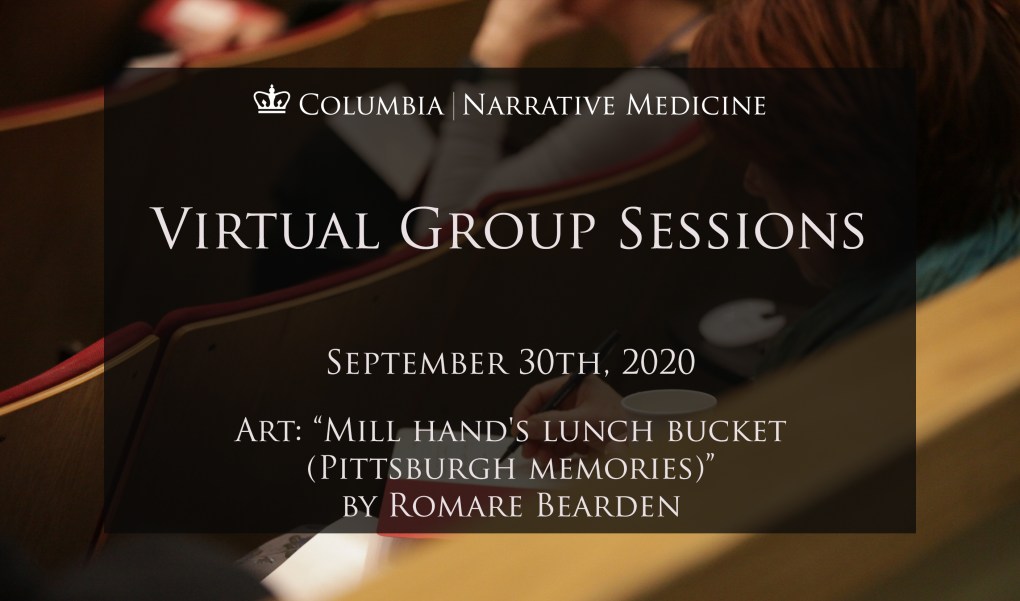
Live Virtual Group Session: 12pm EDT September 30th 2020

Our workshop today included 18 participants from across the U.S. as well as
Angola, Athens, Bahrain, and Canada. The group engaged in a silent, slow looking at
the painting Profile/Part I, The Twenties: Pittsburgh Memories, Mill Handโ€™s Lunch
Bucket, 1978 by Romare Bearden.
They then typed into the chat what they saw
immediately and upon closer study. Responses spanned form, function, and a range of
feelings. We noted human figures, open doors, a stove, big hands, multiple frames,
photographs and images, texture, scraps, a window, a ceiling, smoke, and pollution.
Deeper discussion explored what the layered collageโ€™s elements represent — what
meaning could we make? Participants contrasted the flatness of the visual texture
(โ€œwater stains or wallpaper?โ€) with its movement (โ€œalmost chaoticโ€) with a blend of light,
shadow, hands (offering help, or reaching for help?), exploitation of labor, violence,
unspoken truths, family lineage, and a sense of shared experiences. One participant
recognized how multiple margins create a sense of self-referentiality โ€“ the process of
creating something despite the pieces refusing to cohere into a narrative. We were left
wondering: are estrangement and fragmentation connected, leading to alienation?

Our writing prompt, โ€œTell the story of a moment in scraps and remnantsโ€ inspired six
readers to share what they wrote in four minutes. The diverse responses included a list
of items that formed a collage, a palimpsest (a manuscript or piece of writing material on
which the original writing has been effaced to make room for later writing but of which
traces remain), and a car trip through Detroit (โ€œEverywhere I lived or worked is
goneโ€โ€ฆโ€Not ruins, something ruinedโ€). Another writer picked up on the paintingโ€™s
intergenerational theme by recognizing a grandmother of 14 and describing a history
through war and across generations. The reading of the piece itself was noted as
sounding staccato, which added to the impact of listening. Imagery in other writings
brought to mind people, places and texture (โ€œHis hand, his garden, his flannel shirtโ€) as
well as purpose (a teacher surrounded by books, bricks, and students with a Pink Floyd
mindset โ€œWe donโ€™t need no education.โ€) Our final writer-reader wrote about picking up
the pieces of memory โ€“ lifeโ€™s moments floating away like a kaleidoscope flipping.

Participants are warmly encouraged to share what you wrote below (โ€œLeave a Replyโ€), to keep the conversation going here, bearing in mind that the blog of course is a public space where confidentiality is not assured.

Also, we would love to learn more about your experience of these sessions, so if youโ€™re able, please take the time to fill out a follow-up survey of one to two quick questions!

Please join us for our next session Monday, October 5th at 6pm EDT, with more times listed on our Live Virtual Group Sessions page.


Romare Bearden

 (American, 1911โ€“1988)
Mill hand’s lunch bucket (Pittsburgh memories)
 , 1978โ€“1978
Collage and Watercolor
34.9 x 46 cm. (13.7 x 18.1 in.)

Encuentros virtuales en vivo: Martes 29 de septiembre, 16:30 EST

Tuvimos la segunda sesiรณn en espaรฑol manteniendo el cambio de dรญa y hora y fue una grata experiencia! Fuimos 9 participantes en total representando a Chile, Estados Unidos, Espaรฑa, Bolivia, Colombia y Argentina. Ademรกs, para la mayorรญa de los participantes era la primera vez que participaban en estas sesiones!   

El texto que elegimos para esta sesiรณn fue un poema de Cรฉsar Vallejo, llamado โ€œMasa,โ€ publicado a continuaciรณn. Dos voluntarias leyeron el texto en voz alta. Fue un texto que dio pie a muchas interpretaciones, desde muy diversos puntos de vista, y que posibilitรณ la participaciรณn de varios! Por un lado, generรณ pena de forma muy visceral en un participante al leerlo, cosa que fue compartida por otros, pero a la vez surgiรณ la idea de que aunque fรญsicamente no estรฉ presente porque estรฉ muerto (o muriรฉndose), sigue presente en el pensamiento de aquellos que lo recuerdan (surgiรณ un paralelismo con la pelรญcula Coco de Pixar Studios). De la mano con esta idea alguien observรณ que el poder de la masa es lo que posibilita que alguien โ€œvuelvaโ€ a la vida, o nunca muera del todo. Otra participante se fijรณ en la estructura romboidal del poema como un todo y en la misma estructura de cada verso (persona-masa-conclusiรณn), lo que motivรณ a que otro participante leyera el poema en sentido inverso, desde el final hacia el principio, lo que generรณ mucha sorpresa en el resto, a la vez que un poema que siendo distinto, hacรฌa tanto sentido como el original. Un elemento que generรณ bastante discusiรณn fue el principio del รบltimo verso cuando se refiere al abrazo al primer hombreโ€ฆ algunos defendรญan que era el primer hombre que veรญa al levantarse, otros que aludรญa al primer hombre que aparece en el texto y se lamenta por su muerte (una relaciรณn amorosa), lo que cambiaba sin duda el significado del final de poema. El elemento sobrenatural o metafรญsico tambiรฉn apareciรณ en la conversaciรณn, dado que una de las participantes veรญa al conjunto de hombres no como personas o seres humanos, sino como almas o representaciones, lo que situarรญa la acciรณn del poema en otro plano, mรกs allรก de este plano terrenal. Otros veรญan el poema a la luz de la pandemia actual como un relato de duelo, del poder de la muerte inexorable. Por รบltimo, alguien se fijรณ en la paradoja de que el โ€œprotagonista muertoโ€ necesita de todos los hombres para levantarse, pero parece que sรณlo le interesa estar con uno (al que abraza?)…ย ย 


Escribir en conjunto: โ€œEscribe acerca de un momento de comuniรณn.โ€ No pudimos compartir muchos escritos, porque se nos hizo corto el tiempo, pero los participantes que compartieron escribieron textos de gran belleza, que generaron paz, y tranquilidad, combinando vida personal y laboral, por ejemplo, recogiendo momentos de gran intimidad y a la vez relatados con mucha naturalidad. Otros dejaban adivinar historias que continuaban mรกs allรก de donde estaba escrito y dejaban ganas de seguir leyendo…ย 

Se alienta a los participantes a compartir lo que escribieron a continuaciรณn (โ€œDeja una respuestaโ€), para mantener la conversaciรณn aquรญ, teniendo en cuenta que el blog, por supuesto, es un espacio pรบblico donde no se garantiza la confidencialidad.

ยกCuรฉntenos mรกs sobre su experiencia en este taller completando esta breve encuesta!

Por favor, รบnase a nosotros para nuestra prรณxima sesiรณn en espaรฑol: martes 13 de octubre a las 16:30 EST, con mรกs veces listadas en inglรฉs en nuestra pรกgina de sesiones grupales virtuales en vivo.


Masa | Cรฉsar Vallejo 

Al fin de la batalla,
y muerto el combatiente, vino hacia รฉl un hombre
y le dijo: โ€œยกNo mueras, te amo tanto!โ€
Pero el cadรกver ยกay! siguiรณ muriendo.

Se le acercaron dos y repitiรฉronle:
โ€œยกNo nos dejes! ยกValor! ยกVuelve a la vida!โ€
Pero el cadรกver ยกay! siguiรณ muriendo.

Acudieron a รฉl veinte, cien, mil, quinientos mil,
clamando โ€œยกTanto amor y no poder nada contra la muerte!โ€
Pero el cadรกver ยกay! siguiรณ muriendo.

Le rodearon millones de individuos,
con un ruego comรบn: โ€œยกQuรฉdate hermano!โ€
Pero el cadรกver ยกay! siguiรณ muriendo.

Entonces todos los hombres de la tierra
le rodearon; les vio el cadรกver triste, emocionado;
incorporรณse lentamente,
abrazรณ al primer hombre; echรณse a andarโ€ฆ

Live Virtual Group Session: 6pm EDT September 28th 2020

Fourteen people gathered to discuss poet and psychologist Hala Alyonโ€™s โ€œSpoiler,โ€ a poem published in todayโ€™s issue of The New Yorker. Via our weekly survey, we ascertained that all of this eveningโ€™s respondents have participated in more than four of our close reading and reflective writing sessions via Zoom on Monday evenings.

After listening to an audio recording by the poet, we silently reviewed this twenty-eight line poem, noting what called to each of us before beginning to share comments with the group.

When we did speak, more than one person said that the poem took them to diagnoses of breast cancer, sharing pain, and listening to othersโ€™ processes of living with thoughts prompted about the meaning of their lives. More than one person connected the multiple metaphors appearing in the poem and the multiple metaphors that are used by women living with cancer. One participant heard the poem as โ€œdream logic.โ€

Other ideas that spoke to us suggested the constancy of โ€œthe tides,โ€ that arrive on our shores–forces over which we have no control but which, in the face of, we persist. 

More than one person was attracted to the idea of banishing โ€œnightmaresโ€ by naming our fears. 

Enriching our conversation through intertextuality, people quoted from classical texts by Ray Bradbury, T.S. Eliot, Ralph Waldo Emerson, and Rumi. Someone suggested that Alyonโ€™s poem โ€œSpoilerโ€ is โ€œa feminist answerโ€ to T.S. Eliot’s โ€œThe Waste Land.โ€ 

โ€œQuite the poem,โ€ said one woman, who represented what many felt: Spoiler opens us to a strange mixture of anxiety, beauty, grief, pessimism, and peace. In thinking about what the future may have in store for us, we were prompted to reflect on the way we perceive the passing of time, including the โ€œarrivalโ€ of the future. It was interesting to compare our modern framework to the way in which the Romans envisioned our relationship with time. Unlike what we think of today (we โ€œlook backโ€ to the past and โ€œaheadโ€ towards the future), the Romans thought of themselves as walking with their front to the past (the only thing they knew) and with their back to the future (an uncertain prospect they had no clear view of, being behind). Would this different perspective change the way we think of the past? Would we look at what weโ€™ve built so far differently it is was vividly in front of our eyes as we walk with our back to the future?

Three people read their four- minutes of writing, in the shadow of this difficult text, to the prompt: Write about what you might build knowing that it will be ruined.ย 

These works were filled with reflections on:

  • ย what has been ruined and why and what can yet be
  • how homo sapiens sapiens (man who knows he knows) could also be called ย ย ย ย 
  • โ€œhomofabulansโ€ for our specieโ€™s ability to imagine and archive stories
  • the unasked for determinants of life and death and our need for meaning-making in โ€œthe gap,โ€ the time and space between them

Participants are warmly encouraged to share what you wrote below (โ€œLeave a Replyโ€), to keep the conversation going here, bearing in mind that the blog of course is a public space where confidentiality is not assured.

Also, we would love to learn more about your experience of these sessions, so if youโ€™re able, please take the time to fill out a follow-up survey of one to two quick questions!

Please join us for our next session Wednesday, September 30th at 12pm EDT, with more times listed on our Live Virtual Group Sessions page.


Spoiler by Hala Alyan

Can you diagnose fear? The red tree blooming from uterus
to throat. Itโ€™s one long nerve, the doctor says. Thereโ€™s a reason
breathing helps, the muscles slackening like a dead marriage.
Mine are simple things. Food poisoning in Paris. Hospital lobbies.
My husband laughing in another room. (The door closed.)
For days, I cradle my breast and worry the cyst like a bead.
Thereโ€™s nothing to pray away. The tree loves her cutter.
The nightmares have stopped, I tell the doctor. I know why.
They stopped because I baptized them. This is how my mother
and I speak of dyingโ€”the thing you turn away by letting in.
Iโ€™m tired of April. Itโ€™s killed our matriarchs and, in the back yard,
Iโ€™ve planted an olive sapling in the wrong soil. There is a droopiness
to the branches that reminds me of my friend, the one who calls
to ask whatโ€™s the point, or the patients who come to me, swarmed
with misery and astonishment, their hearts like newborns after
the first needle. What now, they all want to know. What now.
I imagine it like a beach. There is a magnificent sand castle
that has taken years to build. A row of pink seashells for gables,
rooms of pebble and driftwood. This is your life. Then comes the affair,
nagging bloodwork, a freeway pileup. The tide moves in.
The water eats your work like a drove of wild birds. There is debris.
A tatter of sea grass and blood from where you scratched your own arm
trying to fight the current. It might not happen for a long time,
but one day you run your fingers through the sand again, scoop a fistful out,
and pat it into a new floor. You can believe in anything, so why not believe
this will last? The seashell rafter like eyes in the gloaming.
Iโ€™m here to tell you the tide will never stop coming in.
Iโ€™m here to tell you whatever you build will be ruined, so make it beautiful.

Published in the print edition of 
the September 28, 2020, issue of The New Yorker

Narrative Medicine Book Club: Magic Mountain, Week 18

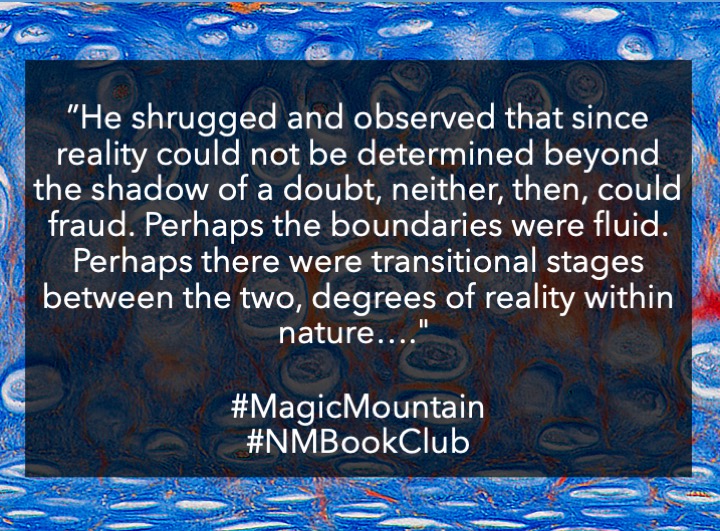
Week 18: What a fascinating sequence in our next-to-last week! In this week’s chapter, “Highly Questionable,” we witness a sรฉance, with the medium of a young Berghof patient named Ellen Brand. Her “spirit,” a “deceased, ethereal creature” named Holger who “speaks” through her, conjures for Castorp and a small group of others, after nearly two hours of writhing and sweating, the figure of Castorp’s cousin, Joachim. What a moment! We don’t totally know what happens for Castorp as he sees his cousin, gazing at him in “friendly silence” with “tenderness,” but Castorp, in response, whispers “‘Forgive me,'” though the text specifies that he whispers it to himself. Does he say this to excuse the fact that he then gets up to turn on the light and leave the room? Or is he saying this, instead, to Joachim? A very powerful, evocative, and unexpected scene. And so we are propelled forward to the end! Those who haven’t finished yet, how do you predict this will all end?ย 


For next week: Finish the book!!ย And join our LAST zoom meeting on Saturday (not Sunday!) October 3rd at 11 am! Register at narrativemedicine.blog/narrative-medicine-book-club


ฮ–ฯ‰ฮฝฯ„ฮฑฮฝฮฎ ฯƒฯ…ฮฝฮตฮดฯฮฏฮฑ ฮฑฯ†ฮทฮณฮทฮผฮฑฯ„ฮนฮบฮฎฯ‚ ฮนฮฑฯ„ฯฮนฮบฮฎฯ‚: ฮ ฮญฮผฯ€ฯ„ฮท 24 ฮฃฮตฯ€ฯ„ฮตฮผฮฒฯฮฏฮฟฯ…, 7:30 m.m. EEST

ฮฃฮฑฯ‚ ฮตฯ…ฯ‡ฮฑฯฮนฯƒฯ„ฮฟฯฮผฮต ฯ€ฮฟฯ… ฯƒฯ…ฮผฮผฮตฯ„ฮตฮฏฯ‡ฮฑฯ„ฮต ฯƒฮต ฮฑฯ…ฯ„ฮฎฮฝ ฯ„ฮท ฯƒฯ…ฮฝฮตฮดฯฮฏฮฑ.

ฮคฮฟ ฮบฮตฮฏฮผฮตฮฝฯŒ ฮผฮฑฯ‚ ฮณฮนฮฑ ฯƒฮฎฮผฮตฯฮฑ ฮฎฯ„ฮฑฮฝ:ย ฮ‘ฯ‡ฮนฮปฮปฮญฮฑฯ‚ ฮšฯ…ฯฮนฮฑฮบฮฏฮดฮทฯ‚,ย “ฮฃฯŽฮผฮฑ

ฮ˜ฮญฮผฮฑ:ย ฮ“ฯฮฌฯˆฯ„ฮต ฯ„ฮทฮฝ ฮนฯƒฯ„ฮฟฯฮฏฮฑ ฮตฮฝฯŒฯ‚ ฯ€ฯŒฮฝฮฟฯ…

ฮฃฯฮฝฯ„ฮฟฮผฮฑ ฮธฮฑ ฮผฮฟฮนฯฮฑฯƒฯ„ฮฟฯฮผฮต ฯ€ฮตฯฮนฯƒฯƒฯŒฯ„ฮตฯฮตฯ‚ ฯ€ฮปฮทฯฮฟฯ†ฮฟฯฮฏฮตฯ‚ ฯƒฯ‡ฮตฯ„ฮนฮบฮฌ ฮผฮต ฮฑฯ…ฯ„ฮฎฮฝ ฯ„ฮท ฯƒฯ…ฮฝฮตฮดฯฮฏฮฑ, ฮณฮน โ€˜ฮฑฯ…ฯ„ฯŒ ฮตฯ€ฮนฯƒฯ„ฯฮญฯˆฯ„ฮต ฮพฮฑฮฝฮฌ.

ฮฃฮฑฯ‚ ฯ€ฯฮฟฯƒฮบฮฑฮปฮฟฯฮผฮต ฮฝฮฑ ฮผฮฟฮนฯฮฑฯƒฯ„ฮตฮฏฯ„ฮต ฯ„ฮฑ ฮณฯฮฑฯ€ฯ„ฮฌ ฯƒฮฑฯ‚ ฮผฮฑฮถฮฏ ฮผฮฑฯ‚ ฯ€ฮฑฯฮฑฮบฮฌฯ„ฯ‰.

ฮšฮฑฮปฮฟฯฮผฮต ฯŒฮปฮตฯ‚ ฮบฮฑฮน ฯŒฮปฮฟฯ…ฯ‚ ฯ€ฮฟฯ… ฯƒฯ…ฮผฮผฮตฯ„ฮตฮฏฯ‡ฮฑฯ„ฮต ฮฝฮฑ ฮผฮฟฮนฯฮฑฯƒฯ„ฮตฮฏฯ„ฮต ฯŒฯƒฮฑ ฮณฯฮฌฯˆฮฑฯ„ฮต ฮบฮฑฯ„ฮฌ ฯ„ฮท ฮดฮนฮฌฯฮบฮตฮนฮฑ ฯ„ฮทฯ‚ ฯƒฯ…ฮฝฮตฮดฯฮฏฮฑฯ‚ ฮผฮฑฯ‚ ฯ€ฮฑฯฮฑฮบฮฌฯ„ฯ‰ (โ€œLeave a replyโ€) ฮบฮฑฮน ฮฝฮฑ ฮบฯฮฑฯ„ฮฎฯƒฮฟฯ…ฮผฮต ฮฑฯ…ฯ„ฮฎ ฯ„ฮทฮฝ ฯ„ฯŒฯƒฮฟ ฮตฮฝฮดฮนฮฑฯ†ฮญฯฮฟฯ…ฯƒฮฑ ฯƒฯ…ฮถฮฎฯ„ฮทฯƒฮฎ ฮผฮฑฯ‚ ฮถฯ‰ฮฝฯ„ฮฑฮฝฮฎ, ฯ…ฯ€ฮตฮฝฮธฯ…ฮผฮฏฮถฮฟฮฝฯ„ฮฌฯ‚ ฯƒฮฑฯ‚, ฮฒฮตฮฒฮฑฮฏฯ‰ฯ‚, ฯŒฯ„ฮน ฮฑฯ…ฯ„ฮฎ ฮตฮฏฮฝฮฑฮน ฮผฮนฮฑ ฮดฮทฮผฯŒฯƒฮนฮฑ ฯ€ฮปฮฑฯ„ฯ†ฯŒฯฮผฮฑ ฮบฮฑฮน ฮท ฯ€ฯฯŒฯƒฮฒฮฑฯƒฮท ฮฑฮฝฮฟฮนฯ‡ฯ„ฮฎ ฯƒฯ„ฮฟ ฮบฮฟฮนฮฝฯŒ.

ฮ˜ฮฑ ฮธฮญฮปฮฑฮผฮต ฮฝฮฑ ฮผฮฌฮธฮฟฯ…ฮผฮต ฯ€ฮตฯฮนฯƒฯƒฯŒฯ„ฮตฯฮฑ  ฮณฮนฮฑ ฯ„ฮทฮฝ ฮตฮผฯ€ฮตฮนฯฮฏฮฑ ฯƒฮฑฯ‚ ฮผฮต ฮฑฯ…ฯ„ฮญฯ‚ ฯ„ฮนฯ‚ ฯƒฯ…ฮฝฮตฮดฯฮฏฮตฯ‚. ฮ‘ฮฝ ฯ„ฮฟ ฮตฯ€ฮนฮธฯ…ฮผฮตฮฏฯ„ฮต, ฯ€ฮฑฯฮฑฮบฮฑฮปฮฟฯฮผฮต ฮฑฯ†ฮนฮตฯฯŽฯƒฯ„ฮต ฮปฮฏฮณฮฟ ฯ‡ฯฯŒฮฝฮฟ ฯƒฮต ฮผฮนฮฑ ฯƒฯฮฝฯ„ฮฟฮผฮท ฮญฯฮตฯ…ฮฝฮฑ ฮดฯฮฟ ฮตฯฯ‰ฯ„ฮฎฯƒฮตฯ‰ฮฝ!

ฮ‘ฮบฮฟฮปฮฟฯ…ฮธฮฎฯƒฯ„ฮต ฯ„ฮฟฮฝ ฯƒฯฮฝฮดฮตฯƒฮผฮฟ:ย https://tinyurl.com/nmedg-survey


ฮ‘ฯ€ฯŒฯƒฯ€ฮฑฯƒฮผฮฑ ฮฑฯ€ฯŒ ฯ„ฮท ฮฝฮฟฯ…ฮฒฮญฮปฮฑ ฮฃฯŽฮผฮฑ ฯ„ฮฟฯ… ฮ‘ฯ‡ฮนฮปฮปฮญฮฑ ฮšฯ…ฯฮนฮฑฮบฮฏฮดฮท (ฮ•ฮบฮดฯŒฯƒฮตฮนฯ‚ ฮ ฮฑฯ„ฮฌฮบฮท, ฮ‘ฮธฮฎฮฝฮฑ, 2017).

ฮˆฮฝฮฑฯ‚ ฯ€ฯŒฮฝฮฟฯ‚.

ฮ•ฮฏฯ‡ฮต ฮฑฯฯ‡ฮฏฯƒฮตฮน ฮฑฯ€ฯŒ ฮฝฯ‰ฯฮฏฯ„ฮตฯฮฑ, ฯฯ€ฮฟฯ…ฮปฮฟฯ‚, ฮญฮฝฮฑ ฮตฮปฮฑฯ†ฯฮฌ ฮณฮปฯ…ฮบฯŒ ฮณฮฟฯ…ฯฮณฮฟฯฯฮนฯƒฮผฮฑ ฯ€ฮฟฯ… ฮญฯ†ฮตฯฮฝฮต ฮณฯฯฮฟฯ…ฯ‚ ฯƒฯ„ฮทฮฝ ฮบฮฟฮนฮปฮนฮฌ ฯ„ฮฟฯ… ฯƒฮฑฮฝ ฮบฮฌฯ„ฮน ฮฝฮฑ โ€˜ฯˆฮฑฯ‡ฮฝฮต ฯ„ฮทฮฝ ฮญฮพฮฟฮดฮฟ, ฮบฮน ฯฯƒฯ„ฮตฯฮฑ, ฮตฮฝฯŽ ฯƒฯ…ฮฝฮญฯ‡ฮนฮถฮต ฯ„ฮฟ ฮฒฮฌฮดฮนฯƒฮผฮฑ, ฮท ฮฑฯ€ฮตฮปฯ€ฮนฯƒฮฏฮฑ ฮฑฯ…ฯ„ฮฟฯ ฯ„ฮฟฯ… ยซฮบฮฌฯ„ฮนยป ฯ„ฮฟ โ€˜ฯ†ฮตฯฮต ฮฝฮฑ ฯ‡ฯ„ฯ…ฯ€ฮฌฮตฮน ฯƒฯ„ฮฑ ฯ„ฮฟฮนฯ‡ฯŽฮผฮฑฯ„ฮฑ ฮบฮฑฮน ฮฝฮฑ ฯ†ฯ‰ฮฝฮฌฮถฮตฮน ฮผฮต ฯ„ฮท ฮผฯŒฮฝฮท ฮณฮปฯŽฯƒฯƒฮฑ ฯ€ฮฟฯ… ฮฎฮพฮตฯฮต, ฮผฮนฮฑ ฮฑฮนฯ‡ฮผฮทฯฮฎ, ฯ€ฮฑฯฮฑฯ„ฮตฯ„ฮฑฮผฮญฮฝฮท ฯƒฮฟฯ…ฮฒฮปฮนฮฌ, ฮฝฯŒฯ„ฮนฮฑ-ฮฝฮฟฯ„ฮนฮฟฮฑฮฝฮฑฯ„ฮฟฮปฮนฮบฮฌ.

       ฮ— ฯ€ฮตฯฮนฯ„ฮฟฮฝฮฏฯ„ฮนฯ‚ ฮฑฯ€ฮฟฯƒฮฟฮฒฮฎฮธฮทฮบฮต ฮตฮณฮบฮฑฮฏฯฯ‰ฯ‚, ฯ‡ฮฌฯฮท ฯƒโ€™ ฮญฮฝฮฑฮฝ ฮณฮตฮฝฮฝฮฑฮนฯŒฮดฯ‰ฯฮฟ ฮฟฮดฮทฮณฯŒ ฯ„ฮฑฮพฮฏ ฯ€ฮฟฯ… ฯ„ฮฟฮฝ ฯ€ฮฎฮณฮต ฮฑฮผฮนฯƒฮธฮฏ ฯƒฯ„ฮฟ ฮ ฯฯŽฯ„ฯ‰ฮฝ ฮฒฮฟฮทฮธฮตฮนฯŽฮฝ, ฯ„ฯŒฯ„ฮต ฮณฯ‰ฮฝฮฏฮฑ ฮšฮฑฯ€ฮฟฮดฮนฯƒฯ„ฯฮฏฮฟฯ… ฮบฮฑฮน 3ฮทฯ‚ ฮฃฮตฯ€ฯ„ฮตฮผฮฒฯฮฏฮฟฯ…, ฮบฮน ฮฑฯ€ฯŒ ฮบฮตฮน, ฮผฮต ฯ„ฮฟ ฮณฮฝฯ‰ฯƒฯ„ฯŒ ฮฑฮปฮฑฮปฮฌฮถฮฟฮฝ ฮตฯฯ…ฮธฯฯŒฮปฮตฯ…ฮบฮฟ ฯŒฯ‡ฮทฮผฮฑ, ฮฟ ฮœฮฌฯฯ„ฮทฯ‚ ฮดฮนฮฑฮบฮฟฮผฮฏฯƒฯ„ฮทฮบฮต ฯƒฯ„ฮฟ ฮ™ฯ€ฯ€ฮฟฮบฯฮฌฯ„ฮตฮนฮฟ.

       ฮ˜ฯ…ฮผฮฌฯ„ฮฑฮน ฯ„ฮฟ ฯ†ฮฟฯฮตฮฏฮฟ, ฯ„ฮทฮฝ ฯ€ฮฑฮณฯ‰ฮฝฮนฮฌ ฯƒฯ„ฮฟ ฯ‡ฮตฮนฯฮฟฯ…ฯฮณฮตฮฏฮฟ, ฯ„ฮฟฮฝ ฯ€ฯŒฮฝฮฟ ฯ€ฮฟฯ… ฮดฮตฮฝ ฮญฮปฮตฮณฮต ฮฝฮฑ ฯ€ฮฌฯˆฮตฮน ฮฝฮฑ ฯ„ฮฟฯ… ฯƒฮบฮฏฮถฮตฮน ฯ„ฮฑ ฯƒฯ‰ฮธฮนฮบฮฌ, ฮบฮน ฯŒฯ„ฮน ฮผฮต ฯ„ฮฟ ฯ€ฮฟฯ… ฮญฯ†ฮตฯฮต ฮฑฮบฯฮนฮฒฯŽฯ‚ ฮฑฯ…ฯ„ฮฎ ฯ„ฮท ฮปฮญฮพฮท ฯƒฯ„ฮฟ ฮผฯ…ฮฑฮปฯŒ ฯ„ฮฟฯ…, ฮฑฮผฮตฯ„ฮฑฮฝฯŒฮทฯ„ฮฟฯ‚, ฮญฯˆฮฑฮพฮต ฮฝฮฑ โ€˜ฮฒฯฮตฮน ฮบฮฌฯ€ฮฟฮนฮฑ ฯƒฮบฮฟฯ„ฮตฮนฮฝฮฎ ฮตฯ„ฯ…ฮผฮฟฮปฮฟฮณฮฏฮฑ, ฮบฮน ฯฯƒฯ„ฮตฯฮฑ ฮญฯ€ฮฑฮนฮพฮต ฮผฮต ฯ„ฮฟฯ…ฯ‚ ฯ„ฮฟฮฝฮนฯƒฮผฮฟฯฯ‚ ฮบฮฑฮน ยซฯƒฯŽฮธฮทฮบฮฑยป ฯƒฮบฮญฯ†ฯ„ฮทฮบฮต, ฮณฮนฮฑฯ„ฮฏ ฮฎฮดฮท ฮบฮฌฯ€ฮฟฮนฮฟฯ‚ ฮญฯƒฮบฯ…ฮฒฮต ฮฑฯ€ฯŒ ฯ€ฮฌฮฝฯ‰ ฯ„ฮฟฯ… ฮบฮฑฮน ฯ„ฮฟฮฝ ฯฯ‰ฯ„ฮฟฯฯƒฮต.

       ยซฮœฮฑฯฯ„ฮนฮฝฮนฮฑฮฝฯŒฯ‚ ฮฃฯ„ฮฑฯฯฮฟฯ…ยป.

       ยซฮ ฯŽฯ‚;ยป

       ยซฮœฮฑฯฯ„ฮนฮฝฮนฮฑฮฝฯŒฯ‚. ฮฃฯ„ฮฑฯฯฮฟฯ…ยป.

       ยซฮœฮทฮฝ ฮฑฮฝฮทฯƒฯ…ฯ‡ฮตฮฏฯ‚, ฮœฮฑโ€ฆ ฯ„ฯฮนฮฝฮนฮฑฮฝฮญยป.

       ฮ”ฮตฮฝ ฯ€ฯฯŒฮปฮฑฮฒฮต ฮฟฯฯ„ฮต ฮฝฮฑ ฮดฮนฮฟฯฮธฯŽฯƒฮตฮน ฮฟฯฯ„ฮต ฮฝโ€™ ฮฑฮฝฮทฯƒฯ…ฯ‡ฮฎฯƒฮตฮน, ฮณฮนฮฑฯ„ฮฏ ฮผฮนฮฑ ฮฑฮนฮธฮญฯฮนฮฑ ฮผฮฌฯƒฮบฮฑ ฮญฯ€ฮตฯƒฮต ฯƒฯ„ฮฟ ฯ€ฯฯŒฯƒฯ‰ฯ€ฯŒ ฯ„ฮฟฯ… ฮบฮฑฮน ฯ„ฮฟฮฝ ฮณฮญฮผฮนฯƒฮต ฯฯ€ฮฝฮฟ.

ย ย ย ย ย ย  ฮ”ฮตฮฝ ฮฎฯ„ฮฑฮฝ ฮท ฯ€ฯฯŽฯ„ฮท ฯ„ฮฟฯ… ฯ‡ฮตฮนฯฮฟฯ…ฯฮณฮนฮบฮฎ ฮตฯ€ฮญฮผฮฒฮฑฯƒฮท. ฮˆฮพฮน ฯ‡ฯฮฟฮฝฯŽฮฝ, ฮฑฮผฯ…ฮณฮดฮฑฮปฮญฯ‚, ฮญฯ†ฮฑฮณฮต ฯ„ฮฑ ฯ€ฮตฯฮนฯƒฯƒฯŒฯ„ฮตฯฮฑ ฯ€ฮฑฮณฯ‰ฯ„ฮฌ ฯ€ฮฟฯ… ฮธฯ…ฮผฮฌฯ„ฮฑฮน ฮฝฮฑ โ€˜ฯ‡ฮตฮน ฯ†ฮฌฮตฮน ฮผฮญฯƒฮฑ ฯƒฮต ฯ€ฮญฮฝฯ„ฮต ฮผฮญฯฮตฯ‚, ฮบฮฑฮน ฮดฮนฮฌฮฒฮฑฯƒฮต ฯ„ฮฟ ฯ€ฯฯŽฯ„ฮฟ ฮšฮปฮฑฯƒฯƒฮนฮบฯŒ ฮ•ฮนฮบฮฟฮฝฮฟฮณฯฮฑฯ†ฮทฮผฮญฮฝฮฟ* ฯ€ฮฟฯ… ฮท ฮผฯ…ฯฯ‰ฮดฮนฮฌ ฯ„ฮฟฯ… ฮญฮผฮตฮปฮปฮต ฮฝฮฑ ฯ„ฮฟฮฝ ฯƒฯ…ฮฝฮฟฮดฮตฯฮตฮน ฯƒฮต ฮบฮฌฮธฮต ฮดฮนฮฑฯ†ฯ…ฮณฮฎ ฯ„ฮฟฯ… ฮฑฯ€ฯŒ ฮปฮฟฮณฮฎฯ‚ ฯ…ฯ€ฮฟฮฝฯŒฮผฮฟฯ…ฯ‚, ฯƒฯ„ฮฟ ฮธฮฌฮฝฮฑฯ„ฮฟ ฮบฮฌฮธฮต ฮฆฮฑฮฝฯ„ฮฏฮฝฮฑฯ‚โ€”ฮท ฮผฯ…ฯฯ‰ฮดฮนฮฌ, ฮบฮฑฮน ฮท ฮตฮนฮบฯŒฮฝฮฑ ฮตฮฝฯŒฯ‚ ฮบฮฑฯ€ฮญฮปฮฟฯ… ฯ€ฮฟฯ… ฮตฯ€ฮญฯ€ฮปฮตฮต ฯƒฯ„ฮฟ ฯ€ฮฟฯ„ฮฌฮผฮน, ฯƒฮทฮผฮฑฯ„ฮฟฮดฮฟฯ„ฯŽฮฝฯ„ฮฑฯ‚ ฯ„ฮฟฮฝ ฮฑฮผฮตฯ„ฮฌฮบฮปฮทฯ„ฮฟ ฯ€ฮฝฮนฮณฮผฯŒ ฯ„ฮฟฯ… ฮšฮฑฮบฮฟฯ.

ฮคฯŽฯฮฑ, ฯƒฯ„ฮฟ ฮดฮนฯ€ฮปฮฑฮฝฯŒ ฮบฯฮตฮฒฮฌฯ„ฮน ฯ„ฮฟฯ… ฮ™ฯ€ฯ€ฮฟฮบฯฮฑฯ„ฮตฮฏฮฟฯ…, ฮญฮฝฮฑฯ‚ ฮฑฯ€ฮฟฯƒฯ„ฮตฯ‰ฮผฮญฮฝฮฟฯ‚ ฮณฮญฯฮฟฮฝฯ„ฮฑฯ‚ ฯ€ฮฟฮฝฮฟฯฯƒฮต ฯƒฮต ฮผฮนฮฑ ฮณฮปฯŽฯƒฯƒฮฑ ฮณฮฟฮทฯ„ฮตฯ…ฯ„ฮนฮบฮฌ ฮฑฮบฮฑฯ„ฮฌฮปฮทฯ€ฯ„ฮท. ฮŸ ฮœฮฌฯฯ„ฮทฯ‚ ฯ€ฯฮฟฯƒฯ€ฮฌฮธฮทฯƒฮต ฮฝฮฑ ฮฑฯ€ฮฟฮบฯฯ…ฯ€ฯ„ฮฟฮณฯฮฑฯ†ฮฎฯƒฮตฮน ฮญฯƒฯ„ฯ‰ ฮบฮฑฮน ฮผฮนฮฑ ฮปฮญฮพฮท ฮฑฯ€ฯŒ ฯ„ฮฟ ฮฑฮดฮนฮฌฮปฮตฮนฯ€ฯ„ฮฟ ฯ€ฮฑฯฮฑฮปฮฎฯฮทฮผฮฑ ฯ„ฮฟฯ… ฮณฮตฮฏฯ„ฮฟฮฝฮฑ, ฮฑฮปฮปฮฌ ฯ‡ฯฮตฮนฮฌฯƒฯ„ฮทฮบฮต ฮฝฮฑ ฮตฮผฯ†ฮฑฮฝฮนฯƒฯ„ฮตฮฏ, ฮญฯƒฯ„ฯ‰ ฮบฮฑฮน ฮดฮนฮฌฯ„ฯ„ฮฟฯ…ฯƒฮฑ, ฮท ฮตฮพฮฏฯƒฮฟฯ… ฮณฮทฯฮฑฮนฮฌ ฯƒฯฮถฯ…ฮณฮฟฯ‚;, ฮฑฮดฮตฮปฯ†ฮฎ;, ฯ„ฮฟฯ… ฯ€ฮฌฯƒฯ‡ฮฟฮฝฯ„ฮฟฯ‚, ฮณฮนฮฑ ฮฝฮฑ ฮบฮฑฯ„ฮฑฮปฮฌฮฒฮตฮน (ฮญฯƒฯ„ฯ‰ ฮฑฯ€ฯŒ ฮผฮนฯƒฯŒฮปฮฟฮณฮฑ, ฮฑฮปฮปฮฌ ฮตฯฮปฮทฯ€ฯ„ฮฑ) ฯ€ฯ‰ฯ‚ ฯŒฮปฮตฯ‚ ฮฟฮน ฮบฮฑฯ„ฮฌฯฮตฯ‚, ฮฟฮน ฮฒฮปฮฑฯƒฯ„ฮฎฮผฮนฮตฯ‚ ฮบฮฑฮน ฮฟฮน ฯ€ฯฮฟฯƒฮตฯ…ฯ‡ฮญฯ‚ ฯ„ฮฟฯ… ฮณฮญฯฮฟฮฝฯ„ฮฑ ฮบฮฑฯ„ฮฌฮณฮฟฮฝฯ„ฮฑฮฝ ฮฑฯ€ฯŒ ฮผฮนฮฑ ฯ€ฮตฯฮนฮฟฯ‡ฮฎ ฯ‡ฮฑฮผฮญฮฝฮท ฯƒฮต ฮบฮฌฯ„ฮน ฮฑฮฝฮตฯฮตฯฮฝฮทฯ„ฮฑ ฮตฮดฮฌฯ†ฮท ฯ„ฯ‰ฮฝ ฮฒฮฑฮธฯฯ„ฮตฯฯ‰ฮฝ ฮ’ฮฑฮปฮบฮฑฮฝฮฏฯ‰ฮฝ ฯ€ฮฟฯ…, ฮฑฮบฯฮนฮฒฯŽฯ‚ ฮตฯ€ฮตฮนฮดฮฎ ฮบฮฑฮผฮฏฮฑ ฯ‡ฯŽฯฮฑ ฮดฮตฮฝ ฮฑฯƒฯ‡ฮฟฮปฮฎฮธฮทฮบฮต ฮผฮต ฯ„ฮฟ ฮฝฮฑ ฯ„ฮฑ ฮดฮนฮตฮบฮดฮนฮบฮฎฯƒฮตฮน, ฮตฮฏฯ‡ฮฑฮฝ ฮฑฯ†ฮตฮธฮตฮฏ ฯ‡ฯ‰ฯฮฏฯ‚ ฮฑฮฝฯ„ฮฏฯƒฯ„ฮฑฯƒฮท ฮฝฮฑ ฯ„ฮฑ ฯ„ฮตฮผฮฑฯ‡ฮฏฯƒฮฟฯ…ฮฝ ฯ„ฯฮนฮตฮธฮฝฮตฮฏฯ‚ ฯƒฯ…ฮฝฮฟฯฮนฮฑฮบฮญฯ‚ ฮดฮนฮตฯ…ฮธฮตฯ„ฮฎฯƒฮตฮนฯ‚.

       ฮ ฯŽฯ‚ ฮบฮฑฮน ฮณฮนฮฑฯ„ฮฏ ฮตฮฏฯ‡ฮต ฮฒฯฮตฮธฮตฮฏ ฮฑฯ…ฯ„ฯŒฯ‚ ฮฟ ฮตฮพฯ‰ฯ„ฮนฮบฯŒฯ‚ ฮฌฮฝฮธฯฯ‰ฯ€ฮฟฯ‚ ฯƒโ€™ ฮญฮฝฮฑ ฮฝฮฟฯƒฮฟฮบฮฟฮผฮตฮฏฮฟ ฯ„ฯ‰ฮฝ ฮ‘ฮธฮทฮฝฯŽฮฝ, ฯ€ฯŽฯ‚ ฮตฮฏฯ‡ฮต ฯƒฯ…ฮฝฮตฮฝฮฝฮฟฮทฮธฮตฮฏ ฮผฮต ฯ„ฮฟฯ…ฯ‚ ฮธฮตฯฮฌฯ€ฮฟฮฝฯ„ฮตฯ‚ ฮฟฯ…ฯƒฮฏฮฑ ฮฌฮปฮฑฮปฮฟฯ‚, ฯ„ฮน ฯ„ฮฟฯ… ฮฎฯ„ฮฑฮฝ ฮท ฮณฯ…ฮฝฮฑฮฏฮบฮฑ ฯ€ฮฟฯ… ฮดฮนฮตฯฮผฮฎฮฝฮตฯ…ฮต ฯ„ฮฟฯ…ฯ‚ ฯ€ฯŒฮฝฮฟฯ…ฯ‚ ฯ„ฮฟฯ…, ฯƒฯ„ฮตฮบฯŒฯ„ฮฑฮฝ ฮปฮฏฮณฮฟ ฯƒฯ„ฮฟ ฮนฮดฯฯ‰ฮผฮญฮฝฮฟ ฯ„ฮฟฯ… ฯ€ฯฮฟฯƒฮบฮญฯ†ฮฑฮปฮฟ ฮบฮน ฯฯƒฯ„ฮตฯฮฑ ฮบฮฟฮฏฯ„ฮฑฮถฮต ฯ„ฮฟ ฯฮฟฮปฮฟฮณฮฌฮบฮน ฯ„ฮทฯ‚, ฯ‡ฮฑฮนฯฮตฯ„ฮฟฯฯƒฮต ฯ„ฮฟฮฝ ฮœฮฌฯฯ„ฮท ฮผฮต ฯƒฯ…ฮฝฯ„ฯฮฏฮผฮผฮนฮฑ ฮตฮปฮปฮทฮฝฮนฮบฯŽฮฝ ฮบฮน ฮญฯ†ฮตฯ…ฮณฮต ฯƒฮฑฮฝ ฮฝฮฑ ฯ„ฮทฮฝ ฯ€ฮตฯฮฏฮผฮตฮฝฮต ฮญฮฝฮฑ ฯ‡ฯฮญฮฟฯ‚ ฯ€ฮนฮฟ ฯƒฮทฮผฮฑฮฝฯ„ฮนฮบฯŒ ฮฑฯ€ฯŒ ฯ„ฮท ฮถฯ‰ฮฎ ฮตฮฝฯŒฯ‚ ฮฌฮปฮปฮฟฯ… ฯ€ฮฟฯ… ฯ„ฮทฯ‚ ฮฎฯ„ฮฑฮฝ ฯ„ฮน;, ฯƒฯฮถฯ…ฮณฮฟฯ‚;, ฮฑฮดฮตฮปฯ†ฯŒฯ‚;, ฯ„ฮฏฯ€ฮฟฯ„ฮฑ;

       ฮŒฯ„ฮฑฮฝ ฯ€ฮฎฯฮฑฮฝ ฯ„ฮฟฮฝ ฮพฮญฮฝฮฟ ฮณฮนฮฑ ฮฝฮฑ ฯ„ฮฟฮฝ ฮบฯŒฯˆฮฟฯ…ฮฝ ฮตฮบฮตฮฏ ฯŒฯ€ฮฟฯ… ฮตฮฏฯ‡ฮฑฮฝ ฮดฮตฮฏฮพฮตฮน ฮฟฮน ฮตฮพฮตฯ„ฮฌฯƒฮตฮนฯ‚, ฮฟ ฮœฮฌฯฯ„ฮทฯ‚, ฮผฯŒฮฝฮฟฯ‚ ฯƒโ€™ ฮญฮฝฮฑ ฮธฮฌฮปฮฑฮผฮฟ ฯ„ฮตฯƒฯƒฮฌฯฯ‰ฮฝ ฮบฮปฮนฮฝฯŽฮฝ, ฮฟฮน ฮดฯฮฟ ฮบฮตฮฝฮญฯ‚ ฮตฮพ ฯ…ฯ€ฮฑฯฯ‡ฮฎฯ‚, ฮธฯ…ฮผฮฎฮธฮทฮบฮต ฮญฮฝฮฑ ฮดฮนฮฎฮณฮทฮผฮฑ ฯ„ฮฟฯ… ฮ‘ฮผฮตฯฮนฮบฮฑฮฝฮฟฯ ฮšฯฮฏฯƒฯ„ฮนฮฑฮฝ ฮ“ฮบฯฮญฮนฮฝฮฒฮนฮป, ฮณฮนฮฑ ฮบฮฌฯ€ฮฟฮนฮฟฮฝ ฯ€ฮฟฯ… ฮฑฯ†ฮนฮบฮฝฮตฮฏฯ„ฮฑฮน ฯƒโ€™ ฮญฮฝฮฑ ฮฑฮตฯฮฟฮดฯฯŒฮผฮนฮฟ ฯŒฯ€ฮฟฯ… ฮฟฮผฮนฮปฮตฮฏฯ„ฮฑฮน ฮผฮนฮฑ ฯƒฮบฮปฮทฯฮฎ, ฮฑฯ†ฯ‰ฮฝฮฎฮตฯƒฯƒฮฑ ฮณฮปฯŽฯƒฯƒฮฑ, ฮบฮฑฮน ฮผฯŒฮฝฮฟ ฯƒฯ„ฮฟ ฯ„ฮญฮปฮฟฯ‚ ฯ„ฮฟฯ… ฮดฮนฮทฮณฮฎฮผฮฑฯ„ฮฟฯ‚ ฮฟ ฮฑฮฝฮฑฮณฮฝฯŽฯƒฯ„ฮทฯ‚ ฯƒฯ…ฮฝฮฌฮณฮตฮน ฯŒฯ„ฮน ฮฑฯ…ฯ„ฯŒ ฯ„ฮฟ ฮฑฮตฯฮฟฮดฯฯŒฮผฮนฮฟ ฮตฮฏฮฝฮฑฮน ฮฟ ฮธฮฌฮฝฮฑฯ„ฮฟฯ‚, ฯŒฯ„ฮน ฮฑฯ…ฯ„ฯŒ ฮฑฮบฯฮนฮฒฯŽฯ‚ ฮตฮฏฮฝฮฑฮน ฮฟ ฮธฮฌฮฝฮฑฯ„ฮฟฯ‚: ฮท ฮฑฮดฯ…ฮฝฮฑฮผฮฏฮฑ ฮตฯ€ฮนฮบฮฟฮนฮฝฯ‰ฮฝฮฏฮฑฯ‚ ฮบฮฑฮน ฯƒฯ…ฮฝฮตฮฝฮฝฯŒฮทฯƒฮทฯ‚ ฮผฮต ฯ„ฮฟฯ…ฯ‚ ฮฌฮปฮปฮฟฯ…ฯ‚. ฮคฮน ฯƒฮฟฯ†ฮฎ ฯ€ฮฟฯ… ฮตฮฏฮฝฮฑฮน ฮฑฯ…ฯ„ฮฎ ฮท ฮปฮญฮพฮท, ยซฯƒฯ…ฮฝฮตฮฝฮฝฯŒฮทฯƒฮทยป, ฯƒฮบฮญฯ†ฯ„ฮทฮบฮต, ฮบฮฑฮน ฮณฮนโ€™ ฮฌฮปฮปฮท ฮผฮนฮฑ ฯ†ฮฟฯฮฌ ฮตฯ…ฯ‡ฮฑฯฮฏฯƒฯ„ฮทฯƒฮต ฯ„ฮฟฮฝ ฮฑฮฝฯŽฮฝฯ…ฮผฮฟ ฮญฮปฮปฮทฮฝฮฑ ฮปฮฟฮณฮฟฯ€ฮปฮฌฯƒฯ„ฮท.


Live Virtual Group Session: 12pm EDT September 23rd 2020

Sixteen participants got up close and personal with Ted Kooserโ€™s arachnid poem Daddy Long Legs. After listening closely to two readings, we discussed our overall impression of the work by noting words, lines and images that stood out. Some questions that were asked: What is a spiderโ€™s simple obsessionโ€”to find food and live? How does it relate to our obsessions? Can steel be springy? What is the poem really about, beyond an insect? One reader, drawing on a kinship with the book Charlotteโ€™s Web, noted the paradox of the relative size/strength relationship of an ant, fly or spider: fragile/crushable yet so very strong. In the spirit of narrative medicine, it was also noted that close looking at insects (outside a poem) reveals their beauty and identity beyond pest status.

Several participants identified an affiliation with the spider and themselves (an easy grace, with our movement controlled by the center of ourself providing a calming balance) and also distinctions: what if we were unflustered by superficiality and could home in on being content with ourselves with love at the center?

The description of the spider reminded one listener-reader of another bug: a drawing of a virus that looks spider-like. This raised questions of vulnerability, mobility and motility: : are we more like a fly caught in a spiderโ€™s web, or when there is no web, what sustains us in addition to our thoughts? We came full circle by recognizing that the poemโ€™s colloquial title was not universally accessible. The words โ€œDaddy Long Legsโ€ evoked thoughts of an ill father for one participant while for others it reminded them of an epistolary novel, a movie, and a stage musical. 

Our reflective writing was to the prompt: Write about a thoughtโ€ฆcaught

We had five writers share their reflections. One writing considered the moment we are now living in with COVID as a time that has caught us in a continued exploration of internal and external thoughts. Another writer saw the act of meditation challenging us to let go of our thoughts and breath. Following on this theme a writer likened a thought as โ€œhooking a fat fishโ€, and considering whether to keep it or toss it back to โ€œswim with our other random thoughtsโ€. Another writer offered the idea of seeing in the eye of a beloved the depth of their love and wanting to be caught in the center of that loved oneโ€™s thoughts. And one writing took us into a dream of violence, where the killing of another provokes the question โ€œam I perpetrator or victim?โ€ and resolving with having been caught in this troubled thought until just now.

Participants are warmly encouraged to share what you wrote below (โ€œLeave a Replyโ€), to keep the conversation going here, bearing in mind that the blog of course is a public space where confidentiality is not assured.

Also, we would love to learn more about your experience of these sessions, so if youโ€™re able, please take the time to fill out a follow-up survey of one to two quick questions!

Please join us for our next session Monday, September 28th at 6pm EDT, with more times listed on our Live Virtual Group Sessions page.


Daddy Long Legs
by Ted Kooser
 
Here, on fine long legs springy as steel,
a life rides, sealed in a small brown pill
that skims along over the basement floor
wrapped up in a simple obsession.
Eight legs reach out like the master ribs
of a web in which some thought is caught
dead center in its own small world,
a thought so far from the touch of things
that we can only guess at it. If mine,
it would be the secret dream
of walking alone across the floor of my life
with an easy grace, and with love enough
to live on at the center of myself.

โ€œDaddy Long Legsโ€ from Flying at Night: Poems 1965-1985, 
by Ted Kooser, ยฉ 2005. 
All rights are controlled by 
the University of Pittsburgh Press, Pittsburgh, PA 15260. 

Live Virtual Group Session: 6pm EDT September 21st 2020

Seventeen participants joined this evening–some furnishing weather reports, purple clouds, a recent sighting of a rainbow–from PA, MA, NH, NY, Seattle (with newly smokeless skies), India, and England, where we hear another Covid-19 lockdown is coming. 

We come into this clearing reiterating our pledge to each other to contain what is shared here, making this โ€œsafe spaceโ€ and acknowledging that it is also โ€œbrave space.โ€ 

After two readings of an excerpt from โ€œSonnyโ€™s Bluesโ€ we waited and waded into the deep waters of this text and a scene of musicians warming to a collaboration of making music. Baldwinโ€™s detailed description, through the eyes of the narrator, who studies Sonnyโ€™s face and Creoleโ€™s body language, as they begin to play in a trio or quartet. The narrator muses throughout about the effort of making music, of what creativity demands, of the hesitation to give voice to an instrument made of wood or wire, of how the musician must fill his instrument with his own breath, his life. As one participant noted the text is rooted โ€œdeep in the body.โ€ Another expressed their awe for the โ€œcultivation of inner listeningโ€ and โ€œknowing to capture the magic in musicโ€ described in this piece.

As a group we wondered about the narrator, who begins this paragraph with the words, โ€œAll I know about music is that few people ever really hear it.โ€ One participant immediately resonated to the idea of hearing and how thatโ€™s what we try to do in these sessions: bring our own associations and experiences to what the author writes and try to hear meaning. He thought perhaps the narrator was the bartender, who watches the musicians. Is he a failed musician?

This brought thoughts about how different it is to be in an audience or on a stage. How well-rendered art obscures the effort, the anxiety that the creator of art feels. Baldwin uses words like โ€œtormentโ€ to get at the intensity of what can be felt in creating, in giving life to music–perhaps not unlike the birthing of a baby. 

One person imagined her way into Baldwinโ€™s experience (knowing how difficult it was for him to express what he had to say) and suggested that experience helped him to imagine the musicianโ€™s task, in Baldwinโ€™s words โ€œMore terrible because it has no words.โ€

Another person noted the extremes described: โ€œterribleโ€ and โ€œtriumphant.โ€ 

There were also similarities we felt in the fluidity of the prose, the fluidity of musical notes merging, of water and air mentioned in the piece. A favorite metaphor was โ€œdeep waterโ€ and Creoleโ€™s wanting Sonny to know what he knew: being in deep water is not the same as drowning. In that way, with that knowing, Creole hoped to lure Sonny from the shoreline to the deep waters of jazz. 

After writing for 4 minutes to the prompt โ€œWrite about leaving the shorelineโ€, three participants read aloud their creative writing.ย 

One person read what sounds like a myth โ€œof heaven and earth,โ€ a โ€œland of many shorelines,โ€ and the godsโ€™ mandate to liberate captives from Ahushdan, which is referred to, alternately, as โ€œa literary placeโ€ and โ€œa military place.โ€ 

Another writer writes of the unfamiliar which is encountered when leaving the shoreline. Is there a destination or is there a venturing out to discover? Fear of โ€œlosing sight of the shorelineโ€ is countered with the wish to stay โ€œtethered to the shore.โ€ One response to this reading began with a brave offering of a visceral memory of untying a rowboat from a riverside and being carried downstream, in a way that frightened the second grader, who ended up needing to be rescued. We learned that this participant tried again and again until able to reach the other side of the river. We acknowledged that many questions – unanswered and not – that emerge when we find ourselves about to cross the shoreline, pulled by the current and lulled by waves.

The third reading explored the shoreline itself–what is left on the shoreline, what of that is human refuse, and what is โ€œundigestedโ€?The sea is described as an โ€œobedientโ€ sea.Another keen listener questioned the qualifier โ€œobedient,โ€ saying that she never thought of the sea–that kills people–as โ€œobedient.โ€

As promised, we are linking here a JAMA Perspectives piece about the shoreline, and what changes and what remains of the โ€œshorelineโ€ when our professional lives are threatened by โ€œocean wavesโ€ of unexpected catastrophic circumstances, as we do in the Times of Covid.

Participants are warmly encouraged to share what you wrote below (โ€œLeave a Replyโ€), to keep the conversation going here, bearing in mind that the blog of course is a public space where confidentiality is not assured.

Also, we would love to learn more about your experience of these sessions, so if youโ€™re able, please take the time to fill out a follow-up survey of one to two quick questions!

Please join us for our next session Wednesday, September 23rd at 12pm EDT, with more times listed on our Live Virtual Group Sessions page.


from Baldwin, James. โ€œSonnyโ€™s Bluesโ€ pp. 137-138.

All I know about music is that not many people ever really hear it. And even then, on the rare occasions when something opens within, and the music enters, what we mainly hear, or hear corroborated, are personal, private, vanishing evocations. But the man who creates the music is hearing something else, is dealing with the roar rising from the void and imposing order on it as it hits the air. What is evoked in him, then, is of another order, more terrible because it has no words, and triumphant, too, for that same reason. And his triumph, when he triumphs, is ours. I just watched Sonnyโ€™s face. His face was troubled, he was working hard, but he wasnโ€™t with it. And I had the feeling that, in a way, everyone on the bandstand was waiting for him, both waiting for him and pushing him along. But as I began to watch Creole, I realized that it was Creole who held them all back. He had them on a short rein. Up there, keeping the beat with his whole body, waiting on the fiddle, with his eyes half closed, he was listening to everything, but he was listening to Sonny. He was having a dialogue with Sonny. He wanted Sonny to leave the shoreline and strike out for the deep water. He was Sonnyโ€™s witness that deep water and drowning were not the same thingโ€”he had been there, and he knew. And he wanted Sonny to know. He was waiting for Sonny to do the things on the keys which would let Creole know that Sonny was in the water.

  And while Creole listened, Sonny moved, deep within, exactly like someone in torment. I had never before thought of how awful the relationship must be between the musician and his instrument. He has to fill it, this instrument, with the breath of life, his own. He has to make it do what he wants it to do. And a piano is just a piano. Itโ€™s made of so much wood and wires and little hammers and big ones, and ivory. While thereโ€™s only so much you can do with it, the only way to find this out is to try and make it do everything.    


Narrative Medicine Book Club: Magic Mountain, Week 17

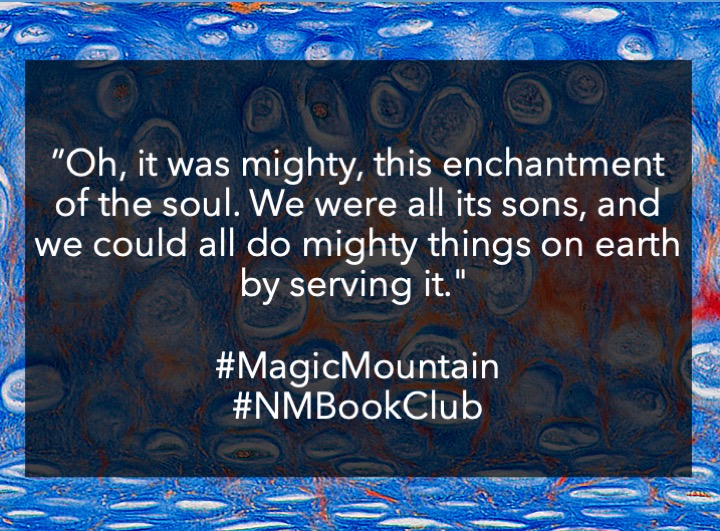
Week 17: The conclusion of the Peeperkorn story surprised me quite a bit. And Chauchat’s departure doesn’t even get its own paragraph?! In the wake of these losses Castorp descends into a full solitude, a “stupor,” where meaning and engagement is harder to find. Yet we end these pages with the introduction of a gramophone to the Berghof; Castorp falls in love with it quite literally (his obsession recalls when he first started reading the medical textbooks), and we get an examination of his favorite recordings, which bring him into deep relation with the world of art and feeling. “…An object created by the human spirit and intellect, which means a significant object, is ‘significant’ in that it points beyond itself, is an expression and exponent of a more universal spirit and intellect, of a whole world of feelings and ideas that have found a more or less perfect image of themselves in that object – by which the degree of its significance is measured. Moreover, love for such an object itself is equally ‘significant.'” I love reading Mann on art; hard not to read all of this as a reflection on the novel itself, as we come close to its end.


For next week: Read to “The Great Petulance.”ย 


Live Virtual Group Session: 12pm EDT September 16th 2020

We welcomed 18 people to participate in our workshopโ€™s close reading discussion of an excerpt from The Swimmer, a short story by John Cheever. Although the title and author had been withheld, some participants recognized the passage from the larger work. Others were unfamiliar with it, and this allowed for a variety of observations and perspectives. An initial response connected depression, seeking, and an unhappy life with the sense of running away exemplified by the odd goal to โ€œswim across the countyโ€ by way of one backyard swimming pool after another. Our readers noted the disparities of a โ€œstubborn autumnal fragranceโ€ฆ strong as gasโ€ that conjured a toxic atmosphere. In addition, the analogy of a life being looked back upon through this self-imposed challenge was highlighted by phrases like, โ€œlooking over his shoulder he saw, in the lighted bathhouse, a young man.โ€ Was our swimmer reflecting back on his youth when he recognizes the aging of his own body where โ€œthe strength in his arms and shoulders had goneโ€?ย 

There was โ€œa ridiculousnessโ€ of this journey/challenge noted, and also the revelation that though we may set a goal and strive to achieve it, the achievement may not result in exaltation and a sense of triumph. It may sometimes result in the question โ€œnow what?โ€

Our writing prompt was an invitation to โ€œTake us on a strange journey.โ€ Four writers read their work. We entered the catacombs of Paris via a strange entrance, led by a cousin (referred to as a โ€œloserโ€) wielding lanterns. This writer asked the question, โ€œIf we go into the depths can we be transformed?โ€ The next writer took us on an immigrant journey where we heard โ€œcries lost among othersโ€ where a great grandmother is embodied in the bowels of a ship, a visceral journey that makes vivid the depth of heritage. In the shadow of Cheever, the striving for a goal but not yielding triumph evoked a familiar feeling. Our next writer described how when walking the streets at night, she liked seeing โ€œtrees towering up to the heavens.โ€ Then one tree struck by lightning smashes to the ground. In this turn of events, what started as NOT a strange journey became one. The writerโ€™s repetition of โ€œtomorrow/tomorrow/tomorrowโ€ created a connection to the unknowable future. Our last reader personified a 2-year-old boy reflecting in a mirror where he saw โ€œsclera lined with ripples of red,โ€ a use of lens language that went beyond literal to metaphorical of how when we look at ourselves we may not actually see ourselves.

Participants are warmly encouraged to share what you wrote below (โ€œLeave a Replyโ€), to keep the conversation going here, bearing in mind that the blog of course is a public space where confidentiality is not assured.

Also, we would love to learn more about your experience of these sessions, so if youโ€™re able, please take the time to fill out a follow-up survey of one to two quick questions!

Please join us for our next session Monday, September 21st at 6pm EDT, with more times listed on our Live Virtual Group Sessions page.


Originally published in The New Yorker, July 18, 1964. Reprinted in The Brigadier and the
Golf Widow (1964) and in The Stories of John Cheever (1978). Copyright ยฉ 1978 by John
Cheever

โ€œWhat do you want?โ€ she asked.

โ€œIโ€™m swimming across the county.โ€

โ€œGood Christ. Will you ever grow up?โ€

โ€œWhatโ€™s the matter?โ€

โ€œIf youโ€™ve come here for money,โ€ she said, โ€œI wonโ€™t give you another cent.โ€

โ€œYou could give me a drink.โ€

โ€œI could but I wonโ€™t. Iโ€™m not alone.โ€

โ€œWell, Iโ€™m on my way.โ€

He dove in and swam the pool, but when he tried to haul himself up onto the curb he found that the strength in his arms and shoulders had gone, and he paddled to the ladder and climbed out. Looking over his shoulder he saw, in the lighted bathhouse, a young man. Going out onto the dark lawn he smelled chrysanthemums or marigoldsโ€”some stubborn autumnal fragranceโ€”on the night air, strong as gas. Looking overhead he saw that the stars had come out, but why should he seem to see Andromeda, Cepheus, and Cassiopeia? What had become of the constellations of midsummer? He began to cry.

It was probably the first time in his adult life that he had ever cried, certainly the first time in his life that he had ever felt so miserable, cold, tired, and bewildered. He could not understand the rudeness of the catererโ€™s barkeep or the rudeness of a mistress who had come to him on her knees and showered his trousers with tears. He had swum too long, he had been immersed too long, and his nose and his throat were sore from the water. What he needed then was a drink, some company, and some clean, dry clothes, and while he could have cut directly across the road to his home he went on to the Gilmartinsโ€™ pool. Here, for the first time in his life, he did not dive but went down the steps into the icy water and swam a hobbled sidestroke that he might have learned as a youth. He staggered with fatigue on his way to the Clydesโ€™ and paddled the length of their pool, stopping again and again with his hand on the curb to rest. He climbed up the ladder and wondered if he had the strength to get home. He had done what he wanted, he had swum the county, but he was so stupefied with exhaustion that his triumph seemed vague. Stooped, holding on to the gateposts for support, he turned up the driveway of his own house.


Encuentros virtuales en vivo: Martes 15 de septiembre, 16:30 EST

Tuvimos la primera sesiรณn en espaรฑol de Septiembre y ademรกs con cambio de dรญa y hora y fue una muy buena experiencia! Fuimos 12 participantes en total representando a Chile, Estados Unidos, Espaรฑa, Brasil y Mรฉxico. La mayorรญa habรญa asistido previamente a una o mรกs sesiones, pero igual tuvimos participantes que asistรญan por primera vez. ย 

El texto que elegimos para esta sesiรณn fue un poema de Rubรฉn Darรญo, llamado โ€œLo Fatal,โ€ publicado a continuaciรณn. Dos voluntarias leyeron el texto en voz alta. Desde el principio, el sentimiento mรกs preponderante entre los asistentes fue el de contradicciรณn, donde el texto habla de sentir y no sentir, vivir y morir, el saber y no saberโ€ฆ nadie tenรญa claridad acerca de quรฉ es lo que el texto querรญa transmitirnos. Del mismo modo, habรญa versos que generaban impacto en los lectores (โ€œdichoso el que no sienteโ€ o โ€œdolor de estar vivoโ€). Sin embargo, lentamente mรกs ideas fueron surgiendo, como la idea de que el tรญtulo no parecรญa estar acorde al contenido del texto, lo que fue subrayado por dos participantes. Otros lectores percibieron que el poema habla de la vida (o de a ausencia de ella) mรกs que de la muerte, lo que cambiaba el foco de una forma relevante. Una participante interpretรณ la intenciรณn del poeta como que preferรญa vivir en la ignorancia de lo que es la vida, dado que la propia vida le genera mucha angustia (le duele estar vivo, pero le aterra estar muerto). Otro participante recibiรณ el texto como algo que el podrรญa escribir a los 85 aรฑos, habiendo vivido un dolor muy grandeโ€ฆ en contraposiciรณn, otros sostenรญan que ese tipo de dolor era propio de un momento previo en la vida, como la juventud,… como se ve, el tema del dolor fue recurrente entre los participantes, a todos les transmitรญa dolor al leer, algunos afirmaron que el poeta escribiรณ estas lรญneas tras haber sufrido una pรฉrdida muy grande (una muerte, una pena de amor?). Otra emociรณn que los participantes percibieron en el texto fue la angustia, angustia por no saber, o angustia por no saber lo que no sรฉ, pero la sensaciรณn de estar peor si lo sรฉ.

Escribir en conjunto: โ€œEscribe acerca de un momento de incertidumbre.โ€ Varios participantes compartieron sus momentos, y aunque en general fueron escritos โ€œa la sombra del texto original,โ€ lo que transmitieron, a diferencia del texto original, fue paz, belleza, movimiento. Un participante se centrรณ en la certeza de elegir una vida incierta, sin que el saber que la vida fuera incierta le generara discomfort. Otros participantes escribieron respuestas que ahondaban en la relaciรณn o diferencia de la incertidumbre y su significado para uno mismo o para los demรกs, lo que reflejaron algunos en el rol del profesional de salud y lo importante que podrรญa ser reflexionar este texto sobre el rol del mรฉdico y la importancia de la certeza (o falta de ella).

Se alienta a los participantes a compartir lo que escribieron a continuaciรณn (โ€œDeja una respuestaโ€), para mantener la conversaciรณn aquรญ, teniendo en cuenta que el blog, por supuesto, es un espacio pรบblico donde no se garantiza la confidencialidad.

ยกEsperamos verte pronto!

ยกCuรฉntenos mรกs sobre su experiencia en este taller completando esta breve encuesta!


Lo fatal | Rubรฉn Darรญo

Dichoso el รกrbol, que es apenas sensitivo,
y mรกs la piedra dura porque esa ya no siente,
pues no hay dolor mรกs grande que el dolor de ser vivo,
ni mayor pesadumbre que la vida consciente.

Ser y no saber nada, y ser sin rumbo cierto,
y el temor de haber sido y un futuro terrorโ€ฆ
Y el espanto seguro de estar maรฑana muerto,
y sufrir por la vida y por la sombra y por

lo que no conocemos y apenas sospechamos,
y la carne que tienta con sus frescos racimos,
y la tumba que aguarda con sus fรบnebres ramos,
ยกy no saber adรณnde vamos,
ni de dรณnde venimos!โ€ฆ