Live Virtual Group Session: 12pm EDT May 20th 2020

Thank you to everyone who joined us for this session!

Our text was an excerpt from On Earth We’re Briefly Gorgeous by Ocean Vuong, posted below.

Our prompt was: Take us on a walk through a memory.

A warm thank you to the mixture of familiar faces and new ones from around the globe — from India to Italy, from Beirut to Bahrain — who attended our session! The U.S. states were also well represented, including California, Iowa, Texas, Florida and Massachusetts. At least eight people were attending for the first time. (Welcome!)

We read an excerpt from Ocean Vuongโ€™s book On Earth Weโ€™re Briefly Gorgeous and together found wonderful layers of meaning. Many of us thought about what we mean when we talk about โ€œprayerโ€ and how that word can take us beyond the usual definitions. One participant talked about a pure transcendentalism in the fourth paragraph, and another saw allusions to multiple religions: the overtly Muslim prayer, but also a Buddhist notion of the walk and a Christian nod with blood. A third found sounds suggesting the wind of God, contrasting with the creatures on the ground where we live. We also noticed the sounds of the narratorโ€™s walk and the references to the body: the skin, the blood and especially the intriguing phrase โ€œas if the tongue was the smallest arm from which a word like that could be offered.โ€ (Several people mentioned that they plan to pursue more of Vuongโ€™s work. A recent conversation between Vuong and Krista Tippett can be heard on the On Being podcast.)

Our writing prompt โ€“ โ€œTake us on a walk through a memoryโ€ โ€“ drew a variety of responses, many of which mingled the abstract and the concrete. Some participants played with alliteration, repetition, movement, and rhythm in their writing, while others incorporated imagery, changes in temporality, and even lyrics in Farsi. Several participants gave their writings titles, which was a unique change from previous workshops. Many others, like Vuong, used their writing to bring experience into understanding, recalling โ€œmemories tinted with the reality of now,โ€ and discovering through their writing where โ€œthe sacredโ€ lies.

Participants are warmly encouraged to share what you wrote below (โ€œLeave a Replyโ€), to keep the conversation going here, bearing in mind that the blog of course is a public space where confidentiality is not assured.

Please join us for our next session Thursday, May 21st at 7pm EDT, with more times listed on our Live Virtual Group Sessions page.

We look forward to seeing you again soon!


On Earth We’re Briefly Gorgeous, excerpt by Ocean Vuong

Back in Hartford, I used to wander the streets at night by myself. Sleepless, Iโ€™d get dressed, climb through the windowโ€” and just walk.

Some nights I would hear an animal shuffling, unseen, behind garbage bags, or the wind unexpectedly strong overhead, a rush of leaves clicking down, the scrape of branches from a maple out of sight. But mostly, there were only my footsteps on the pavement steaming with fresh rain, the scent of decade- old tar, or the dirt on a baseball field under a few stars, the gentle brush of grass on the soles of my Vans on a highway median.

But one night I heard someone praying.

Through the lightless window of a street- level apartment, a manโ€™s voice in Arabic. I recognized the word Allah. I knew it was a prayer by the tone he used to lift it, as if the tongue was the smallest arm from which a word like that could be offered. I imagined it floating above his head as I sat there on the curb, waiting for the soft clink I knew was coming. I wanted the word to fall, like a screw in a guillotine, but it didnโ€™t. His voice, it went higher and higher, and my hands, they grew pinker with each inflection. I watched my skin intensify until, at last, I looked upโ€” and it was dawn. It was over. I was blazed in the blood of light.

Salat al- fajr: a prayer before sunrise. โ€œWhoever prays the dawn prayer in congregation,โ€ said the Prophet Muhammad, โ€œit is as if he had prayed the whole night long.โ€

I want to believe, walking those aimless nights, that I was praying. For what Iโ€™m still not sure. But I always felt it was just ahead of me. That if I walked far enough, long enough, I would find itโ€” perhaps even hold it up, like a tongue at the end of its word.

(c) 2019 Penguin Press/Ocean Vuong

Laboratori Di Medicina Narrativa: martedรฌ 19 Maggio dalle 19 alle 20

Ringraziamo le 200+ persone che da tutta Italia ci hanno raggiunto nel nostro spazio Zoom per il primo laboratorio di medicina narrativa in lingua italiana! Da quando il laboratorio รจ cominciato, si sentiva unโ€™energia e una voglia di partecipare, condividere, ascoltare e stare assieme ad altre persone, nonostante le distanze. Lo spazio Zoom sembrava quasi risuonare dellโ€™entusiasmo dei partecipanti. I facilitatori erano ugualmente emozionati di cominciare questo nuovo progetto di medicina narrativa.

Abbiamo letto insieme il testo di Alda Merini โ€œSpazioโ€, una poesia scritta negli anni novanta, che abbiamo scelto perchรฉ evocativa di temi molto sentiti durante questa emergenza sanitaria. Il prompt di scrittura รจ stato โ€œDescrivi un tuo spazioโ€.ย 

Costretti a casa o in luoghi chiusi per molto tempo durante la pandemia, i nostri partecipanti  hanno espresso il desiderio di aprirsi a nuovi spazi. Il lockdown ci ha fatto sperimentare un senso di clausura e un grande silenzio tuttโ€™attorno nelle cittร  che si erano svuotate, luoghi deserti, in assenza di corpi che invece vivevano confinati allโ€™interno dei perimetri ristretti e obbligati delle case. I verbi di movimento utilizzati dalla poetessa (cantare, crescere, errare, saltare) sono per noi la metafora di un risveglio, di un cambiamento e della possibilitร  di andare oltre i confini del corpo, di uscire dalla paralisi. Nella discussione di gruppo dagli spazi del mondo esteriore si รจ passati a quelli del mondo interno: la stessa poesia della Merini sembra fare questo passaggio dal fuori al dentro, tra la prima e la seconda parte del testo. E da dentro si sprigiona un urlo inumano, di silenzio, che parla dellโ€™antica ferita quasi a richiedere ascolto dagli altri ma anche da se stessi. Abbiamo scoperto insieme quanto abbiamo bisogno di fare spazio dentro di noi per ascoltarci, per comprenderci anche nella nostra fragilitร  e vulnerabilitร . Coltivare lo spazio interiore รจ una grande risorsa per far fronte ad eventi difficili. Questo come atto di cura di sรฉ, di guarigione.Gli workshop online di questo periodo rappresentano anchโ€™essi uno spazio di ascolto, riflessione e condivisione, per sostenerci come comunitร  e affrontare tutta questa sofferenza che รจ dilagata ovunque.

A questo primo appuntamento eravamo moltissimi e solo pochi sono potuti intervenire per commentare in risposta alla poesia di oggi, leggere la propria scrittura, esprimere pensieri ad alta voce. Tuttavia anche ascoltare, scrivere, riflettere in silenzio costituiscono un movimento partecipativo e significativo per aprirsi agli altrui punti di vista, per cogliere sguardi nuovi, per apprendere come onorare le storie degli altri e le proprie. โ€œAscoltarsi รจ creare spazioโ€, come osservato da un commento condiviso al termine del nostro laboratorio di oggi. Siamo lieti di aver potuto creare questo spazio insieme: leggendo, commentando, condividendo, ascoltando, o semplicemente con la propria presenza. 

Ringraziandovi di cuore, vi invitiamo a continuare la conversazione postando in questo blog la vostra scrittura o qualche altro commento che magari avreste voluto condividere con il grande gruppo. Restiamo connessi e arrivederci al prossimo workshop di sabato 23 maggio alle ore 16.00, per continuare a creare insieme โ€œuno spazioโ€ per sentirci vicini nonostante la lontananza. Per permettere a piรน voci e commenti di arricchire questo nostro spazio, abbiamo deciso di offrire un workshop di 90 minuti (invece di 60 minuti). Pertanto, il workshop di sabato 23 durerร  dalle 16.00 alle 17.30. Vi aspettiamo!


Spazio, Alda Merini ย 
(da โ€œVuoto dโ€™amoreโ€)
ย 
Spazio spazio, io voglio, tanto spazioย 
per dolcissima muovermi ferita;ย 
voglio spazio per cantare crescereย 
errare e saltare il fossoย 
della divina sapienza.ย 
Spazio datemi spazioย 
chโ€™io lanci un urlo inumano,ย 
quellโ€™urlo di silenzio negli anniย 
che ho toccato con mano.ย 

Wirtualne Grupy Narracyjne: Wtorek 19 maja, 18:00 CET

Dziฤ™kujemy wszystkim, ktรณrzy wziฤ™li udziaล‚ w dzisiejszej grupie narracyjnej!

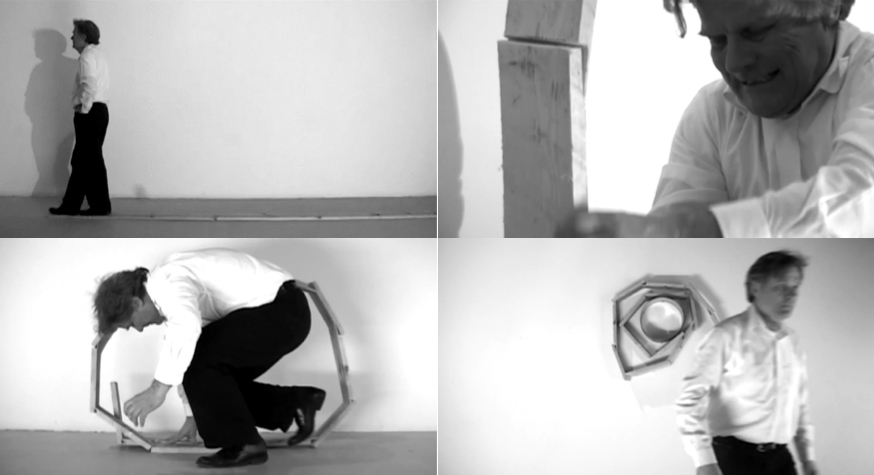
Wspรณlnie uwaลผnie przyjrzeliล›my siฤ™ performansowi Janusza Baล‚dygi โ€žKrokiโ€. Poniลผej zamieszczamy fotosy z nagrania, caล‚oล›ฤ‡ dostฤ™pna jest tutaj.

โ€žNapisz o czymล›, co jest podzielone.โ€

Motywem przewodnim, ktรณry wyล‚oniล‚ siฤ™ w procesie pracy dzisiejszej grupy, byล‚o pojฤ™cie podziaล‚u oraz sytuacja dokonywania wyboru. Uczestnicy grupy czฤ™sto nawiฤ…zywali do wielu aspektรณw i moลผliwoล›ci dzielenia. Dostrzegali je zarรณwno w samym performansie, jak i w swoich jego interpretacjach. Praca ta byล‚a wymagajฤ…ca na wielu poziomach, a w jej przebiegu moลผna byล‚o dostrzec paralelฤ™ do przebiegu zdarzeล„ w nagraniu. Grupa doล›wiadczyล‚a silnej identyfikacji, czego spostrzeลผenie przyniosล‚o poczucie spokoju i satysfakcji. Zostaล‚a rรณwnieลผ wspรณlnie wypowiedziana potrzeba akceptacji tego, co w ลผyciu okazuje siฤ™ byฤ‡ konieczne lub nieuniknione oraz tego, co utracone zostaje w wyniku podejmowania decyzji. Zgoda na to staje siฤ™ krokiem do przodu.

Zapraszamy do udziaล‚u w kolejnych sesjach, ktรณrych terminy podane sฤ… na polskiej podstronie Wirtualnych Grup Narracyjnych. Najbliลผsza grupa odbฤ™dzie siฤ™ 28 maja (czwartek) o godzinie 18:00 โ€“ zarejestruj siฤ™ juลผ dziล›.

Wszelkie pytania oraz proล›by o organizacjฤ™ indywidualnych grup narracyjnych dla Waszych zespoล‚รณw moลผna przesyล‚aฤ‡ na adres: narrativemedicine@cumc.columbia.edu oraz humanistykamedyczna@cm.uj.edu.pl.

Do zobaczenia niebawem!

ลนrรณdล‚o/Source: Ninateka

***

Thank you to everyone who joined us for this session!

Together we looked at โ€œKrokiโ€ (โ€œStepsโ€), a performance by Janusz Baล‚dyga. Still images are posted above and the entire video recording is available here.

The main themes that emerged in this session were the concepts of division and situations in which a choice has to be made. They saw both themes in the video performance itself as well as their interpretations of it. This work was challenging on many levels and a parallel between the group dynamic and the videoโ€™s course of action could be easily drawn. The group experienced a strong identification and noticing it brought a feeling of peace and satisfaction. Participants expressed together the need of acceptance of the things that seem necessary or inevitable in life and of the things that are lost because of making choices. The acceptance becomes the step forward.

Please join us for our next sessions: Wednesday May 20th, 12pm EDT (English language) and Thursday May 21st, 7pm EDT (English language), with more times listed on our Live Virtual Group Sessions page.

If you have questions, or would like to schedule a personalized narrative medicine session for your organization or team, email us at narrativemedicine@cumc.columbia.edu.

We look forward to seeing you again soon!


Live Virtual Group Session: 2pm EDT May 17th 2020

A combination of new and returning participants, 31 total, joined us today, representing local (IN, IA, OR, CT, NJ, NY, CA WA and MI) and international (India, Canada, Italy, the UK, Morocco, Switzerland and Spain) perspectives.ย 

Our text was a page of six panels from cartoonist Roz Chastโ€™s book Canโ€™t We Talk About Something More Pleasant? posted below. Three readers, each representing a voice in the cartoon panel sequence, read it aloud twice. One workshop participant identified a missing voice: that of the mother who was present only as the object of care. Themes discussed included the assumptive inaccuracy of classifying caretaking as โ€œdirty workโ€ and the proposal of caretaking as honorable,ย  the cyclical nature of the parent/child relationship, the intersectionality of race and gender, the tensions between self-care and care for others, and the movement through layers of time. Readers identified with the portrayal of conflicting emotions.

Our prompt โ€œWrite or draw good handsโ€ brought us from the visually particular (tending wounds of a dirty old tomcat, white knuckles, making chicken soup, prayer beads) to the universal (holding space, comfort, goodness, visualization, caregiving at a cost, an incantation like a prayer). Accessing an emotional intergenerational space, one participant wrote, โ€œNow is the time for holding hands,โ€ an affirmation that seemed not only to capture the mood of the moment, but also to remind us that even a Zoom across the internet can feel like a room of care. The summarizing comment noted with wonder that the small frames of an artist’s work can hold us secure together for a moment in the great cosmos.

Participants are warmly encouraged to share what you wrote below (โ€œLeave a Replyโ€), to keep the conversation going here, bearing in mind that the blog of course is a public space where confidentiality is not assured. If you chose to draw, your are welcome to share as well, simply email your visual file to narrativemedicine@columbia.edu and we will add and credit it to the post here.

Please join us for our next session Wednesday, May 20th at 12pm EDT, with more times listed on our Live Virtual Group Sessions page.

We look forward to seeing you again soon!


Live Virtual Group Session: 7pm EDT May 15th 2020

At tonight’s session we welcomed familiar faces from around the US — Pennsylvania, Indiana, Iowa, and more — and also from India, to read the poem “Perhaps the World Ends Here,” by Poet Laureate of the Unitedย States Joy Harjo, posted below.

The poem invited a range of readings and responses, as participants reflected on the literal and metaphorical representation of the kitchen table. One person referred to the way the poem was bracketed — like life — by a beginning and an ending; another wondered why the ending was the focus, reflected in the poet’s choice of title. Importantly, one participant noted the privilege embedded in the very notion of home represented by the table image. The diversity of responses pointed itself to the value of narrative medicine, in its invitation to engage with the experiences and interpretations of others.

As we responded in writing to the prompt, “At this table…” this idea was reflected again in participants’ shared writing, which — through that one powerful image — opened into a world of memories, dreams, and connections.

Participants are warmly encouraged to share what you wrote below (โ€œLeave a Replyโ€), to keep the conversation going here, bearing in mind that the blog of course is a public space where confidentiality is not assured.

Please join us for our next session Sunday, May 17th at 2pm EDT, with more times listed on our Live Virtual Group Sessions page.

We look forward to seeing you again soon!

Perhaps the World Ends Here by Joy Harjo

The world begins at a kitchen table. No matter what, we must eat to live.

The gifts of earth are brought and prepared, set on the table. So it has been since creation, and it will go on.

We chase chickens or dogs away from it. Babies teethe at the corners. They scrape their knees under it.

It is here that children are given instructions on what it means to be human. We make men at it, we make women.

At this table we gossip, recall enemies and the ghosts of lovers.

Our dreams drink coffee with us as they put their arms around our children. They laugh with us at our poor falling-down selves and as we put ourselves back together once again at the table.

This table has been a house in the rain, an umbrella in the sun.

Wars have begun and ended at this table. It is a place to hide in the shadow of terror. A place to celebrate the terrible victory.

We have given birth on this table, and have prepared our parents for burial here.

At this table we sing with joy, with sorrow. We pray of suffering and remorse. We give thanks.

Perhaps the world will end at the kitchen table, while we are laughing and crying, eating of the last sweet bite.

“Perhaps the World Ends Here” from The Woman Who Fell From the Sky by Joy Harjo. Copyright ยฉ 1994 by Joy Harjo.


Live Virtual Group Session: 12pm EDT May 13th 2020

Thank you to todayโ€™s 41 participants who joined us from around the United States and the world, including India, France, Portugal, Italy, the UK, Germany, Canada, and the Netherlands!

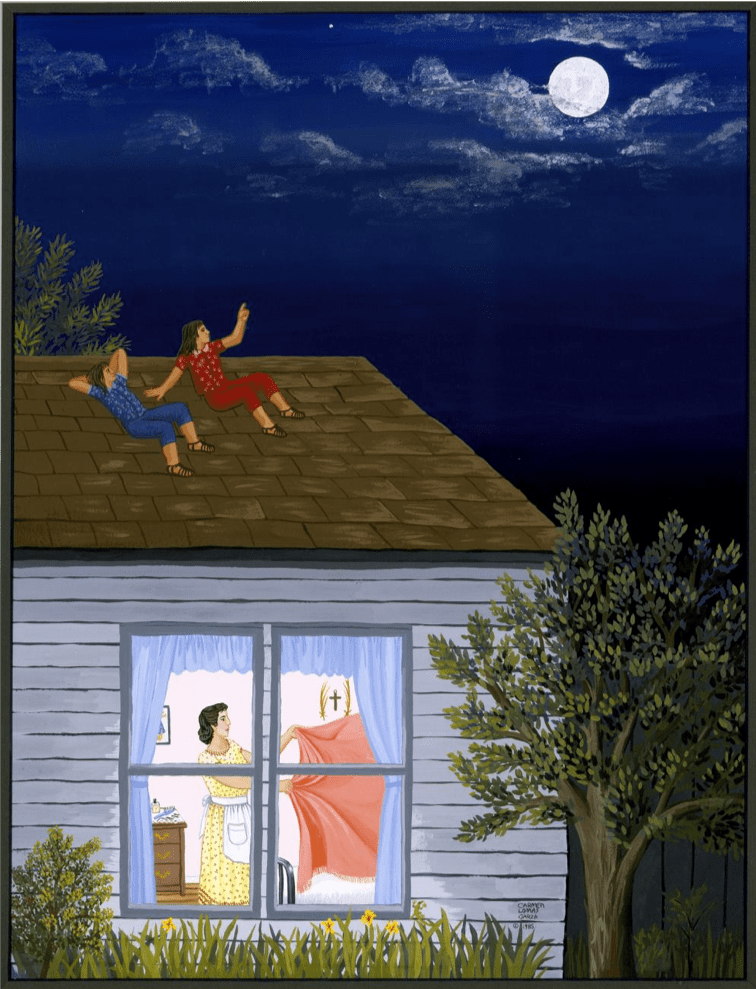
After introductions and a centering exercise, we shared an especially rich discussion of the 1985 painting Camas para Sueรฑos (Beds for Dreams), by Carmen Lomas Garza, posted below. We entered into our discussion through the following questions, โ€œHow do you enter this painting? Where did your eye start, and where did it end?โ€ Our eyes went many places: into the shadows, to the moon, among flowers, and to childhood. We thought about the frame of the window within the outer frame of the image as a whole, and we noticed how looking into someoneโ€™s window can feel voyeuristic. The artistic style evoked terms like โ€œstorybookโ€ and โ€œplayful,โ€ and we noticed the surprise of daffodils, which appear in early spring, beneath leafy trees of summer, lending a quality of magical realism. This sense was amplified by the way the daffodils and trees were both in bloom, and each item appeared in its ideal form — a full moon, showy flowers, full trees, the straight lines of the house. We also explored elements of dualism, including concealment/unconcealment, darkness/light, artificial light/natural light, and outdoors/indoors. And we talked about the quiet mood, a moment in time, true safety and security, confinement and expanse. Details such as a crucifix, an apron and daffodils inspired connections to symbolism of fertility, peace, hope and joy.ย 

We wrote to the prompt, โ€œWrite about something that stays with you,โ€ which evoked responses that often had a flavor of magical realism that echoed the painting we had just discussed. Specific details of the painting, such as the moon and the flora, appeared as elements in the writings. In one, they were woven into the narratorโ€™s own story so that the narrator seemed to move in and out of the world of the painting. Some participants wrote about nostalgia, memory, childhood, family, and reaching across time and space through generations to loved ones.ย  Another participant wrote about โ€œliquid love,โ€ a phrase that stood out to many of us for both its alliteration and its metaphorical possibilities.ย 

Participants are warmly encouraged to share what you wrote below (โ€œLeave a Replyโ€), to keep the conversation going here, bearing in mind that the blog of course is a public space where confidentiality is not assured.

Please join us for our next sessions: Friday, May 15th at 7pm EDT in English or Thursday May 14th at 18:00 CET in Polish, with more times listed on our Live Virtual Group Sessions page.

We look forward to seeing you again soon!

Carmen Lomas Garza, Camas para Sueรฑos (Beds for Dreams), 1985


Live Virtual Group Session: 6pm EDT May 11th 2020

This was a lovely evening session with new people who joined faithful participants who return many times to discuss texts and write to prompts.

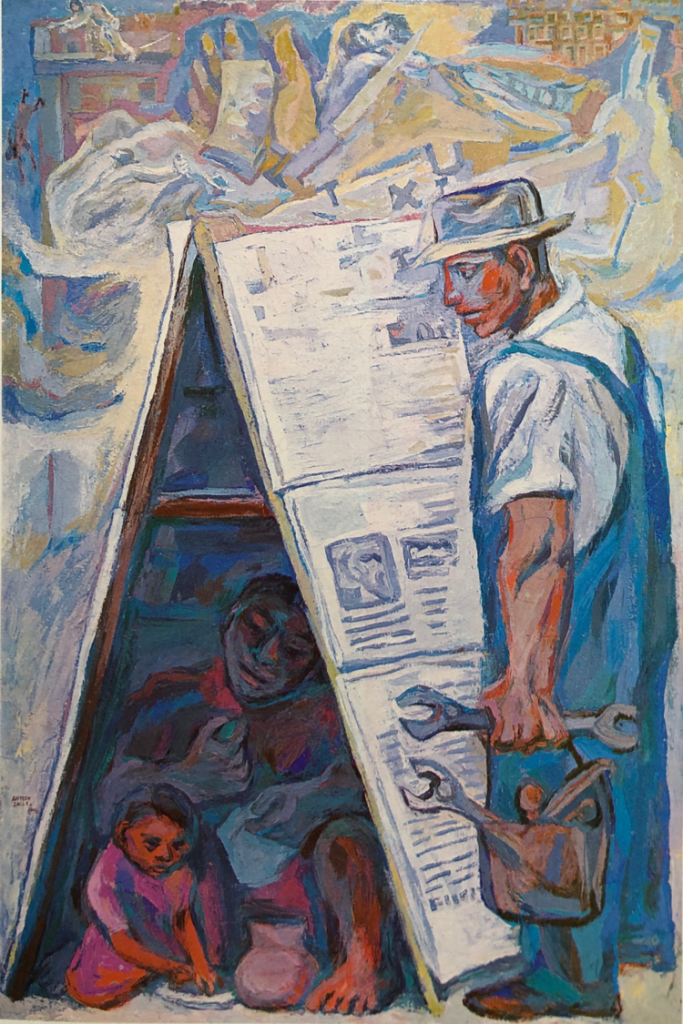
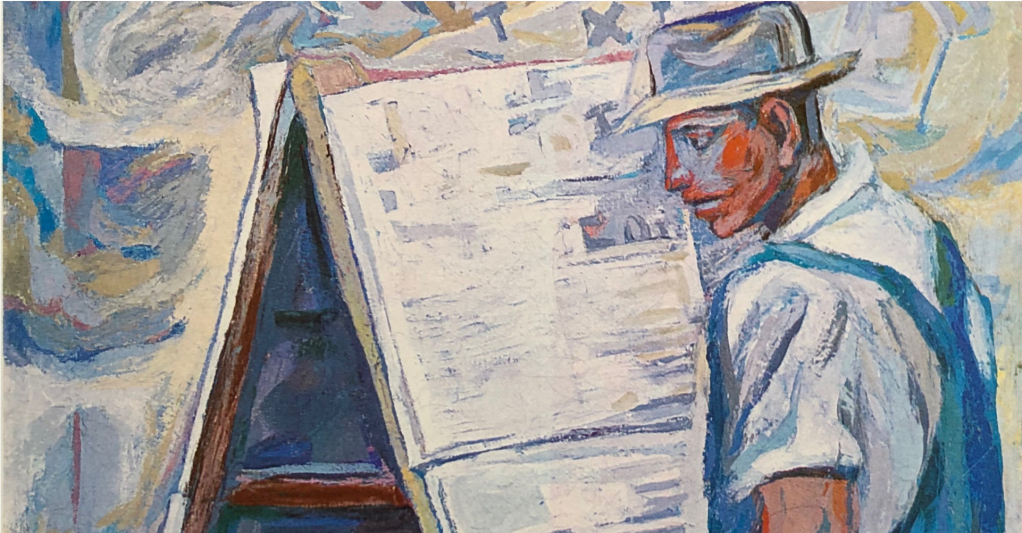
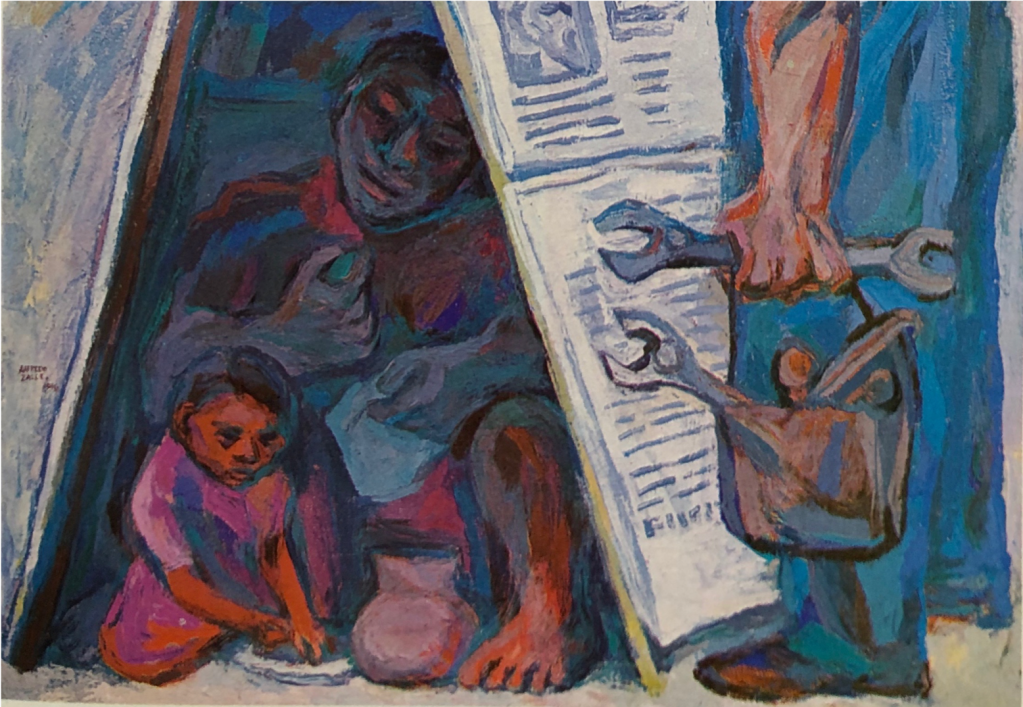
Together we looked at “Vendedora de periรณdicos,” a painting by Alfredo Zalce, posted below.

After introducing the painting, sans identifying information (artist, title, year), everyone looked closely for two minutes in silence. When invited to share their observations/reactions, participants commented first on the action in the left-hand corner โ€”a falling body, a figure who had either pushed or tried to save the figure plunging to the ground, passinganother figure who appeared to attack a person or an animal. One person said it was โ€œstartling.โ€

Another drew attention to the figures in bolder colorsโ€”primary colors mixed with whiteโ€”in the foreground, and said that the figures sheltering under a newspaper stand called to mind โ€œclassic mother and childโ€ images. There were comments on the worker, who is dressed in a blue overall and carries tools in a bucket. Someone saw a man โ€œwho can fix thingsโ€ and another saw the tools as โ€œmenacing.โ€

Before any details of the text were revealed, participants shared their own titles for the painting: โ€œTaking Shelterโ€, โ€œBetween Me and the Worldโ€, โ€œWorking Manโ€, โ€œA Motherโ€™s Calmโ€, โ€œChaos and Securityโ€ . ย After sharing a slide with the title added, we asked how words and image together changed what was seen. The Spanish title Vendedora del periรณdicos (Zalce, 1946) hinted at possible geographical places as well as the action of the woman selling papers and the man stopping to read the news. That brought ideas that the blurry, shapes floating at the top of the newsstand might be what the man was readingโ€”accounts of accidents, lovers, a knife, and money changing hands.

The prompt, โ€œWrite about what is swirling in the airโ€ brought list poems and prose rich in images and sounds. Just as people had commented on the juxtaposition of images and ideas discovered in examining the painting, participants included ordinary and extraordinary happenings and the worry, joy, fear, and uncertainty as they walk their dogs, shop for groceries, work in neonatal intensive care units, accompanied by ubiquitous thoughts of Covid-19 present on surfaces and swirling in the air. Many of the responses shared in their connection to the present moment in healthcare, and spoke of both learning how to live in that moment and desiring to escape it. One delightful wish, expressed in the writing, was for the microscopic virus to be visible as red, blue, yellow and gold glitter.

Participants are warmly encouraged to share what you wrote below (โ€œLeave a Replyโ€), to keep the conversation going here, bearing in mind that the blog of course is a public space where confidentiality is not assured.

Please join us for our next sessions: Wednesday, May 13th at 12pm EDT in English or Tuesday May 12th at 8mm EEST in Greek, with more times listed on our Live Virtual Group Sessions page.

We look forward to seeing you again soon!

Vendedora de periรณdicos
(1946, painting by
Alfredo Zalce) 

Live Virtual Group Session: 2pm EDT May 9th 2020

Thank you to everyone who joined us for this session!

Our text was an excerpt from โ€œThe Diving Bell and the Butterfly: A Memoir of Life in Deathโ€ by Jean-Dominique Bauby, posted below. We read the excerpt once and discussed how the author and father demonstrated care for each other through their actions, without the need for words. We saw the mirror surrounded by photos of loved ones as another sign of affection between father and son. One participant pointed out that the second paragraph describing the fatherโ€™s โ€œlifetimeโ€™s [of] clutterโ€ reminded her of what she and others are living through now, โ€œMy life is around me in my house.โ€ย 

Our prompt was:ย Write about a room of care. Two participants shared their writing inspiring a rich array of responses from the listeners. Responders noted that the sharedย  pieces were written in the shadow of the Diving Bell text. The first sharerโ€™s detailed description of a richly appointed room of care and comfort invited listeners to shelter in a space of vulnerability. The second share moved with spare, short sentences, limited imagery, and rigorous honesty offering listeners permission to experience with the writer the giving and receiving of love and care along with a need for relief.

Participants are warmly encouraged to share what you wrote below (โ€œLeave a Replyโ€), to keep the conversation going here, bearing in mind that the blog of course is a public space where confidentiality is not assured.

Please join us for our next session: Monday, May 11th at 6pm EDT, with more times listed on our Live Virtual Group Sessions page.

We look forward to seeing you again soon!

The Diving Bell and the Butterfly, excerpt by Jean-Dominique Bauby

Hunched in the red-upholstered armchair where he sifts through the day’s newspapers, my dad bravely endures the rasp of the razor attacking his loose skin. I wrap a big towel around his shriveled neck, daub thick lather over his face, and do my best not to irritate his skin, dotted here and there with small dilated capillaries. From age and fatigue, his eyes have sunk deep into their sockets, and his nose looks too prominent for his emaciated features. But, still flaunting the plume of hair — now snow white — that has always crowned his tall frame, he has lost none of his splendor
 
All around us, a lifetime’s clutter has accumulated; his room calls to mind one of those old persons’ attics whose secrets only they can know — a confusion of old magazines, records no longer played, miscellaneous objects. Photos from all the ages of man have been stuck into the frame of a large mirror. There is dad, wearing a sailor suit and playing with a hoop before the Great War; my eight-year-old daughter in riding gear; and a black-and-white photo of myself on a miniature-golf course. I was eleven, my ears protruded, and I looked like a somewhat simpleminded schoolboy. Mortifying to realize that at that age I was already a confirmed dunce.
 
I complete my barber’s duties by splashing my father with his favorite aftershave lotion. Then we say goodbye; this time, for once, he neglects to mention the letter in his writing desk where his last wishes are set out.
 
 
from The Diving Bell and the Butterfly: A Memoir of Life in Death, by Jean-Dominique Bauby (Vintage: 1998)


Live Virtual Group Session: 7pm EDT May 7th 2020

A warm thank you to everyone who joined us this Thursday for our session! We welcomed many familiar faces and many new faces from across the country and the globe.

Despite the physical distances that may have separated us, we were able to form a close-knit group in our virtual space and dive into a close reading of Danez Smithโ€™s โ€œa note on the body,โ€ posted below. Participants discussed how bodies are regarded and treated, and how their dignity and privacy must be maintained, especially during the current healthcare crisis. Participants also commented on the distinction between โ€œthe bodyโ€ and โ€œyour body,โ€ and how the self inhabits the body and lives through it. We discussed how the text can be seen as an anthem to the critically ill patient, a testament to the struggle between body and identity in the context of illness, or a description of illness as a betrayal of the flesh. Participants were struck by the presence of the blank spaces in the poem, and how this forces the reader to confront the poem in a particular way. We also pondered whether the speaker of the poem was speaking to his/her/their self or to an audience, or both.

During the writing portion of our session, participants wrote to the prompt: โ€œWrite a note to yourself beginning with โ€˜you have all you needโ€™โ€. This prompt led participants to consider the weight of illness on the body, and how those with Covid are somehow regarded and treated as different from bodies with other illnesses. Participants wrote about how the body is related to both the inside and outside, how it has both an interior existence and an exterior existence. Several participants drew from the poemโ€™s tone and incorporated the self-referential aspect, writing as if talking to themselves in a nurturing way. Others played with satiety, identity, and popular culture references.ย 

Participants are warmly encouraged to share what you wrote below (โ€œLeave a Replyโ€), to keep the conversation going here, bearing in mind that the blog of course is a public space where confidentiality is not assured.

Please join us for our next session: Saturday, May 9th at 7pm EDT, with more times listed on our Live Virtual Group Sessions page.

We look forward to seeing you again soon!

a note on the body
Danez Smith

your body still your body
your arms still wing
your mouth still a gun
 
          you tragic, misfiring bird
 
you have all you need to be a hero
donโ€™t save the world, save yourself
 
you worship too much & you worship too much
 
when prayer doesnโ€™t work:      dance, fly, fire
 
this is your hardest scene
when you think the whole sad thing might end
 
but you live      oh, you live
 
everyday you wake you raise the dead
 
          everything you do is a miracle


From Donโ€™t Call Us Dead (Graywolf Press, 2017) Copyright ยฉ 2017 by Danez Smith. 

Live Virtual Group Session: 12pm EDT May 6th 2020

Thank you to the mix of 45 returning and new participants representing a variety of countries, states, cities and medical/creative disciplines who converged for todayโ€™s workshop!

Our text was: “He Has Lived in Many Houses” by Thomas Lux, posted below. After a 10-second centering pause, we listened to two volunteers read this 1996 Thomas Lux poem about being someplace but seeking another, being home regardless of geography, and adapting to oneโ€™s surroundings. Participants then considered three questions: โ€œWhat did you see in the poem? What did you hear in the poem? What did the poem smell like?โ€ In the rich discussion, participants commented on how home is a point of reference, one that can be sacred and personal, and part of both travel and the traveler: an anchor, a sanctuary, an inner space. Participants spoke about the uniqueness of home, and noted the emotional foundation and sacredness intrinsic to the word โ€œhomeโ€ that may not necessarily be present in the same way with the word โ€œhouse.โ€ They were struck by the swaying rhythm of the poem, and highlighted how by starting each line with a small preposition, there was an ebb and flow to its rhythmicity. They were struck by the presence of a daily routine, a cycle, and the transition from past, present, and future tenses during the search for home. Briny shores, a fishing village and rust were among the olfactory associations made.

Our prompt was: Write about a sanctuary. Our four-minute prompt inspired writings linked to childhood (โ€œa bestowed sanctuaryโ€), intergenerational voices and tone, an appreciation for a sanctuary that โ€œdoesnโ€™t talk backโ€ and a construction of reality of map vs. mind. Participants wrote about how although there may be a journey to find home, home is not the final destination, as it is re-constructed along the journey of life. It moves, evolves, and is shaped by both internal and external forces. It is also both internal and external to the person who inhabits it, perhaps a physical exterior providing protection and safety while remaining internal, intrinsic, sacred to the heart of the inhabitant. On the other hand, we wondered whether what sanctuary is possible in a precarious world, and whether recognizing that childhood is a sanctuary means that the sanctuaryโ€™s protection has been broken. Participants were also inspired by the smells in the poem and incorporated sensory experience into their own work.

Participants are warmly encouraged to share what you wrote below (โ€œLeave a Replyโ€), to keep the conversation going here, bearing in mind that the blog of course is a public space where confidentiality is not assured. If you chose to draw, your are welcome to share as well, simply email your visual file to narrativemedicine@columbia.edu and we will add and credit it to the post here.

Please join us for our next session: Thursday, May 7th at 7pm EDT, with more times listed on our Live Virtual Group Sessions page.

We look forward to seeing you again soon!

He Has Lived in Many Houses
by Thomas Lux

furnished rooms, flats, a hayloft,
a tent, motels, under a table,
under an overturned rowboat, in a villa (briefly) but not,
as yet, a yurt. In these places
he has slept, eaten,
put his forehead to the window glass,
looking out. He's in a stilt-house now,
the water passing beneath him half the day;
the other half it's mud. The tides
do this: they come, they go,
while he sleeps, eats, puts his forehead
to the window glass.
He's moving soon: his trailer to a trailer park,
or to the priory to live among the penitents
but in his own cell,
with wheels, to take him, when it's time
to go, to: boathouse, houseboat
with a little motor, putt-putt,
to take him across the sea
or down the river
where at night, anchored by a sandbar
at the bend,
he will eat, sleep, and press his eyelids
to the window
of the pilothouse
until the anchor-hauling hour
when he'll embark again
toward his sanctuary, harborage, saltbox,
home.


Originally published in The Atlantic Monthly, January 1992