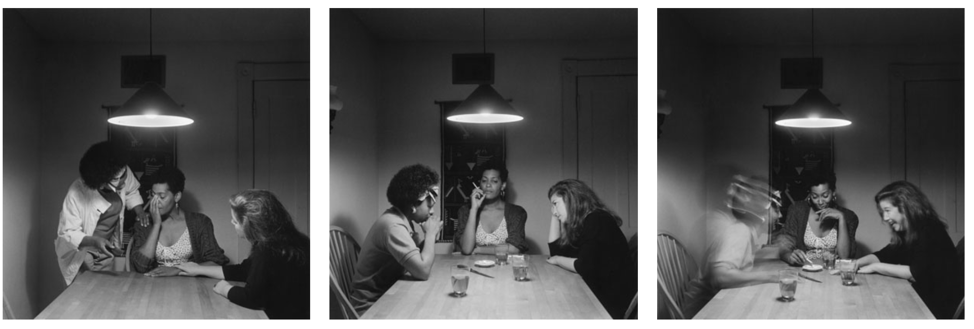
Abbiamo studiato insieme tre foto della serie “La tavola di cucina” di Carrie Mae Weems (allegato al termine di questa pagina)
In seguito, abbiamo usato il prompt “Alla mia tavola…”.
Condivideremo ulteriori dettagli della sessione nei prossimi giorni; vi invitiamo a rivisitare questa pagina nei prossimi giorni!
Invitiamo i partecipanti del laboratorio a condividere i propri scritti nella parte “blog” dedicata alla fine della presente pagina (“Leave a Reply”). Speriamo di creare, attraverso questo forum di condivisione, uno spazio in cui continuare la nostra conversazione!
We welcomed 22 people from U.S. states including New York, New Jersey, and California and other countries including India, Bahrain and Canada. Together, we watched “The Last Performance,” a one-minute film written and directed by Reza Moayedi (2013, Iran).
After two viewings of the film, we opened the discussion by asking what we knew about people in the film — the musician, his companion, the person in the control room. Hands were “raised” immediately, and participants shared aspects of the film that resonated personally for them. We wondered if the two people on stage were a father and daughter, or perhaps a patient and caretaker. We also thought about how the story might have changed with different casting — for example, what if the director had chosen actors with other apparent ages or genders, or if the musical instrument had been a piano or electric guitar? One participant drew a parallel to two plays by Eugene Ionesco: “The Chairs” and “The Lesson.” We explored how the film’s title shaped our ideas about what we saw, especially because it came at the end of the work rather than at the beginning.
Our prompt was “Write about a space you’d like to return to,” which opened up the many ways that we can think about space. One writer discussed the architecture of space and the difference between public and private spaces. Another spoke from the personal perspective, thinking about conscious and unconscious spaces, and the way we lose ourselves to become part of the larger world. We also thought about the spaces that we’d like to go back to that no longer exist, such as spaces where our parents were still young and healthy, or spaces of innocence before we knew things we wished we did not. Our final two readers used sensory details to populate their spaces. For one, that was the French Alps, a place dotted with red poppies and “peppered by hamlets,” and open to freedom, and for the other, Hanging Basket Lake, with water so ice-cold that the narrator shivers just to look at it. That latter piece ended with a tumble, and we noticed how the earlier details let us feel the impact of the fall in our own bodies.
Participants are warmly encouraged to share what you wrote below (“Leave a Reply”), to keep the conversation going here, bearing in mind that the blog of course is a public space where confidentiality is not assured.
Please join us for our next session Sunday, June 14th at 3pm EDT, with more times listed on our Live Virtual Group Sessions page.
We look forward to seeing you again soon!
THE LAST PERFORMANCE Reza Moayedi DIRECTOR , WRITER & PRODUCER – Reza Moayedi / DIRECTOR OF PHOTOGRAPHY – Nima Daneshmand / EDITOR – Saeed Hemati / SOUND – Maziar Hajati / ASSISTANT DIRECTOR – Haleh Alizadeh / ASSITANT CAMERA – Masoud Ramezanpour / CAST – Gholamreza Amani , Mona Sayad , Manouchehr Atashak
Dziękujemy wszystkim, którzy wzięli udział w dzisiejszej grupie narracyjnej!
Wspólnie przeczytaliśmy, zamieszczony poniżej, wiersz Rona Padgetta „Ryzyko” w przekładzie Andrzeja Szuby.
Inspiracja do kreatywnego pisania brzmiała: „Opowieść w ułamku sekundy”.
Dynamika pracy dzisiejszej grupy odzwierciedlała szczególną relację, jaka wiąże mówiącego i słuchającego. Z jednej strony bardzo wyraźnie dała o sobie znać potrzeba wypowiedzi i posiadania głosu, a z drugiej konieczność czasu i przestrzeni, aby móc jak najpełniej przyjąć to, co ma zostać ujawnione. Od samego początku liczba osób zgłaszających się do wypowiedzi znacząco przewyższała czasoprzestrzenną pojemność (wirtualnej) rzeczywistości. Można w tym było dostrzec podobieństwo do relacji, jaka istnieje między synem a matką w dzisiejszym tekście. Dostrzeżono znaczącą dysproporcję pomiędzy długim, wielokrotnie złożonym zdaniem opisującym to, co syn chciałby wypowiedzieć, a nawet wykrzyczeć, a przestrzenią zagarniętą przez różne ograniczenia i zakłócenia, w tym dźwięk telewizora. Wypowiedzi uczestników były bardzo obszerne, posiadały wiele wzajemnych nawiązań i odniesień, rozciągając w wielu kierunkach pole interpretacji. Ta wielość treści do wypowiedzenia, w powiązaniu z koniecznością poczekania na swoją kolej, była źródłem różnorodnych emocji, które zdawały się ukrywać pod stwardniałą warstwą wypowiadanych słów. Słowa o uczuciach często stwarzały niespodziewaną barierę dla ich bezpośredniego wyrażenia. W związku z tym inspiracja wywołała swego rodzaju sprzeciw. W swoich tekstach uczestnicy, jakby jednym głosem, dopominali się o bycie w pełni i z uważnością wysłuchanymi, tak jak i ów syn. Opisywali niemożliwość opowieści w ułamku sekundy, jednocześnie chętnie posługując się zwartą, kilkuwyrazową formą. Doświadczenie tej grupy pozostawiło w nas pytanie, czy potrafimy stwarzać dla siebie nawzajem przestrzeń, w której czujemy się wystarczająco wysłuchani.
Zapraszamy do udziału w kolejnych sesjach, których terminy podane są na polskiej podstronie Wirtualnych Grup Narracyjnych. Najbliższa grupa odbędzie się 18 czerwca (czwartek) o godzinie 18:00 – zarejestruj się już dziś.
Ron Padgett
Ryzyko

Czasem, gdy oddzwaniałem
do matki w Tulsa, słyszałem:
„Chwileczkę, Ron, tylko
to ściszę”. To, czyli
telewizor. I zaczynało się
szukanie pilota, potem zabawa
z przyciskami, a we mnie rosła
irytacja i zniecierpliwienie,
i miałem ochotę wykrzyczeć: „Oglądasz
za dużo, i jest za głośno, i dlaczego
nie wyjdziesz z domu!”, ponieważ
nie radziłem sobie z lękiem przed
jej starością, a moje serce stwardniało,
bo ją kochałem, choć przecież nie chciałem
rezygnować z własnego życia i mieszkać
gdzieś w pobliżu, żeby mnie mogła
codziennie widzieć, a nie tylko słyszeć,
i dlatego ściszała telewizor i mówiła:
„No, teraz lepiej”, a później, czasami,
zdawała szczegółowe sprawozdanie z jakiegoś
koszmarnego, właśnie oglądanego programu.
                     przeł. Andrzej Szuba
(Wiersz pochodzi z tomu „Bezczynność butów”, Instytut Mikołowski, Mikołów 2018.)
***
Thank you to everyone who joined us for this session!
Together we read “Jeopardy”, a poem by Ron Padgett, translated to Polish by Andrzej Szuba (posted below).
Our prompt for today was: “A story in a split second”.
The dynamics of today’s group session reflected a special relationship between the speakers and listeners. The need to speak and to have a voice on one hand, and the need for time and space necessary to be able to accept what will be revealed on the other, were all clearly visible. From the very beginning, the number of people raising their hands and wanting to speak significantly exceeded the spatiotemporal capacity of the (virtual) reality, similar to the relationship that exists between the son and the mother in the poem. The participants saw a significant contrast between the long, compound, complex sentence describing what the son would like to say and shout out, and the space taken by limitations and interferences, including the sound of the TV. Participants’ statements were extensive and had many perspectives, extending the field of interpretation in many different directions. The great amount of thoughts that people wanted to share, combined with the necessity to wait for their turn, was a source of a variety of emotions that seemed to be hidden under a hardened layer of spoken words. Words describing feelings sometimes created an unexpected barrier which limited their direct expression. Therefore, the writing prompt caused some kind of an opposition. The characters in their writing, as if in one voice, demanded to be fully and attentively heard just like the son in the poem. They described the impossibility of a story by writing in a similar form as the poem, using several words and shortened lines. The experience of this group has left us with the question of whether we can create for each other a space in which we feel heard well enough.
Please join us for our next sessions: Wednesday June 10th, 12pm EDT (in English) and Sunday June 14th, 3pm EDT (in English), with more times listed on our Live Virtual Group Sessions page.
If you have questions, or would like to schedule a personalized narrative medicine session for your organization or team, email us at narrativemedicine@cumc.columbia.edu.
We look forward to seeing you again soon!
Ron Padgett
Jeopardy

Sometimes when I phoned
my mother back in Tulsa, she would
say, “Hold on a minute, Ron, let me
turn this thing down,” the thing
her TV, and she would look
around for the remote and then fumble
with its little buttons as an irritation
mounted in me and an impatience
and I felt like blurting out “You watch TV
too much and it’s too loud and why
don’t you go outside” because I was
unable to face my dread of her aging
and my heart made cold toward her
by loving her though not wanting to give up
my life and live near her so she
could see me every day and not
just hear me, which is why she
turned the TV down and said,
“Okay, that’s better,” then sometimes
launched into a detailed account
of whatever awful show she was watching.

(Form R. Padgett, “Collected Poems”, Minneapolis: Coffee House Press, 2013.)
Al workshop del 9 giugno 2020 si è percepito un clima di grande partecipazione e di calore emotivo. Abbiamo lavorato sul alcune pagine tratte dal libro di Lev Tolstoj “La morte di Ivan Il’ic”, un testo del 1886 che ha evocato molte riflessioni sul tema della cura e del prendersi cura. In particolare, le voci di tre lettori ci hanno portano nella scena in cui avviene una conversazione tra Ivan, malato e sofferente e il giovane e forte Gerasim, che mentre accudisce il suo padrone lo conforta con gesti di semplicità, sincerità e leggerezza. L’invito alla scrittura è stato “Scrivi una lettera al tuo Gerasim”.
La lettura accurata del testo ha portato i partecipanti ad evidenziare alcuni elementi chiave del racconto: l’incontro fra due corpi fra loro molto diversi (salute/malattia, forza/fragilità, baldanza/debolezza) che apre ad una relazione che progredisce da semplici gesti di accudimento ad una condivisione potente sul piano umano fra i due protagonisti. Questo avviene grazie alla straordinaria naturalezza con cui Gerasim si approccia ad Ivan, senza pietismo né commiserazione e anche contenendo la propria gioia di vivere per non mortificarlo. Egli fa tutto “volentieri”, con leggerezza e delicatezza e questo atteggiamento conforta il malato. Una partecipante ha detto che è come se “il tempo si fosse fermato e lo spazio dilatato” in questa scena di cura, dove tutto diventa “relazione”, ma anche incontro fra generazioni, scambio tra chi cura e chi viene curato, riconoscimento reciproco.
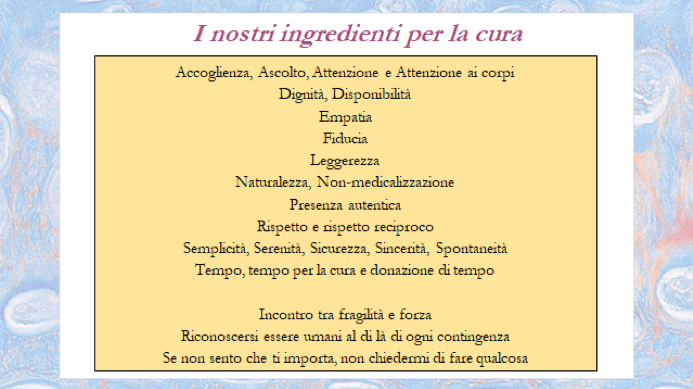
Ecco gli ingredienti della cura che i partecipanti hanno scritto nella chat al termine della close reading del testo:
Per passare subito dopo all’attività di scrittura a partire dall’invito dei facilitatori e alla lettura di molti testi, che hanno richiamato e amplificato con parole, emozioni e significati il brano di Tolstoj da cui eravamo partiti. Ascoltare attentamente e rispondere ai testi dei partecipanti ci ha portati a riflettere su come ogni persona abbia aperto un nuovo puto di vista e nuove possibilità di interpretare la cura, che è cura dell’altro ma anche di sé e del contesto. Il tempo della relazione è stato indicato come un tempo donato, di conforto, “oro e balsamo” per chi soffre ma anche per chi sta accanto alla sofferenza dell’altro. La cura richiede preparazione e generosità e genera gratitudine e riconoscimento reciproco. L’insieme delle scritture e delle risposte agli scritti ha costruito una sorta di racconto sulle pratiche di cura. In chiusura abbiamo ascoltato l’audio di una poesia di Mariangela Gualtieri “Sii dolce con me”, il cui testo vogliamo qui riportare, in quanto ricco di parole che hanno rimbalzato e risuonato nei lavori della sessione:
Sii dolce con me. Sii gentile. È breve il tempo che resta. Poi saremo scie luminosissime. E quanta nostalgia avremo dell’umano. Come ora ne abbiamo dell’infinità. Ma non avremo le mani. Non potremo fare carezze con le mani. E nemmeno guance da sfiorare leggere.
Una nostalgia d’imperfetto ci gonfierà i fotoni lucenti. Sii dolce con me. Maneggiami con cura. Abbi la cautela dei cristalli con me e anche con te. Quello che siamo è prezioso piú dell’opera blindata nei sotterranei e affettivo e fragile. La vita ha bisogno di un corpo per essere e tu sii dolce con ogni corpo. Tocca leggermente leggermente poggia il tuo piede e abbi cura di ogni meccanismo di volo di ogni guizzo e volteggio e maturazione e radice e scorrere d’acqua e scatto e becchettio e schiudersi o svanire di foglie fino al fenomeno della fioritura, fino al pezzo di carne sulla tavola che è corpo mangiabile per il mio ardore d’essere qui. Ringraziamo. Ogni tanto. Sia placido questo nostro esserci – questo essere corpi scelti per l’incastro dei compagni d’amore.
Noi facilitatori ed organizzatori ringraziamo tutti i partecipanti della loro presenza attenta, sensibile, profondamente umana.
Da “La morte di Ivan Il’ič” di Lev Tolstoj, 1886
Gerasim era un giovane contadino, pulito, fresco, bene in polpa dai cibi cittadini. Sempre allegro, sereno. Sulle prime la vista di quell’uomo vestito alla russa, sempre lindo, che faceva una tale ingrata operazione, turbava Ivan Il’ič. Una volta questi, alzatosi dalla seggetta senza la forza di tirarsi su i pantaloni, si lasciò cadere in una poltrona, e si guardava con terrore le cosce nude, fiacche, dai muscoli crudamente rilevati.
Entrò con i suoi grossi stivali – recando un gradevole odore di catrame, da questi stivali e la freschezza dell’aria invernale- a passo leggero e forte Gerasim, col suo lindo grembiule di canapa e una linda camicia d’indiana dalle maniche rimboccate sulle braccia giovani e forti. Senza guardare Ivan Il’ič – evidentemente contenendo, per non mortificare il malato, la gioia di vivere che gli traspariva dal volto, s’avvicinò alla seggetta.
— Gerasim — disse Ivan Il’ič con voce debole. Gerasim trasalì, temendo d’aver fatto male qualcosa, e con un rapido movimento volse verso il malato il suo giovane viso, fresco, buono, semplice, appena ombreggiato dalla barba che cominciava a crescere.
— Che cosa comandate?
— E’ seccante fare questo, no? Mi devi scusare. Io non posso.
— Macchè— E Gerasim fece vedere i suoi giovani bianchi denti e gli occhi gli brillarono.
— Perché non dovrei farlo? Voi siete malato.
E con mano accorta e vigorosa fece quello che doveva e uscì a passo leggero. E dopo cinque minuti tornò, con lo stesso passo leggero.
Ivan Il’ič stava ancora lì sulla poltrona.
— Gerasim — disse, quando costui ebbe rimesso a posto il vaso pulito, lavato — ti prego, aiutami, vieni qui —. Gerasim si avvicinò. — Sollevami. Mi è penoso farlo da solo, e Dmitrij l’ho mandato fuori.
Gerasim si avvicinò ancora di più; colle robuste braccia, leggero come camminava, l’abbracciò, lo sollevò delicatamente e lo sostenne, con una mano gli tirò su i pantaloni e voleva metterlo a sedere. Ma Ivan Il’ič lo pregò di accompagnarlo al divano. Gerasim, senza sforzo e come se non lo toccasse neppure, lo menò, quasi portandolo di peso, al divano e lo mise a sedere.
— Grazie. Come sei bravo… come fai bene tutto…
Gerasim sorrise di nuovo e fece per andarsene. Ma Ivan Il’ič si trovava così bene con lui che lo trattenne.
— Ecco, avvicinami, ti prego, quella sedia. No, quella là. Mettimela sotto le gambe. Sto meglio quando ho i piedi in alto.
Gerasim portò la sedia, la posò senza fare rumore, abbassandola a terra e vi stese su le gambe di Ivan Il’ič. A questi pareva di stare meglio, mentre Gerasim gli teneva alti i piedi.
— Sto meglio quando ho i piedi alzati — disse Ivan Il’ič —. Mettimi qui sotto quel cuscino.
Gerasim obbedì. Di nuovo gli sollevò i piedi e li posò sul cuscino. Di nuovo a Ivan Il’ič parve di star meglio mentre Gerasim gli sollevava i piedi. Quando li riabbassò gli parve di star peggio.
— Gerasim, disse, hai da fare, adesso?
— Per nulla — disse Gerasim, che aveva imparato dai domestici cittadini a parlar coi padroni.
— Che cosa ti rimane da fare?
— Che mi rimane? Niente, ho finito tutto: solo spaccar la legna per domani.
— Allora tienimi un poco su le gambe… puoi?
— Ma certo che posso — Gerasim alzò le gambe di Ivan Il’ič al quale parve di non sentir più il dolore in quella posizione.
— E la legna?
— Non abbiate pensiero. Avrò sempre tempo.
Ivan Il’ič disse a Gerasim di mettersi a sedere mentre gli teneva le gambe, e intanto discorreva con lui. E, strana cosa, gli pareva di sentirsi davvero meglio quando Gerasim gli teneva le gambe.
Da quel momento Ivan Il’ič cominciò a chiamare di tanto in tanto Gerasim, e gli appoggiava i piedi sulle spalle, e amava discorrere con lui. Gerasim gli rendeva quel servizio senza difficoltà, volentieri, con una semplicità e una bontà che lo commovevano. La salute, la forza, la baldanza vitale di chiunque altro offendevano Ivan Il’ič; soltanto la forza e la baldanza di Gerasim non gli facevano male, anzi lo calmavano.
Thank you to everyone who joined us for this session!
Together, we read the poem “The Explorer” by Gwendolyn Brooks (posted below). This text stimulated many questions about the spaces we exist in and the “quiet places” we search for, particularly in the context of our current national and international events. “We are all looking for a quiet place,” observed one of our participants, as this poem highlighted for them the interplay between the personal private to a larger, broader social context. “It’s a poem that sends the reader into spirals,” commented another participant, highlighting the mental and sensory “work” the poem requires us readers to do, as explorers “sifting through” “the fabric of life” and “the general confusion” that comes with it. Together, we explored the “complicated connotations” of the word “noises” in the first line: what kind of noises is the explorer moving through? We noted how “noise can be subjective”: what someone hears as noise could be, “music”, “dissent”, or “neutral sounds” for someone else. We experienced comfort in the “velvet peace”, and someone commented how this made us aware of the “texture of the things around us”. We found ourselves wondering about the different dimensions in which peace can be achieved, both in the exterior and the interior realms. Many of our participants were drawn to the end of this poem, “fearing the choices that cried to be taken”; as someone observed, choices are “made”, rather than “taken”. In the eyes of some of our participants, the explorer in the poem unites people to make choices together… only to find no peace and no quiet rooms to negotiate and decide the next steps of the journey.
For our writing activity, we dove further into the “choices” the poem raised for us. We wrote to the prompt “write about the choices crying to be taken.” Our readers reminded us of the feeling of smallness we may feel in front of the insurmountable height of some choices, whether in the past, in the present or the in future. “How do I move forward from this virtual time?” asked one of our readers. Throughout our dialogue, some participants shared a sense of relief at the thought that “we are not the only “ones” that have choices”, as well as the strong sense of responsibility that comes with knowing that “choices impact those around us”. At the end of our conversation, we returned to the image of the explorer, moving through the world one step and one choice at a time. In the words of our participants, we left each other having “awakened the explorer in [us], especially after spending more than 75 days in lockdown” and reminded that “we are always exploring”.
Participants are warmly encouraged to share what you wrote below (“Leave a Reply”), to keep the conversation going here, bearing in mind that the blog of course is a public space where confidentiality is not assured.
Please join us for our next session Wednesday, June 10th at 12pm EDT, with more times listed on our Live Virtual Group Sessions page.
We look forward to seeing you again soon!
THE EXPLORER
- Gwendolyn Brooks (1959)

Somehow to find a still spot in the noise
Was the frayed inner want, the winding, the frayed hope
Whose tatters he kept hunting through the din.
A velvet peace somewhere.
A room of wily hush somewhere within.

So tipping down the scrambled halls he set
Vague hands on throbbing knobs. There were behind
Only spiraling, high human voices,
The scream of nervous affairs,
Wee griefs,
Grand griefs. And choices.

He feared most of all the choices, that cried to be taken.

There were no bourns.
There were no quiet rooms.

Published Harpers Magazine, September, 1959
Thank you to everyone who joined us for this session!
Our text was “Caged Bird” by Maya Angelou, posted below.
Our prompt was “Write about a time you either sang or heard the caged bird’s song.”
More details on this session will be posted soon, so check back!
Participants are warmly encouraged to share what you wrote below (“Leave a Reply”), to keep the conversation going here, bearing in mind that the blog of course is a public space where confidentiality is not assured.
Please join us for our next session Monday, June 8th at 6pm EDT, with more times listed on our Live Virtual Group Sessions page.
Siamo stati molto lieti di avervi qui con noi! Abbiamo studiato insieme un estratto dal romanzo autobiografico “Cronaca familiare” (1947) di Vasco Pratolini (riportato al termine di questa pagina). I partecipanti hanno parlato del danno come elemento inevitabile della vita, e del bisogno di riconoscere e superare quel danno, se possibile, per affrontare la vita che c’è davanti. Hanno considerato il danno provocato dalla malattia, che entrambi i protagonisti (i due fratelli, Vasco e Ferruccio) hanno vissuto, e il danno della seconda guerra mondiale che li circondava. Sono rimasti colpiti dalla frase “Io pedalavo e tu mi guidavi”, che richiama la reciprocità nella relazione tra i due fratelli, la dipendenza dell’uno dall’altro, la fiducia e l’amore familiare l’uno per l’altro. Qualche partecipante ha commentato come i due fratelli siano diventati un insieme talmente affiatato “da percorrere allo stesso modo, con le stesse forze e con gli stessi obiettivi la stessa strada”. Altri partecipanti hanno fatto notare come la fratellanza rappresentasse in sé una relazione di cura per i protagonisti.
In seguito, abbiamo usato il prompt “Descrivi l’entrare in un nuovo mondo”. I partecipanti hanno sottolineato come i commenti e gli interventi di tutti dessero una “vita vera” al testo e come, attraverso l’ascolto degli scritti e dei commenti degli altri, si acquisti una nuova lettura delle relazioni. Alcuni partecipanti hanno scritto sulla vicinanza che si desidera ritrovare in questa nuova realtà a cui siamo confrontati, la consapevolezza del mondo attorno, la speranza e la presenza dell’io, di un io che si presenta qui, alla soglia di un nuovo mondo.
Invitiamo i partecipanti del laboratorio a condividere i propri scritti nella parte “blog” dedicata alla fine di questa pagina (“Leave a Reply”).
“Cronaca familiare” (1947)
Vasco Pratolini
BUR Biblioteca Univerzale Rizzoli
A Roma, una sera sulla fine del 1944, fui chiamato al telefono. Udii la tua voce nell’orecchio. <<Sono appena arrivato. Mi trovo in piazza Risorgimento.>>
<<Come stai?>>
<<Così e così. Ma sono in grado di camminare; non preoccuparti. Ti aspetto nel bar.>>
Non ci vedevamo dal settembre dell’anno prima; ero stato costretto a partire precipitosamente, senza nemmeno salutarti. Ti avevo lasciato gravemente ammalato, infermo tu ora, e per diversi mesi ero rimasto senza tue notizie. Dopo la liberazione di Firenze, una tua lettera mi diceva che avevi trascorso quell’anno quasi sempre in ospedale.
Inforcai la bicicletta per raggiungerti. Era già sera e le strade erano buie ed affollate, ma l’aria era ancora tiepida e il vento che mi batteva sul volto mi rallegrava. È l’ultima ora di contentezza che ricordo, non troverò mai più la felice disposizione di spirito che allietò quella sera. Ci si può assuefare alle persecuzioni, alle fucilazioni, alle stragi; l’uomo è come un albero e in ogni suo inverno levita la primavera che reca nuove foglie e nuovo vigore. Il cuore dell’uomo è un meccanismo di precisione, completo di poche leve essenziali che resistono al freddo, alla fame, all’ingiustizia, alle sevizie, al tradimento, ma che il destino può vulnerare come il fanciullo l’ala della farfalla. Il cuore ne esce con il battito stanco; da quel momento l’uomo diventerà forse più buono, forse più forte, e forse anche più deciso o cosciente nella sua opera, ma non troverà più nel suo spirito quella pienezza di vita e di umori in cui ogni volta egli sfiora la felicità. Era, quella sera, il 18 dicembre 1944.
Il bar era deserto. Sedevi a un tavolo dietro la vetrata; in un angolo stavano abbracciati un soldato straniero e una ragazza. Ti alzasti quando io entrai. Eri altro, diafano, la barba bionda, lunga di due giorni ti ombrava il volto come una luce appena diffusa. Il tuo sguardo era dolce, incerto, quasi velato. <<Fatti vedere>> ti dissi, e fissai i tuoi occhi ch’erano, come in ogni innocente, il tuo specchio. V’era, in essi, il segno di una dura lotta, e nell’intensità della loro acquamarina, una irreducibilità più forte del male.
Non c’erano tram né auto per cui salisti sulla canna della bicicletta; bilanciavamo la valigia sul manubrio, lentamente entrammo in città. Tutto, adesso, può diventare un simbolo. Alto com’eri, mi proibivi l’orizzonte; io pedalavo e tu mi guidavi. Pedalavo piano, appena da mantenere l’equilibrio, per evitarti le scosse. A ruota libera infilammo via Tomacelli ove il traffico divenne più intenso, ti divertivi a scampanellare, a dare sulla voce ai passanti; mi chiedevi il nome delle strade, le notizie dell’anno trascorso, dicevi: <<Mi sembra di entrare in un nuovo mondo>>. E poi: <<Speriamo che Roma mi porti fortuna>>.
Ci coricammo nello stesso letto, come tanti anni prima. Parlammo fino all’alba. Tu dicesti:
<<Ti ricordi? Dieci anni fa eri tu il malato e io il sano>>.
<<Anche tu guarirai>> ti risposi.
<<Quante cose sono successe in questi dieci anni!>>
Eravamo in letto, la camera dava sul cortile; si udiva scalpicciare dal piano di sopra e ogni tanto, di lontano, proveniva l’eco di uno sparo. Ti voltasti verso di me, sul fianco, dicesti: <<Siamo cambiati molto in questi dieci anni. Io in specie, ma anche tu>>. Ti sporgesti sul mio viso e mi baciasti.
Ricordammo i dieci anni durante i quali avevamo imparato a volerci bene.
We welcomed participants from Chile, Morocco, India, the UK, the Netherlands, and all over the U.S. for this session, during which we shared the poem “Possibilities,” by the Nobel Prize-winning Polish writer Waclava Szymborska as translated by S. Baranczak & C. Cavanagh, posted below. As an exercise in approaching the poem with an open mind, we began with just the poem itself, without a title or author name, and we invited two volunteers to read the poem aloud.
Discussants recognized the poem’s form (a list, like a multiple-choice test, a comforting coping mechanism or uncannily settling, open to vagaries, as a reader I sought order, seems based on contingency, a mix of thoughts without coherence, reflects what we choose to carry and bear) and debated whether the poem belied a lack or excess of agency. One participant said she loved the way the narrator’s specificity suggested self-knowledge; another abhorred the poem’s insistent centering of the self. The proliferation of I’s was noted in contrast to the single line describing the narrator’s eyes.
After disclosing the poem’s title and thinking about whether it changed our reading, we offered as a prompt an invitation to “write about a possibility.” Five participants read their writing. The range of responses was — as always — inspiring. One writer shared a fully formed piece that wrote of not one possibility but many, including the possibility of loving. Another writer balanced the possibility of bad outcomes against good, and wondered if the pain of our world in this moment can end.
Participants are warmly encouraged to share what you wrote below (“Leave a Reply”), to keep the conversation going here, bearing in mind that the blog of course is a public space where confidentiality is not assured.
Please join us for our next session Saturday, June 6th at 2pm EDT, with more times listed on our Live Virtual Group Sessions page.
Dziękujemy wszystkim, którzy wzięli udział w dzisiejszej grupie narracyjnej!
Wspólnie uważnie wsłuchaliśmy się w utwór Roberta Schumanna „Zart und singend (Delikatnie i śpiewająco)”, należący do cyklu „Davidsbündlertänze (Tańce Związku Dawida)”, Op. 6 No. 14, w interpretacji Langa Langa z płyty „Lang Lang at the Royal Albert Hall” – dostępny tutaj.
Inspiracja do kreatywnego pisania brzmiała: „Kiedy nie pamiętam o swoim ciele”.
Praca grupy przebiegała tym razem – tak jak utwór – dolce e cantando. Pierwszej części spotkania towarzyszyły, niewypowiedziane jeszcze wtedy wprost, słowa Agnès Vardy: „Gdybyśmy otworzyli ludzi, zobaczylibyśmy krajobrazy”. Uczestnicy opisując swoje pierwsze wrażenie po wysłuchaniu utworu przywoływali pewne symboliczne przestrzenie, takie jak plaża czy łąka. Wskazywali na ich rozległość, która momentami zdawała się być pusta. Dynamika spotkania zmieniła się, kiedy wspomniane zostały różne odgłosy pochodzące z sali koncertowej: kaszlnięcia, westchnienia, chrząknięcia, będące subtelnymi oznakami obecności ciał. Uczestnicy zaczęli opowiadać o tym, jak doświadczyli – lub nie – utworu w swoich ciałach. Niektórzy mówili o ruchu, niektórzy o jego braku, a inni jeszcze o całkowicie odcieleśnionym doświadczeniu utworu, o wrażeniu przebywania poza ciałem. Po drugim wysłuchaniu opowiadali jak ich doświadczenie zmieniło się, kiedy zachowywali uważność na słuchające ciało. Dominował głos, który nie dostrzegał ciała. Z tego też wyłoniła się powyższa inspiracja. Treść tekstów często nawiązywała do obawy przed ujawnianiem się ciała, co miałoby się wiązać z jakąś jego dysfunkcją, chorobą. Wskazywano również na doświadczenie rozdzielności siebie i ciała. Jednak ponad wyrażonym na poziomie treści dualizmem dało się odczuć przenikającą wszystkie teksty jedność formy. Uczestnicy, jeden po drugim, jakby śpiewnie, rytmicznie odczytywali swoje teksty i wypowiadali komentarze, uzupełniając się i splatając nawzajem. Nawet pojedyncze głosy, które mogłyby się zdawać odrębne, reprezentowały melodię całego nagrania. Wskazanie tego było jakby punktem kulminacyjnym utworu, sprawiając że cała grupa zanurzyła się w emocjach przypominających te, które towarzyszą finałowi koncertu.
Zapraszamy do udziału w kolejnych sesjach, których terminy podane są na polskiej podstronie Wirtualnych Grup Narracyjnych. Najbliższa grupa odbędzie się 9 czerwca (wtorek) o godzinie 18:00 – zarejestruj się już dziś.
Thank you to everyone who joined us for this session!
Together we listened closely to Robert Schumann’s “Zart und singend (Tender and singing”, a piece belonging to the “Davidsbündlertänze (Dances of the League of David)” cycle, Op. 6 No. 14, performed by Lang Lang – available here.
Our prompt for today was: “When I don’t remember about my body.”
This time the group’s work went on – just like the song – dolce e cantando. The first part of the session was accompanied by words of Agnès Varda, unspoken at the time: “If we opened people up, we’d find landscapes.” Participants describing their first impressions after listening to the piece described some symbolic spaces, such as beach and meadow. They pointed out the spaces’ openness, that at times seemed empty. The dynamics of the session changed when various sounds from the concert hall were mentioned: coughing, sighing, grunting, which are all subtle signs of a presence of bodies. Participants began to talk about how they experienced – or not – the piece of music in their bodies. Some of them were talking about movement, some about its absence, and others about a completely disembodied experience of the piece, about the sensation of being out of the body. After the second listening, they spoke about how their experience had changed when they were attentive to the listening body. A voice that didn’t notice the body was predominant. The prompt also emerged from this. The content of the texts often referred to the fear of revealing the body, which would be associated with some kind of its dysfunction or illness. The experience of a rupture between the body and the self was also pointed out. However, beyond the dualism expressed at the content level, one could feel the unity of the form permeating all texts. The participants, one by one, almost liltingly, rhythmically read their texts and commented them, complementing and intertwining with each other. Even the individual voices that might have seemed distinct represented the melody of the entire recording. Realizing this was like a climax of the piece, causing the whole group to immerse themselves in emotions reminiscent of those that accompany a final of a concert.
Please join us for our next sessions: Wednesday June 3rd, 12pm EDT (in English) and Saturday June 6th, 2pm EDT (in English), with more times listed on our Live Virtual Group Sessions page.
If you have questions, or would like to schedule a personalized narrative medicine session for your organization or team, email us at narrativemedicine@cumc.columbia.edu.
Thank you to everyone who joined us for this session! We were so glad to resume our Monday workshops and welcome participants from across the globe: Canada, India, Lebanon, Mexico and across the USA: Maine, Massachusetts, New Hampshire, New Jersey, New York, Oregon, and West Virginia.
Angelica Recierdo’s poem “The Salon” evoked a powerfully rich discussion on this evening when so many of us are devastated by the death of George Floyd in Minneapolis. Several weeks ago when Natalia and Lynne chose this text (written before the COVID-19 pandemic) they crafted the prompt: “Write about the frontline” conceiving widely of “the frontline” as encompassing service workers in nursing homes and hospitals as well as food and sanitation workers, EMT, fire, and law enforcement. They had not anticipated, until the past week, that “the frontline” could conjure images of peaceful protestors and rioters coming face to face with the police and National Guard.
In somber tones 34 participants delved thoughtfully into the text. The group imagined the occupants of the nail salon and extended the theme of the poem to include women around the world and the creative energy they exude — providing beauty and comfort for other women, who may or may not engage in eye contact and conversation; who are seated above the women who shape and sculpt and soften their hands and feet; or women who may be as exhausted as the beauticians from taking care of others. Someone called these interactions “comraderies come full circle.”
The words “limbs and digits and pain” brought forth mention of prosthetics and “the aesthetics of prosthetics” that change not only function but also identity and how one is viewed by others. “It changes the entire person,” commented one participant about the use of limb prosthetics.
The group considered professional and racial diversity of the text’s human subjects, economic injustice, therapeutic touch, risk of chemical exposure to poison, returning too soon to spaces of exposure to airborne viruses, asking, in effect: what price beauty?
In the poem is the background noise of the 5 o’clock news, which for readers now is 24-hour news foregrounding confrontations of peace and protest, violence and nonviolence. Images of frontlines now come not only at the bedside but also from the streets One person pointed to the blurring of frontlines and another wondered, “What is happening behind battle lines?” We traced disparities in the United States of morbidity and mortality, of incarceration and injustice between those with light skin and those with dark skin. As one of the participants said, “These brown and black children we can’t seem to love.”
Newcomers and loyal participants in Narrative Medicine’s methods of reading closely and deeply listening took turns providing care. In Zoom-drawn rows, we faced each other and created a space in which to hold individual and collective griefs. One woman spoke of this as “having a container for all the grief in the world.”
We are so grateful for our session tonight and want to leave you with the thoughts of a participant who wrote, “I’m walking away reminded to remember others’ fatigue and needs, as well as their abilities and beauty.”
During debriefing, our wonderful Joe Eveld reflected on the participant’s characterization of the session as a container for grief, and realized how much it resonated with a quote by Joy Harjo on the power of poetry that he had recently referenced in an essay: “A poem is an energetic construct…You can talk about anything in a poem. … It will hold what you cannot hold.” – (You can read more of what Joe has for us in the Editor’s Letter for the latest issue of Intima: A Journal of Narrative Medicinehere.)
Participants are warmly encouraged to share what you wrote below (“Leave a Reply”), to keep the conversation going here, bearing in mind that the blog of course is a public space where confidentiality is not assured.
Please join us for our next session Wednesday, June 3rd at 12pm EDT, with more times listed on our Live Virtual Group Sessions page.
We look forward to seeing you again soon!
“The Salon” by Angelica Recierdo

Women in rows. One row at the feet of the other,
Like shoe-shiners at airports that no one makes eye contact with.

To be in the business of limbs, digits, and pain,
Is to make yourself tired making tired women beautiful.

The Vietnamese woman in front of me is a sculptor.
Polishing dead skin to present me
A smooth new part of my body. I thank her.
Pay her for tenderly touching me in ways
Some lovers can’t even do, won’t even do.

The Salvadorean woman in front of me is a surgeon.
Wielding a tweezer, she softens and plucks the cuticle.
She plucks my story out and we laugh together in Spanglish.
We celebrate colors with the 5 o’clock news in the background.
Acetone in our noses, my hand rests on hers as she works.