Live Virtual Group Session: 6PM EDT August 16th 2021

Thank you to everyone who joined for this session!

Twenty-one Zoom participants gathered to read and discuss the poem โ€œThe Raincoatโ€ by Ada Limรณn from Milkweed Editions, The Carrying,  2018, posted below.

Without knowing the narratorโ€™s age or gender, we contemplated what seemed like โ€œlooking backโ€ at a time when surgery is suggested for a young person diagnosed with what we read as a chronic condition involving the spine. A mother and child spend a lot of time in the car together as attempts are made to attend to the conditionโ€”to โ€œunspoolโ€ the spine, release breath and bodily pain. A musician comments on the way pain impedes singing. Someone suggests that multiple factors–spending time with mother, massage, and musicโ€”together play a part in the narratorโ€™s development of an โ€œunfettered voiceโ€ not only as s/he sings in the car but also in the creation of this poem. We notice the shape of the lines on the page: falling in place like the interlocking bones of the spine. More than one person senses that, in the time of the poem, when the grown narrator drives to โ€œanother spine appointmentโ€ the mother is no longer alive. As the narrator reaches the age the mother was โ€œthenโ€ questions arise about her time and effort making all those trips to the physical therapist, orthopod, and masseuse. While driving, another mother is seen taking off her raincoat and giving it to her young daughter. We recognize the narratorโ€™s remembrances and the โ€œaha momentโ€ of gratitude in the words โ€œmy whole life Iโ€™ve been under her raincoat thinking it was somehow a marvel that I never got wet.โ€ The raincoat: an example of metonymy, one word taking the place of so much more.

After receiving the prompt โ€œWrite about a raincoat that keeps you dry,โ€ we wrote for four minutes. Four people read aloud. One piece referred to a โ€œtriple layer raincoatโ€ made of family, friends, and faith. And, even when we think we need a โ€œtech shabbatโ€ the human connection in these technology-assisted Zoom sessions allow for connection and help in โ€œthis rainy season.โ€ Another piece began with a scene of mother and daughter watching television in 1963 with the childโ€™s head in the motherโ€™s lap, comforted by her words about life after death. Several writers listed memories of what they were/are protected from by the presence of mother or other. The โ€œraincoatโ€ can be a hug, a gesture, a look, words. Some of these โ€œhave no expiration dateโ€ and go on sheltering and restoring. Participants responded to the writing created among us this evening as balm, mantle, or medicine. Narrative Medicineโ€”thatโ€™s what we do.

Participants are warmly encouraged to share what you wrote below (โ€œLeave a Replyโ€), to keep the conversation going here, bearing in mind that the blog of course is a public space where confidentiality is not assured.

Also, we would love to learn more about your experience of these sessions, so if youโ€™re able, please take the time to fill out a follow-up survey of one to two quick questions!

Please join us for our next session Wednesday August 18th at 12pm EDT, with more times listed on our Live Virtual Group Sessions page.


โ€œThe Raincoatโ€ by Ada Limรณn

When the doctor suggested surgery
and a brace for all my youngest years,
my parents scrambled to take me
to massage therapy, deep tissue work,
osteopathy, and soon my crooked spine
unspooled a bit, I could breathe again,
and move more in a body unclouded
by pain. My mom would tell me to sing
songs to her the whole forty-five minute
drive to Middle Two Rock Road and forty-
five minutes back from physical therapy.
Sheโ€™d say, even my voice sounded unfettered
by my spine afterward. So I sang and sang,
because I thought she liked it. I never
asked her what she gave up to drive me,
or how her day was before this chore. Today,
at her age, I was driving myself home from yet
another spine appointment, singing along
to some maudlin but solid song on the radio,
and I saw a mom take her raincoat off
and give it to her young daughter when
a storm took over the afternoon. My god,
I thought, my whole life Iโ€™ve been under her
raincoat thinking it was somehow a marvel
that I never got wet.

From The Carrying (Milkweed Editions, 2018) by Ada Limรณn. 
Copyright ยฉ 2018 by Ada Limรณn. 

Encuentros virtuales en vivo: Sรกbado 14 de AGOSTO, 13:00 EST (17:00 UTC)

Asistieron seis participantes representando los paรญses de Argentina, Colombia, Espaรฑa, Uruguay y Estados Unidos. Dos participantes mรกs se unieron al final de la sesiรณn, pero lamentablemente ya estรกbamos terminando con los comentarios sobre los textos escritos por los participantes. El texto elegido fue โ€œAccidentes Nocturnosโ€ de la poetisa uruguaya Ida Vitale.

Despuรฉs de las instrucciones habituales sobre cรณmo funciona el taller, invitamos a los participantes a enfocarse en cualquier palabra, verso, imagen, o en la misma forma del poema que les llamara la atenciรณn y les evocara pensamientos y sensaciones que quisieran compartir. La estructura ambivalente del poema tuvo un gran efecto en los participantes.

Uno de los elementos que les llamรณ la atenciรณn a todos los participantes fue el uso de la sintaxis y la puntuaciรณn. Por ejemplo, los participantes se preguntaron quiรฉn era realmente el sujeto de algunos verbos, como en la oraciรณn โ€œJuega a acertar las sรญlabas precisasโ€. ยฟEl sujeto se referรญa al lector/oyente (en la forma del imperativo) o a otro referente citado anteriormente en el texto (en la forma del presente del indicativo)? Este uso de la sintaxis sorprendiรณ a los participantes, pero a su vez les permitiรณ hacer diferentes lecturas y aceptar, sin embargo, la posibilidad de que las dos interpretaciones pudieran existir simultรกneamente. Otros participantes observaron la estructura simรฉtrica del poema: la primera parte hacรญa referencia a las rumiaciones nocturnas que pueden poblar nuestra mente e impedirnos conciliar un sueรฑo reparador (representada en las imรกgenes de  โ€œlas palabras minuciosasโ€, โ€œel aguaceroโ€, โ€œel viento y los รกrbolesโ€) y la segunda parte  hacรญa referencia a aquellos recursos como la mรบsica (ya sea en un sentido literal o metafรณrico) que pueden โ€œsalvarnosโ€ del insomnio. Otra participante observรณ el uso de la aliteraciรณn (repeticiรณn de un mismo sonido al comienzo de palabra) del sonido /s/ en los primeros versos del poema, en un intento de reproducir la onomatopeya โ€œshhโ€ la cual es usada (culturalmente) para acunar a un niรฑo. Otros participantes apreciaron la cotidianidad del poema refiriรฉndose a este como un poema que trata un tema de la vida diaria, como el acto de dormir y descansar y su importancia para la salud en general en una sociedad estresada. Y otros se deleitaron con las representaciones metafรณricas que pueden tener los artefactos que usamos para dormir, como por ejemplo las almohadas, comparadas con un delfรญn. La discusiรณn fue muy rica y puso de manifiesto la capacidad imaginativa y creadora de los participantes.

Despuรฉs de este intercambio productivo, escribimos por cinco minutos segรบn la consigna en base al poema. La consigna fue โ€œEscribe sobre alguna ocasiรณn en que las palabras minuciosas de la noche te hablaronโ€.

Luego, invitamos a los participantesย  a leer exactamente lo que habรญan escrito sin preocuparse de tener que producir un texto literario. Como metodologรญa de la medicina narrativa, el comentario sobre los textos de los participantes se enfoca no sรณlo en el contenido sino especialmente en la forma y estilo de los textos. Tres participantes compartieron sus textos. Estos reflejaron la influencia lรญrica del mismo poema en el tono poรฉtico de los mismos. Unos participantes escribieron sobre noches de insomnio que solo el alba puede apaciguar y otros sobre la posibilidad de armonรญa y reconciliaciรณn del sueรฑo. Todos los textos de los participantes fueron estรฉticamente enriquecedores.

Ahora, alentamos a los participantes que si asรญ lo desean, escriban nuevas ideas, o otros textos en el sitio web de las sesiones en espaรฑol a continuaciรณn … Pero, antes de escribir, les recordamos que el blog es un espacio pรบblico donde, por supuesto, no se garantiza la confidencialidad.

Por favor, รบnase a nosotros en nuestra prรณxima sesiรณn en espaรฑol: El sรกbado 4 de septiembre a las 13 hrs. o a la 1 pm EST (hora de Nueva York). Tambiรฉn, ofrecemos sesiones en inglรฉs. Ve aย  nuestra pรกgina de sesiones grupales virtuales en vivo.

ยกGracias y hasta la prรณxima!


โ€œAccidentes Nocturnosโ€ por Ida Vitale

Palabras minuciosas, si te acuestas
te comunican sus preocupaciones.
Los รกrboles y el viento te argumentan
juntos, diciรฉndote lo irrefutable
y hasta es posible que aparezca un grillo
que en medio del desvelo de tu noche
cante para indicarte tus errores.
Si cae un aguacero, va a decirte
cosas finas, que punzan y te dejan
el alma, ay, como un alfiletero.
Sรณlo abrirte a la mรบsica te salva:
ella, la necesaria, te remite
un poco menos รกrida a la almohada,
suave delfรญn dispuesto a acompaรฑarte,
lejos de agobios y reconvenciones,
entre los raros mapas de la noche.
Juega a acertar las sรญlabas precisas
que suenen como notas, como gloria,
que acepte ella para que te acunen,
y suplan los destrozos de los dรญas.

Live Virtual Group Session: 6PM EDT August 11th 2021

Thank you to everyone who joined for this session!

For this session we watched a dance performance from Season 5 of So You Think You Can Dance titledย โ€œGravityโ€, posted below.

Our prompt for this session was: โ€œSomething always brings me back…โ€

More details on this session will be posted, so check back!

Participants are warmly encouraged to share what you wrote below (โ€œLeave a Replyโ€), to keep the conversation going here, bearing in mind that the blog of course is a public space where confidentiality is not assured.

Also, we would love to learn more about your experience of these sessions, so if youโ€™re able, please take the time to fill out a follow-up survey of one to two quick questions!

Please join us for our next session Monday August 16th atย 6pm EDT,ย with more times listed on ourย Live Virtual Group Sessionsย page.


Live Virtual Group Session: 6PM EDT August 9th 2021

Thank you to everyone who joined for this session!

For this session we watched the music and lyric video for “This Is Me” from the film The Greatest Showman, posted below.

Our prompt for this session was: โ€œThis is me…โ€

More details on this session will be posted, so check back!

Participants are warmly encouraged to share what you wrote below (โ€œLeave a Replyโ€), to keep the conversation going here, bearing in mind that the blog of course is a public space where confidentiality is not assured.

Also, we would love to learn more about your experience of these sessions, so if youโ€™re able, please take the time to fill out a follow-up survey of one to two quick questions!

Please join us for our next sessionย Wednesday August 11th atย 6pm EDT,ย with more times listed on ourย Live Virtual Group Sessionsย page.


Live Virtual Group Session: 12PM EDT August 6th 2021

Thank you to everyone who joined for this session!

Our text for this session was the poemย One Artย byย Elizabeth Bishop,ย available here.

Our prompt for this session was: โ€œWrite about lost and found.โ€

More details on this session will be posted, so check back!

Participants are warmly encouraged to share what you wrote below (โ€œLeave a Replyโ€), to keep the conversation going here, bearing in mind that the blog of course is a public space where confidentiality is not assured.

Also, we would love to learn more about your experience of these sessions, so if youโ€™re able, please take the time to fill out a follow-up survey of one to two quick questions!

Please join us for our next sessionย Monday August 9th atย 6pm EDT,ย with more times listed on ourย Live Virtual Group Sessionsย page.


Live Virtual Group Session: 6PM EDT August 2nd 2021(Our 150th Session in English!)

29 participants joined for our 150th VGS session in English. This was the first session for five people and the second for five more. It is always wonderful to have our core group and new participants mix! After reviewing the technical aspects of participating via Zoom and our shared values of confidentiality and approaching texts with narrative humility, we listened to two readers voice poet laureate (2013) Ted Kooserโ€™s โ€œTattoo,โ€ posted below.ย 

We were immediately struck by the lines โ€œwhere vanity once punched him hardโ€ and โ€œthe sleeves of his tight black T-shirt rolled up to show who he wasโ€ – prompting us to think about the ways we present ourselves. In the case of the man described by the narrator: Who was he andwho is he now? What may have changed internally as well as externally? What has stayed the same? We considered the manโ€™s choice of T-shirt and the gesture attributed to him–that of rolling his shirt sleeve and exposing the daggered heart–before going to the yard sale. A man still expressing himself in the theatre of the body. โ€œLife has happened,โ€ offered one participant, who noted not only the โ€œbony shoulderโ€ but also the โ€œshuddering heartโ€ calling our attention to aging and to the housing of fears now or then. 

We had fun imagining various narrative viewpoints. Was the narrator a young man observing an older man while denying that his body would age and grow softer like the man he observed? Or was the narrator a woman drawn to the description of a one-time โ€œstallionโ€ wearing his tight T-shirt with bravado? Was the observer another older man who had known, or not known, the man in younger days? And what were the authorโ€™s, the narratorโ€™s, and our own identifications with//projections onto the character portrayed?  

After writing 4 minutes to the prompt โ€œDraw or describe the shoulder tattooโ€ we heard 3 writers read aloud.

The first combined a physical/clinical description of a physically โ€œdepletedโ€ human heart  with a verso to the heart as a holder of emotion and its metaphorical demise from โ€œthe excessesโ€ of too many tears. One person was reminded of โ€œThe Chartโ€ by Dr. Rafael Campo–to which the writer signaled that Campoโ€™s work had served as inspiration for tonightโ€™s prompted writing.

We listened to another piece, which began with a reference to a โ€œglowโ€ of iodine painted on the skin before surgery and an imposed and lasting โ€œbruising.โ€ Participants were quick to hear the echoing of this writing with โ€œThe Tattooโ€ and to see in our mindsโ€™ eye the image of marks created with words. 

The third piece began with an image of the tattoo โ€œdancingโ€ and โ€œflexingโ€ on the shoulder and concluded with impressions of the manโ€™s spirit very much alive. 

These shared writings, like the text by Kooser, elicited many thoughts and responses, which were shared both orally and via the chat. These included attention to tattoos as forms of โ€œwhat our skin tellsโ€ and how tattoos, at one time were โ€œmarkers of gender and classโ€ and now are much more prevalent. The color โ€œblueโ€ evoked the possible use of the word to convey physical โ€œheart failureโ€ and de-oxygenation of blood and/or โ€œa failed heart.โ€ One comment suggested that we are โ€œhuman billboardsโ€ and asked if the โ€œdaggered heartโ€ represents not a warning or a murder but lost love.

Near the end of another session-that, in a way, are endless sessions of meaningful exchanges-a participant dropped into the chat, โ€œAre we bodies that have souls or souls that have bodies?โ€

Thank you everyone for all your Monday evening contributions and for your contributions here in the narrative blog.

Participants are warmly encouraged to share what you wrote below (โ€œLeave a Replyโ€), to keep the conversation going here, bearing in mind that the blog of course is a public space where confidentiality is not assured.

Also, we would love to learn more about your experience of these sessions, so if youโ€™re able, please take the time to fill out a follow-up survey of one to two quick questions!

Please join us for our next session Friday August 6th at 12pm EDT, with more times listed on our Live Virtual Group Sessions page.


Tattoo by Ted Kooser

What once was meant to be a statementโ€”
a dripping dagger held in the fist
of a shuddering heartโ€”is now just a bruise
on a bony old shoulder, the spot
where vanity once punched him hard
and the ache lingered on. He looks like
someone you had to reckon with,
strong as a stallion, fast and ornery,
but on this chilly morning, as he walks
between the tables at a yard sale
with the sleeves of his tight black T-shirt
rolled up to show us who he was,
he is only another old man, picking up
broken tools and putting them back,
his heart gone soft and blue with stories.


from Delights & Shadows, 
Copper Canyon Press, Port Townsend, WA 2004


Live Virtual Group Session: 12PM EDT July 30th 2021

Thank you to everyone who joined for this session!

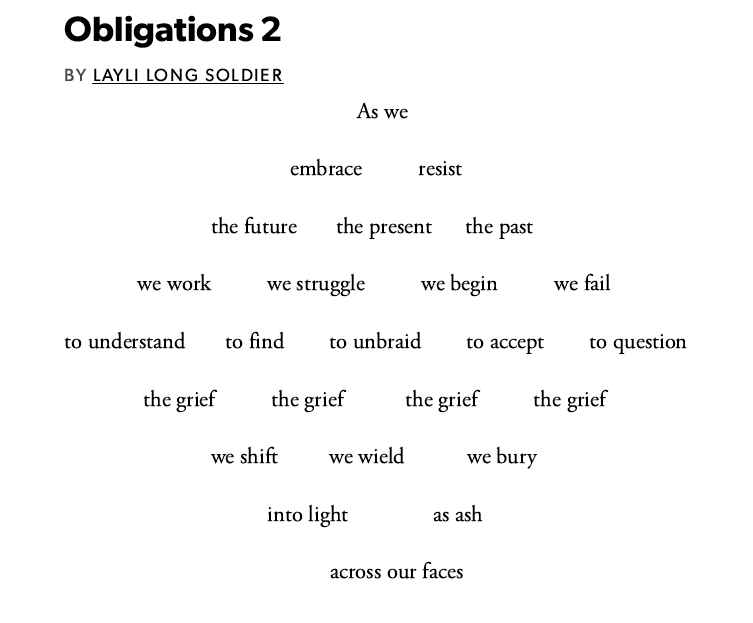
Our text for this session was the poem Obligations 2 by Layli Long Soldier, posted below.

Our prompt for this session was: โ€œAs we embrace” or “As we resistโ€

More details on this session will be posted, so check back!

Participants are warmly encouraged to share what you wrote below (โ€œLeave a Replyโ€), to keep the conversation going here, bearing in mind that the blog of course is a public space where confidentiality is not assured.

Also, we would love to learn more about your experience of these sessions, so if youโ€™re able, please take the time to fill out a follow-up survey of one to two quick questions!

Please join us for our next session Monday August 2nd at 6pm EDT, with more times listed on our Live Virtual Group Sessions page.


 Obligations 2 by Layli Long Soldier


Live Virtual Group Session: 6PM EDT July 26th 2021

Thank you to everyone who joined for this session!

Our text for this session was the poemย Dead Starsย byย Ada Limรณn,ย posted below.

Our prompt for this session was: โ€œWrite/list demands to launch into the sky.โ€

More details on this session will be posted, so check back!

Participants are warmly encouraged to share what you wrote below (โ€œLeave a Replyโ€), to keep the conversation going here, bearing in mind that the blog of course is a public space where confidentiality is not assured.

Also, we would love to learn more about your experience of these sessions, so if youโ€™re able, please take the time to fill out a follow-up survey of one to two quick questions!

Please join us for our next sessionย Friday July 30th atย 12pm EDT,ย with more times listed on ourย Live Virtual Group Sessionsย page.


Dead Starsย byย Ada Limรณn

Out here, thereโ€™s a bowing even the trees are doing.
                 Winterโ€™s icy hand at the back of all of us.
Black bark, slick yellow leaves, a kind of stillness that feels
so mute itโ€™s almost in another year.

I am a hearth of spiders these days: a nest of trying.

We point out the stars that make Orion as we take out
       the trash, the rolling containers a song of suburban thunder.

Itโ€™s almost romantic as we adjust the waxy blue
       recycling bin until you say, Man, we should really learn
some new constellations.

And itโ€™s true. We keep forgetting about Antlia, Centaurus,
       Draco, Lacerta, Hydra, Lyra, Lynx.

But mostly weโ€™re forgetting weโ€™re dead stars too, my mouth is full
       of dust and I wish to reclaim the risingโ€”

to lean in the spotlight of streetlight with you, toward
       whatโ€™s larger within us, toward how we were born.

Look, we are not unspectacular things.
       Weโ€™ve come this far, survived this much. What

would happen if we decided to survive more? To love harder?

What if we stood up with our synapses and flesh and said, No.
     No, to the rising tides.

Stood for the many mute mouths of the sea, of the land?

What would happen if we used our bodies to bargain

for the safety of others, for earth,
                 if we declared a clean night, if we stopped being terrified,

if we launched our demands into the sky, made ourselves so big
people could point to us with the arrows they make in their minds,

rolling their trash bins out, after all of this is over?

Encuentros virtuales en vivo: Sรกbado 24 de Julio, 13:00 EST (17:00 UTC)

Asistieron 5 participantes representando a los paรญses de Argentina, Colombia, Espaรฑa, Estados Unidos y Uruguay. El texto elegido fue โ€œSรฉ todos los cuentosโ€ del poeta espaรฑol Leรณn Felipe.ย 

La discusiรณn se centrรณ en el significado de la palabra โ€œcuentoโ€. En espaรฑol, la palabra โ€œcuentoโ€ se puede entender en el sentido de narrativa y discurso social por un lado y en el sentido cultural de โ€œembusteโ€ o โ€œengaรฑoโ€ por otro. Al principio, la mayorรญa de los participantes le dieron este รบltimo sentido, como si el poeta se quejara de haber sido โ€œengaรฑadoโ€ toda su vida con los cuentos y retรณrica de la sociedad. En esta interpretaciรณn, la palabra โ€œcuentosโ€ tenรญa la funciรณn de โ€œcontrolarโ€ o โ€œreprimir una rebeliรณn socialโ€ dijo una participante. Los participantes que hicieron esta observaciรณn se basaron en el contexto histรณrico en que fue escrito el poema. 

Sin embargo, otra participante nos dio una perspectiva diferente. Ella notรณ que para desmentir el impacto del engaรฑo social de los โ€œcuentosโ€, el poeta escribe su propia narrativa de vida donde lo mรกs valorado es su experiencia de vida. De esta manera, el poeta afirma su experiencia subjetiva como fuente de conocimiento. Pero, paradรณjicamente, para establecer su  valoraciรณn subjetiva, el poeta necesita hacerlo  escribiendo su propio cuento, es decir su propia narrativa de vida: โ€œYo no sรฉ muchas cosas es verdad. Digo tan sรณlo lo que he visto. Y he visto que โ€ฆโ€  La nueva interpretaciรณn de esta participante nos enriqueciรณ a todos, ya que no habรญamos pensado antes que el poema estuviera construido como un cuento dentro de otro cuento, como un mandala, o como  las famosas โ€œmuรฑecas rusasโ€ (en dรณnde una muรฑeca contiene a la otra),  segรบn observรณ otra participante.

Despuรฉs de este intercambio productivo, escribimos por cinco minutos segรบn la consigna en base al poema. La consigna fue โ€œEscribe sobre ese cuento o historia que tรบ creรญas o pretendรญas conocer.โ€ Luego, invitamos a los participantes  a leer exactamente lo que habรญan escrito sin preocuparse de tener que producir un texto literario. Como metodologรญa de la medicina narrativa, el comentario sobre los textos de los participantes se enfoca no sรณlo en el contenido sino especialmente en la forma y estilo de los textos. La consigna motivรณ a los participantes a hacer asociaciones tanto sobre sus vidas personales como sus vidas profesionales. De los textos escritos por los participantes surgieron reflexiones acerca de cรณmo los cuentos, en el sentido de prejuicios sociales, pueden comprometer la asistencia de salud a ciertas personas a quienes se estigmatiza por su apariencia fรญsica o su comportamiento. Finalmente los participantes reflexionaron sobre el hecho de que los textos siempre estรกn abiertos a nuevas interpretaciones porque es imposible cubrir todas las interpretaciones. Por eso es necesario estar conscientes de que al hacer una interpretaciรณn, si bien estamos favoreciendo una idea tambiรฉn estamos oscureciendo otra. 

Aquรญ, ahora alentamos a los participantes que si asรญ lo desean, compartan lo que escribieron a continuaciรณn. Deja tu respuesta aquรญ, si deseas continuar la conversaciรณn sobre el poema de Leรณn Felipe. Pero antes, les recomendamos tener en cuenta que el blog es un espacio pรบblico donde, por supuesto, no se garantiza la confidencialidad.

Por favor, รบnase a nosotros en nuestra prรณxima sesiรณn en espaรฑol: El sรกbado 14 de agosto a las 13 hrs. o a la 1 pm EST. Tambiรฉn, ofrecemos sesiones en inglรฉs. Ve aย  nuestra pรกgina de sesiones grupales virtuales en vivo.

ยกEsperamos verte pronto!


Sรฉ todos los cuentos, por Leรณn Felipe

Yo no sรฉ muchas cosas, es verdad.
Digo tan sรณlo lo que he visto.
Y he visto:
Que la cuna del hombre la mecen con cuentos,
que los gritos de angustia del hombre los ahogan
con cuentos,
que el llanto del hombre lo taponan con cuentos,
que los huesos del hombre los entierran con 
cuentos,
y que el miedo del hombre...
ha inventado los cuentos.
Yo no sรฉ muchas cosas, es verdad,
pero me han dormido con todos los cuentos...
y sรฉ todos los cuentos. 

Live Virtual Group Session: 12PM EDT July 21st 2021

Thank you to everyone who joined for this session!

Our text for this session was the poemย Everything We Left Behind by Manasi Garg,ย posted below.

Our prompt for this session was: โ€œWrite about shedding the years”

More details on this session will be posted, so check back!

Participants are warmly encouraged to share what you wrote below (โ€œLeave a Replyโ€), to keep the conversation going here, bearing in mind that the blog of course is a public space where confidentiality is not assured.

Also, we would love to learn more about your experience of these sessions, so if youโ€™re able, please take the time to fill out a follow-up survey of one to two quick questions!

Please join us for our next sessionย Monday July 26th atย 6pm EDT,ย with more times listed on ourย Live Virtual Group Sessionsย page.


Everything We Left Behind by Manasi Garg

In my dreams, my grandmother and I are 
bodies of fat and light and we clasp our hands so 
tightly that even God knows to cry. I am in love
with her and her marbled flesh. We walk through her first home.
Cursed city. I watch her shed the years, watch them whisper into the clouds 
like linens drying under the hot sun. Here is her house that burned down. 
Here is the temple next to the fruit orchard. Here is where the 
neighbors threw rocks. She was only 11 when 
the world ended. Pakistan, 1947. She tells me the men would rather
drown their daughters than let them be taken. 
I picture a thousand Ophelias: the white dresses billowing,
the river water scything their breathless skin in rivulets, their heads
bobbing up and down Ravi River like a string of pearls. 
I wonder if they filled their pockets with stones or if they just accepted
the darkness, the finality of it all: if they wanted it, if it felt like a
motherโ€™s womb, if they were aching to return home.