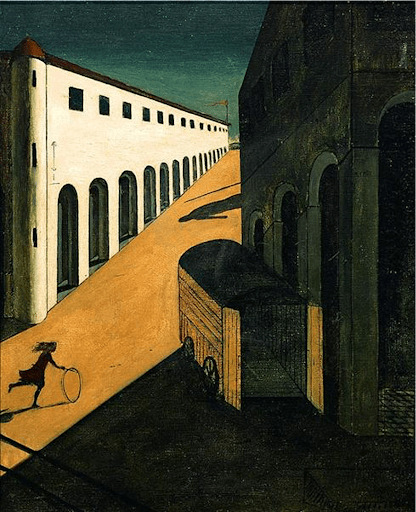

Abbiamo studiato il quadro, ยซMistero e malinconia di una stradaยป del 1914 e una replica tarda degli fine anni sessanta, entrambi eseguiti da Giorgio De Chirico (allegati al termine di questa pagina).
In seguito, abbiamo proposto il prompt: “Scrivi della strada che รจ di fronte a teโฆโ.
Condivideremo ulteriori dettagli della sessione nei prossimi giorni; vi invitiamo a rivisitare questa pagina nei prossimi giorni!
Invitiamo i partecipanti del laboratorio a condividere i propri scritti nella parte “blog” dedicata alla fine della presente pagina (“Leave a Reply”). Speriamo di creare, attraverso questo forum di condivisione, uno spazio in cui continuare la nostra conversazione!
Stiamo raccogliendo impressioni e breve feedback sui nostri laboratori di medicina narrativa su Zoom!
Questo breve questionario (anonimo, e aperto a chiunque abbia frequentato almeno un laboratorio) รจ molto importante per noi, e ci permetterร di elaborare sul valore dei nostri laboratori e sul ruolo dello spazio per riflettere e metabolizzare il momento presente. Vi preghiamo quindi di condividere le nostre riflessioni con noi!
โMistero e malinconia di una stradaโ (1914)โMistero e malinconia di una stradaโ (circa fine anni sessanta)
Asistieron 8 participantes desde Argentina, Chile, Espaรฑa, y Estados Unidos. Tuvimos una sesiรณn muy divertida en espaรฑol.
Hicimos una lectura atenta de una fotografรญa con el tรญtulo, โDos Dimensionesโ, de Andi Halil, Indonesia. El carรกcter multifacรฉtico de la fotografรญa despertรณ mรบltiples lecturas en los participantes. Lo primero que notamos fue que era en blanco y negro, que la falta de color nos hace reflejarnos hacia adentro. Detrรกs de cada imagen hay algo mรกs, algo que nos llama a preguntar el significado verdadero de lo que estamos viendo. Mirando la foto mรกs de cerca, no sabemos si las dos imagines son de la misma persona (chicos). Una participante notรณ que la primera imagen en la fotografรญa es de un espejo o una foto trucada. Otra persona mencionรณ que es como si fuera un fenรณmeno de metaforizar la ilusiรณn de ver algo, que es compuesto y con dimensiones o relieves, aunque puede parecer como una construcciรณn superpuesta. Notando el espejo, alguien comentรณ que ahรญ tenemos la razรณn por el tรญtulo era โDos Dimensiones.โ Un participante mencionรณ que mirando a las dos partes rotas, una parte no concuerda con la otra. Asรญ que posiblemente estamos viendo a tres chicos o al menos la foto del niรฑo (si es que es barรณn) estรก cortada de forma que no se puede juntar.
Consideramos las diversas dimensiones de la fotografรญa. Una participante hizo la analogรญa que analizando esta foto es como mirando a una radiografรญa, hay que mirar a ambos lados o ambas imagines. ยฟQuรฉ se ve? ยฟSufrimiento u otra cosa? Muchos participantes pensaron que vieron sufrimiento que los chicos no pueden contar o expresar. Otro participante comento que quizรกs la imagen muestra una parte de la vida, infancia rota por lo que se ve la mirada seca; no hay brillo en la mirada de la niรฑa. ยฟQuizรกs un reflejo de los problemas sociales del paรญs/zona? La niรฑa mantiene el silencio, pero el niรฑo no, aunque no estamos seguros si la imagen de atrรกs es una niรฑa; muchos pensamos que si era una niรฑa. Esto puedo ser por los roles estereotรญpicos de los gรฉneros.
Un participante mencionรณ que veรญa muchas caras en la misma persona. Y otra dijo que solo vemos el lado izquierdo en todas las imรกgenes. Con toda la fragmentaciรณn, se ve una personaโuna persona que sufre. Nos recuerda que hay que tener compasiรณn para el prรณjimo. Estuvimos de acuerdo que podrรญamos debatir sobre esta fotografรญa todo el dรญa.
La propuesta de escritura fue โEscribe sobre lo inexpresableโ.ย Algunos participantes compartieron sus textos que hablaban de lo que siente uno tan personal, por lo que es propio, vivido, y real. Sin saberlo, un participante escribiรณ una respuesta a otra participante en su escritura. Otra participante comentรณ que le recuerda a la fotografรญa y algo que una persona le habรญa dicho recientemente, que en vez de tener empatรญa hay que tener compasiรณn. Muchas veces no se necesita palabrasโcon un abrazo es suficiente. ยฟQuรฉ es inexpresable? Se necesita complicidad, se necesita el otro para expresar lo mรกs difรญcil para compartir.
Aquรญ, ahora alentamos a los participantes que si asรญ lo desean, compartan lo que escribieron a continuaciรณn. Deja tu respuesta aquรญ, si deseas continuar la conversaciรณn sobre el poema de Claribel Alegrรญa. Pero antes, les recomendamos tener en cuenta que el blog es un espacio pรบblico donde, por supuesto, no se garantiza la confidencialidad.
Our prompt for this session was: โWrite about wandering in your human feet.โ
More details on this session will be posted, so check back!
Participants are warmly encouraged to share what you wrote below (โLeave a Replyโ), to keep the conversation going here, bearing in mind that the blog of course is a public space where confidentiality is not assured.
Also, we would love to learn more about your experience of these sessions, so if youโre able, please take the time to fill out a follow-up survey of one to two quick questions!
โFor Calling the Spirit Back from Wandering the Earth in Its Human Feetโ by Joy Harjo
Put down that bag of potato chips, that white bread, that bottle of pop.
Turn off that cellphone, computer, and remote control.
Open the door, then close it behind you.
Take a breath offered by friendly winds. They travel the earth gathering essences of plants to clean.
Give it back with gratitude.
If you sing it will give your spirit lift to fly to the starsโ ears and back.
Acknowledge this earth who has cared for you since you were a dream planting itself precisely within your parentsโ desire.
Let your moccasin feet take you to the encampment of the guardians who have known you before time, who will be there after time. They sit before the fire that has been there without time.
Let the earth stabilize your postcolonial insecure jitters.
Be respectful of the small insects, birds and animal people who accompany you.
Ask their forgiveness for the harm we humans have brought down upon them.
Donโt worry.
The heart knows the way though there may be high-rises, interstates, checkpoints, armed soldiers, massacres, wars, and those who will despise you because they despise themselves.
The journey might take you a few hours, a day, a year, a few years, a hundred, a thousand or even more.
Watch your mind. Without training it might run away and leave your heart for the immense human feast set by the thieves of time.
Do not hold regrets.
When you find your way to the circle, to the fire kept burning by the keepers of your soul, you will be welcomed.
You must clean yourself with cedar, sage, or other healing plant.
Cut the ties you have to failure and shame.
Let go the pain you are holding in your mind, your shoulders, your heart, all the way to your feet. Let go the pain of your ancestors to make way for those who are heading in our direction.
Ask for forgiveness.
Call upon the help of those who love you. These helpers take many forms: animal, element, bird, angel, saint, stone, or ancestor.
Call your spirit back. It may be caught in corners and creases of shame, judgment, and human abuse.
You must call in a way that your spirit will want to return.
Speak to it as you would to a beloved child.
Welcome your spirit back from its wandering. It may return in pieces, in tatters. Gather them together. They will be happy to be found after being lost for so long.
Your spirit will need to sleep awhile after it is bathed and given clean clothes.
Now you can have a party. Invite everyone you know who loves and supports you. Keep room for those who have no place else to go.
Make a giveaway, and remember, keep the speeches short.
Then, you must do this: help the next person find their way through the dark.
Reprinted from Conflict Resolution for Holy Beings by Joy Harjo.
Copyright ยฉ 2015 by Joy Harjo.
Our prompt for this session was: โWrite about honoring the ancestors.โ
More details on this session will be posted, so check back!
Participants are warmly encouraged to share what you wrote below (โLeave a Replyโ), to keep the conversation going here, bearing in mind that the blog of course is a public space where confidentiality is not assured.
Also, we would love to learn more about your experience of these sessions, so if youโre able, please take the time to fill out a follow-up survey of one to two quick questions!
Our prompt for this session was: โMinds unraveling.โ
More details on this session will be posted, so check back!
Participants are warmly encouraged to share what you wrote below (โLeave a Replyโ), to keep the conversation going here, bearing in mind that the blog of course is a public space where confidentiality is not assured.
Also, we would love to learn more about your experience of these sessions, so if youโre able, please take the time to fill out a follow-up survey of one to two quick questions!
โAll Hallowsโ Eveโ by Dorothea Tanning
Be perfect, make it otherwise.
Yesterday is torn in shreds.
Lightningโs thousand sulfur eyes
Rip apart the breathing beds.
Hear bones crack and pulverize.
Doom creeps in on rubber treads.
Countless overwrought housewives,
Minds unraveling like threads,
Try lipstick shades to tranquilize
Fears of age and general dreads.
Sit tight, be perfect, swat the spies,
Donโt take faucets for fountainheads.
Drink tasty antidotes. Otherwise
You and the werewolf: newlyweds.
Our prompt for this session was: โWrite about a person who surprised you.โ
More details on this session will be posted, so check back!
Participants are warmly encouraged to share what you wrote below (โLeave a Replyโ), to keep the conversation going here, bearing in mind that the blog of course is a public space where confidentiality is not assured.
Also, we would love to learn more about your experience of these sessions, so if youโre able, please take the time to fill out a follow-up survey of one to two quick questions!
You Are Old, Father William by Lewis Carroll
"You are old, father William," the young man said,
"And your hair has become very white;
And yet you incessantly stand on your head โ
Do you think, at your age, it is right?"
"In my youth," father William replied to his son,
"I feared it would injure the brain;
But now that I'm perfectly sure I have none,
Why, I do it again and again."
"You are old," said the youth, "as I mentioned before,
And have grown most uncommonly fat;
Yet you turned a back-somersault in at the door โ
Pray, what is the reason of that?"
"In my youth," said the sage, as he shook his grey locks,
"I kept all my limbs very supple
By the use of this ointment โ one shilling the box โ
Allow me to sell you a couple."
"You are old," said the youth, "and your jaws are too weak
For anything tougher than suet;
Yet you finished the goose, with the bones and the beak โ
Pray, how did you manage to do it?"
"In my youth," said his father, "I took to the law,
And argued each case with my wife;
And the muscular strength, which it gave to my jaw,
Has lasted the rest of my life."
"You are old," said the youth; one would hardly suppose
That your eye was as steady as ever;
Yet you balanced an eel on the end of your nose โ
What made you so awfully clever?"
"I have answered three questions, and that is enough,"
Said his father; "don't give yourself airs!
Do you think I can listen all day to such stuff?
Be off, or I'll kick you down stairs!"
Our prompt for this session was: โWrite an imagined history of an ancestor.โ
More details on this session will be posted, so check back!
Participants are warmly encouraged to share what you wrote below (โLeave a Replyโ), to keep the conversation going here, bearing in mind that the blog of course is a public space where confidentiality is not assured.
Also, we would love to learn more about your experience of these sessions, so if youโre able, please take the time to fill out a follow-up survey of one to two quick questions!
Ainโt no way you could know this, but you were the first of us to set foot on the land that became the state where I was born โ Oregon. And now here we are, strangers but not estranged, more like kindred, more like forevermore tethered to terra firma by death date and birth date. Yours: August 16, 1788. Mine: August 16, 1975. Here I am centuries after your death, wanting to share with you what has become of the place where you gasped your last breath and I gloried my first.
Thereโs much I donโt know about your living-and-breathing in Cape Verde, so Iโve envisioned what it was like, have pictured you hanging near the ports โ burnished, famished bleary-eyed โ proclaiming to anybody with ears that youโd board a ship bound for the New World and change forevermore your fortune. Then Captain Robert Gray and his crew docked their sloop for a little R&R and refitting. The way I picture it, Gray trekked inland and highsighted about how historic his voyage would be, and how heโd captain Lady Washington around the Cape Horn and through the Drake Passage to Americaโs west coast to trade trinkets for furs and sail on to China, about how he was looking to add a new member to his small crew. As I imagine it, his notice sounded to you like the ocean looked in your dreams. So, you fat-mouthed to Gray and crew how much you knew about seafaring, how quick you could learn what you didnโt know, big-upped how good you were with your hands, how able a swimmer you were, the super thew in your thin arms and legs, declared if there was a challenge to be met, youโd meet it, so help you God!
Whatever your pitch, sure enough you were soon aboard the ship and sailing around the horn for this New World. What were those days like? Did you expect to watch the sunset over the horizon, to witness a full moon in a sky spent with stars, to hear the music of the sails catching the wind, but instead sorrowed over gales bashing the yards, a tempest tossing the ship on her broadside, Gray yelling, โAll hands on deckโ?
Our prompt for this session was: โWrite about knowing that the world is alive.โ
More details on this session will be posted, so check back!
Participants are warmly encouraged to share what you wrote below (โLeave a Replyโ), to keep the conversation going here, bearing in mind that the blog of course is a public space where confidentiality is not assured.
Also, we would love to learn more about your experience of these sessions, so if youโre able, please take the time to fill out a follow-up survey of one to two quick questions!
Powers, Richard. Bewilderment. 2021. New York: W.W. Norton. [page 173]
Yet Kepler never saw a single planet straight on. It cast a wide net, watching for the faintest imaginable dimming of suns many parsecs away, and it gathered that light with a precision of a couple dozen parts per million. Infinitesimal dips in the brightness of stars betrayed invisible planets passing in front of them. It still stupefies me: like seeing a moth crawl across a streetlight from thirty thousand miles away.
But Kepler couldnโt give me what I wanted: to know, beyond all doubt, that one other world out there was alive. I donโt know why it meant so much to me, when it left so many people cold. Not even my wife really cared all that much one way or another. Robbie did.
To know for certain whether a planet breathed, we needed direct infrared images fine enough to yield detailed spectral fingerprints of their atmospheres. We had the power to get them. For longer than Robbie had been aliveโlonger than Aly and I were togetherโIโd been one of the researchers planning a space-based telescope that could populate my every model and decide forever whether the universe was barren or alive. The craft we were backing was a hundred times more powerful than Hubble. It made our best existing telescopes look like old men with dark glasses and service dogs.
It was also a wild fling of cash and effort that made no practical difference in the world. It wouldnโt enrich the future or cure a single disease or protect anyone from the rising flood of our craziness. It would simply answer the thing we humans had been asking since we came down from the trees: was the mind of God inclined toward life, or did we Earthlings have no business being here?
Estรกbamos 6 participantes desde Nueva York, Islas Canarias, y Argentina. Tuvimos algunos problemas de conexiรณn que dificultaron el debate, pero a pesar de ello, nos enriquecimos mutuamente.ย
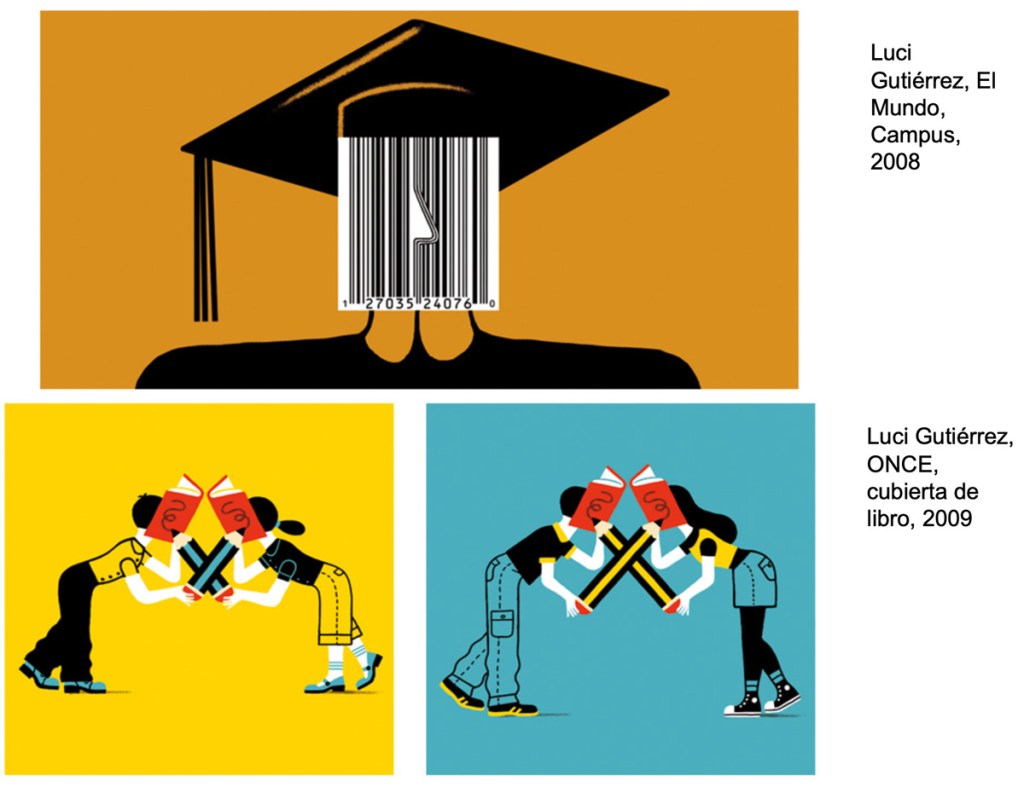
Elegimos imรกgenes de Luci Gutiรฉrrez, ilustradora espaรฑola, que combinamos para la sesiรณn de hoy, publicadas en el periรณdico el Mundo, en 2008 y en una cubierta de un libro para la ONCE, en 2009.
La primera imagen nos invitรณ a pensar sobre la Imagen sin rostro, solo un cรณdigo de barras. Los cรณdigos de barras solo son leรญdos por mรกquinas. Y todas las mรกquinas leen lo mismo, sin importar el dรณnde y el cuรกndo. Muestra un egresado que se convierte en un nรบmero que va a cumplir a su funciรณn. Pero el ser humano se levanta cada dรญa con unโcรณdigo de barrasโ diferente que solo puede leer otro ser humano. Es un dibujo que informatiza e iguala a todos los seres humanos. Graduamos a seres uniformes. Sin embargo, la nariz asoma modificando el cรณdigo. Tener la capacidad de romper/luchar, la pequeรฑa rebeldรญa. Pero alguien apunta que si intentas salir, igual no existes. Si no cumples con la mayorรญa, darรกs error. Pero igual eso es lo que queremos. ยฟEs mรกs importante romper lo normal y aportar cosas diferentes? ยฟEs posible vivir siendo diferente?
Las segundas imรกgenes provocan reacciones diferentes en los participantes. Impresionan de โigualdadโ, cada uno escribe la historia del otro, son iguales. Pero tambiรฉn es posible que sea una imagen de cรณmo se escribe la historia desde fuera. Parece que los lรกpices salen desde fuera. Son complementarios, pero tambiรฉn los cuadernos de tapas rojas son una alarma del pensamiento homogรฉneo porque son iguales. Pero vistas ambas imรกgenes, parecen mostrar el paso del tiempo. Lo importante es lo que unos tienen que escribir en el cuaderno del otro. Los lรกpices cambian de tamaรฑo, porque hay mรกs historias que contar.
Todo crece en la imagen, pero no parece crecer el espacio del texto, los libros son iguales. Como si se negara la identidad, al tapar las identidades. Hay un discurso comรบn que homogeneiza las identidades, que oculta las caras. Pero tambiรฉn puede tener que ver con que estรก dirigido a ciegos. O tal vez, indica que la vida es la que es y no puede hacerse mรกs grande, mรกs larga.
Hay un discurso de identidades oprimidas. La composiciรณn parece llevar desde las imรกgenes de abajo a la superior. Creando personas que pueden terminar siendo homogรฉneas.
El tiempo pasa de una imagen a otra. El dibujo es exactamente igual, en los libros. Cambiaron todo, pero no cambiaron el dibujo que hacen en los cuadernos. Cambiaron ropa y cuerpo, pero no cambiaron su historia. Otro participante ve que, a pesar de las diferencias, mantiene la igualdad, la armonรญa. Crecer sin perder las identidades de igualdad.
Escribimos sobre los sรญmbolos que ocultan o descubren nuestros rostros. Los compaรฑeros escribieron sobre la vergรผenza, como impulsor de la ocultaciรณn. El humor como forma de hablar de eso que queremos ocultar. Los rostros que queremos ocultar y no sabemos cuรกndo. La piel como ocultaciรณn de la voces. Voces que estรกn en algรบn lugar.
Descubrimos como escribimos a la sombra del texto y cรณmo las imรกgenes muestran historias diferentes que se crean en combinaciรณn con nuestras propias historias previas.
Aquรญ, ahora alentamos a los participantes que si asรญ lo desean, compartan lo que escribieron a continuaciรณn. Deja tu respuesta aquรญ, si deseas continuar la conversaciรณn sobre las imรกgenes de Luci Gutiรฉrrez. Pero antes, les recomendamos tener en cuenta que el blog es un espacio pรบblico donde, por supuesto, no se garantiza la confidencialidad.
Our prompt for this session was: โMy paradise…โ
More details on this session will be posted, so check back!
Participants are warmly encouraged to share what you wrote below (โLeave a Replyโ), to keep the conversation going here, bearing in mind that the blog of course is a public space where confidentiality is not assured.
Also, we would love to learn more about your experience of these sessions, so if youโre able, please take the time to fill out a follow-up survey of one to two quick questions!
A Portable Paradise - by Roger Robinson
And if I speak of Paradise,
then Iโm speaking of my grandmother
who told me to carry it always
on my person, concealed, so
no one else would know but me.
That way they canโt steal it, sheโd say.
And if life puts you under pressure,
trace its ridges in your pocket,
smell its piney scent on your handkerchief,
hum its anthem under your breath.
And if your stresses are sustained and daily,
get yourself to an empty room โ be it hotel,
hostel or hovel โ find a lamp
and empty your paradise onto a desk:
your white sands, green hills and fresh fish.
Shine the lamp on it like the fresh hope
of morning, and keep staring at it till you sleep.