Thank you to everyone who joined for this session!
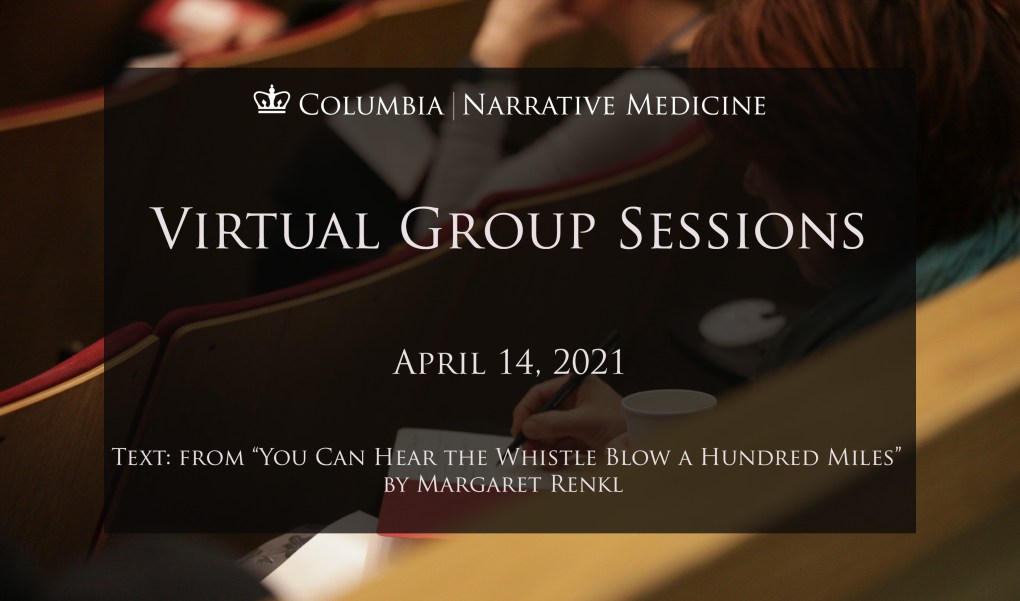
Today’s narrative journey started with an excerpt from the NY Times “Opinion” essay “You Can Hear the Whistle Blow a Hundred Miles” by Margaret Renkl, posted below. “Tell me something about this person” opened up our discussion of the female narrator who seemed to be on a train at night, and possibly in a state of uncertainty. On the surface, “I know you think I’m making this up” and “misremembering” made us consider the narrator’s reliability, and reflect on why/if that was problematic as reader/listeners. We returned to the text and recognized what was there (a book, a light, darkness, a harmonica) as well as what wasn’t there (people gazing at phones, iPads, or laptops). This created for us a sense of nostalgic sight-and-soundtracks that evoked camp songs, train songs, and a respect for the narrator’s imagination. We avoided the temptation to “diagnose” the narrator, although “My eyes suddenly too blurred to read” made us wonder if it was a moment of fatigue, sadness, crying, longing or a combination.
Our prompt for this session was: “Describe an aching kind of sound.”
One reflection was a brief-yet-detailed cinematic journey that started with a door creaking on hinges “as old as our relationship” and then shutting, as a figure lay in the bed under the sheets. We also heard a story that started with the excitement of impending birth and moved us through the fear and anxiety of labor as we heard the long, low, unearthly moan that signifies motherhood. Another reflection explored the aching sound of a childhood memory, being in bed and hearing a distant train whistle — silence that is heavy, broken by sadness and longing; but also feeling like a warm blanket, a time now lost bringing both ache and comfort. Another writer shared a moment while “chopping veggies” that quickly felt like being “cut to pieces” by the blaring sound of a song once “ours” no longer being shared. And one reflection brought us back to our present experience in “lockdown” when a plaintive melody once familiar, is now changed forever to a sound of grief for our losses.
A closing comment in the chat apropos to Narrative Medicine pointed out that each of us is like an individual instrument adding our voice or clear notes to the music, responding to the aching sounds/voices that we hear through our Narrative Work.
Participants are warmly encouraged to share what you wrote below (“Leave a Reply”), to keep the conversation going here, bearing in mind that the blog of course is a public space where confidentiality is not assured.
Also, we would love to learn more about your experience of these sessions, so if you’re able, please take the time to fill out a follow-up survey of one to two quick questions!
Please join us for our next session Monday April 19th at 6pm EDT, with more times listed on our Live Virtual Group Sessions page.
When they turned off the cabin lights and my seatmate closed her eyes to sleep, I tucked my book under my arm and made my way to the club car. There the overhead lights were off, too, but a single light shone above the table at each booth. A few people were reading. One was playing a hand of solitaire. I don’t remember if nobody was talking, or if the sound of the train moving down the tracks simply masked their quiet voices. “If you miss the train I’m on, you will know that I am gone.”
As I made my way to an open booth, darkness gathered outside the windows and in the corners of the car. Darkness swept across the floor and curled around the ceiling, and that’s when an old man at the far end of the car started to play a slow, sad song on the harmonica. It was the kind of music that fills a silence with longing and gives a voice to loneliness, and without needing any words at all. The aching kind of sound you would swear you could hear a hundred miles.
I know you think I’m making this up, or only misremembering myself as the tragic heroine of a movie where Willie Nelson plays a cameo role. But this part of the story I remember perfectly. Those thin, plaintive notes reached through the shadows and found me as I sat down alone, my eyes suddenly too blurred to read.
Margaret Renkl, You Can Hear the Whistle Blow a Hundred Miles, NYT April 2021




 Connections in Narrative Medicine