Live Virtual Group Session: 6pm EDT June 10th 2021

Thank you to everyone who joined for this session!

Our text for this session was the poemย โ€œAnother Night at Sea Levelโ€ย byย Meg Day,ย posted below.

Our prompt for this session was: โ€œWrite about a time you welcomed an adventure.โ€

More details on this session will be posted, so check back!

Participants are warmly encouraged to share what you wrote below (โ€œLeave a Replyโ€), to keep the conversation going here, bearing in mind that the blog of course is a public space where confidentiality is not assured.

Also, we would love to learn more about your experience of these sessions, so if youโ€™re able, please take the time to fill out a follow-up survey of one to two quick questions!

Please join us for our next sessionย Saturday June 12th at 11am EDT,ย with more times listed on ourย Live Virtual Group Sessionsย page.


โ€œAnother Night at Sea Levelโ€ย byย Meg Day


On the third day, I wrote to you
about the sky, its elastic way
of stretching so ocean-wide
that the only way to name it
was to compare it to Montanaโ€™s.
Lately, the sky is a ceiling
I wake to: broad & blank
& stubborn, stiff at the edges
like a fever cloth wrung out
& gone cold in the night, damp
with the wicking of latent ache.
But tonight I was walking
home along the coastline
& caught the huge moon
in my throat. Thereโ€™s a man
somewhere on the planet
who has been to that moon,
who has stepped out of that sky,
& will never sleep the same
because of it. Will always be
sad or feel small, or wonder
how it is a person can be
a person, if being a person
is worrying about things;
whose eyes cannot see
what things are, but only
the slightness of them.
I think of writing to you
in this wayโ€”welcoming
the adventure of itโ€”
& of being wrecked
proper, of being ruined.

Live Virtual Group Session: 12pm EDT June 9th 2021

Thank you to everyone who joined for this session!

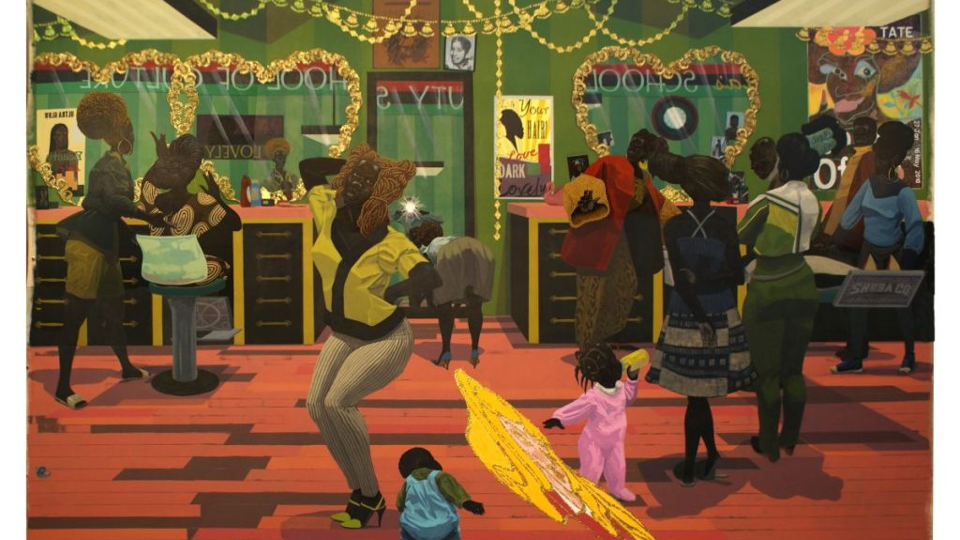
Today our session had 18 participants from across the globe and included two new attendees to the Narrative Medicine virtual workshop sessions. We introduced the painting โ€œSchool of Beauty, School of Cultureโ€ by Kerry James Marshall for 5 minutes of โ€œclose readingโ€. Participants were invited to first observe and then to take down some notes about what they were experiencing. The first discussion question asked, โ€œAs we enter this painting, where are we and whatโ€™s going on here?โ€ย 

One participant said it was a place that celebrates the beauty of hair โ€“ its natural texture and color, which recalled government policies that seek to limit or protect the freedom of expression. There is a sense of community and enjoyment in the pursuit of this expression of confident beauty, and the painting sparks feelings of joy and community. Additional comments observed the festive colors and reflective light, evoking a party atmosphere with dancing. Others observed a portrait of Rosa Parks on the wall, as well as another poster that might be subverting the idea of what beauty is due to its exaggerated features. 

A question arose about an object in the center lower half of the painting that looked like a bird, a spill of yellow color, oddly shaped and undefined. Someone thought it might be a blanket, perhaps dropped by one of the two children in the foreground, who are interacting with it. Or could it be a symbol of marketed beauty in the form of a โ€œprincess blanketโ€ depicting a blonde haired, white-skinned fairytale girl? Or was it, in fact, a reflected image on the window of a white female outside on the sidewalk looking in and taking a photograph of the woman posing near the children? A flash bulb is reflected in an interior, background mirror. Another comment referenced the famous Holbein painting with a skull floating in the same foreground area that can be discerned if you were to tilt the painting at an angle; could this be a blond, womenโ€™s visage haunting this space?ย  These observations suggested a more complicated, multi-layered story being portrayed. The sense of the interior community versus the exterior voyeuristic gaze of the observer was a provocative place to end our discussion.

Additionally, here is an annotated resource for the painting that illuminates many aspects of the painting.

Our writing prompt today was โ€œwrite about the art of finding beautyโ€. Participants began sharing their writing, which focused on such themes as living up to beauty standards and questioning who sets them. We discussed finding beauty in ourselves, finally feeling like we are โ€œenoughโ€ after being our own worst critics. One participant noted that beauty is an โ€œintrospective assignmentโ€ and a task we must all undertake for ourselves. Another participant reflected on an experience of finding beauty in a Japanese garden, where the quiet, calming beauty of the space revealed itself โ€œlike a haiku poemโ€. Finally, another participant reminded us that, if we look for it, beauty can be found all around us — โ€œI promise.โ€

Participants are warmly encouraged to share what you wrote below (โ€œLeave a Replyโ€), to keep the conversation going here, bearing in mind that the blog of course is a public space where confidentiality is not assured.

Also, we would love to learn more about your experience of these sessions, so if youโ€™re able, please take the time to fill out a follow-up survey of one to two quick questions!

Please join us for our next session Thursday June 10th at 6pm EDT, with more times listed on our Live Virtual Group Sessions page.


Live Virtual Group Session: 6pm EDT June 7th 2021

Thank you to everyone who joined for this session!

Our text for this session was an excerpt fromย โ€œInvisible Citiesโ€ by Italo Calvino,ย posted below.

Our prompt for this session was: โ€œWrite about a fascinating absence.โ€

More details on this session will be posted, so check back!

Participants are warmly encouraged to share what you wrote below (โ€œLeave a Replyโ€), to keep the conversation going here, bearing in mind that the blog of course is a public space where confidentiality is not assured.

Also, we would love to learn more about your experience of these sessions, so if youโ€™re able, please take the time to fill out a follow-up survey of one to two quick questions!

Please join us for our next sessionย Wednesday June 9th at 12pm EDT,ย with more times listed on ourย Live Virtual Group Sessionsย page.


After a seven daysโ€™ march through woodland, the traveler directed toward Baucis cannot see the city and yet he has arrived. The slender stilts that rise from the ground at a great distance from one another and are lost above the clouds support the city. You climb them with ladders. On the ground the inhabitants rarely show themselves: having already everything they need up there, they prefer not to come down. Nothing of the city touches the earth except those long flamingo legs on which it rests and, when the days are sunny, a pierced, angular shadow that falls on the foliage.

         These are three hypotheses about the inhabitants of Baucis: that they hate the earth; that they respect the earth so much that they avoid all contact; that they love it as it was before they existed and with spyglasses and telescopes aimed downward they never tire of examining it, leaf by leaf, stone by stone, ant by ant, contemplating with fascination their own absence.

Cities and Eyes (Italo Calvino, Invisible Cities, pg. 77)


Encuentros virtuales en vivo: Sรกbado 5 de Junio, 13:00 EST (17:00 UTC)

Tuvimos una muy divertida sesiรณn en espaรฑol. Atendieron 9 participantes en total, representando a estados locales (incluyendo California y Nueva York y otros paรญses (incluyendo Argentina, Espaรฑa, Chile, y Colombia).

Hicimos una lectura atenta del poema โ€œBesosโ€ de Gabriela Mistral. La complejidad del poema despertรณ mรบltiples lecturas en los participantes. Lo primero que notamos fue que el poema habla de dos tipos de besosโ€”uno conceptual sin sujeto y el otro personal, indefinible. La dualidad de los dos besos. Mirando mรกs a cerca al poema, una participante comentรณ que hay el beso bueno, el beso malo, el beso traicionero, el beso mรกs complicado, el mรกs turbulento, y el que no se debe de dar. En buscando el por quรฉ del poema, alguien notรณ que la autora demuestra mucha agonรญa y despecho hacia otra persona. Al final parece como manipulaciรณn: โ€œyo te enseรฑรฉ a besarโ€ y โ€œsangre en mis labiosโ€. Otra persona notรณ que hay mucho para analizar en el poema en tan corto tiempo. Y al final estรกn las dos preguntas pidiรฉndole al otro si se recuerda. Un participante preguntรณ, ยฟcuรกles de estas experiencias he vivido yo?

La parte que causo la mayorรญa de conversaciรณn fue la sรฉptima estrofa:

Judas besa a Jesรบs y deja impresa
en su rostro de Dios, la felonรญa,
mientras la Magdalena con sus besos
fortifica piadosa su agonรญa.

Las primeras estrofas tienen estructura parecida, pero se interrumpe cuando el poema menciona a Judas y Magdalena. A una participante le pareciรณ esta comparaciรณn disonante. Otra persona notรณ que la que es piadosa es Magdalena; contraste de lo bueno y de lo malo. Aun otro participante mencionรณ que esta estrofa es fuera de tema, รกspera. El elemento disonante del pรกrrafo de Judas y Magdalena afectรณ y molestรณ a muchos participantes. Alguien notรณ que para ella era porque la traiciรณn de Jesus cuesta la vida, despuรฉs lo que le pasa Judas, y la agonรญa de Magdalena. Aun otro participante mencionรณ que esta estrofa surge inesperadamente y hay que subjetivarlo. Otra persona dijo que en la opiniรณn de ella, hay que objetivar la imagen de Jesus. Muchos estaban de acuerdo que esta estrofa marca el quiebre de la segunda parte del poema y esta fuera del tono emocional del poema. Todos estuvimos de acuerdo que la traiciรณn es la parte mas trรกgica que puede traer el beso.

La propuesta de escritura fue โ€œEscribe sobre un besoโ€. Algunos participantes compartieron sus textos, muchos de los cuales estaban en la sombra del texto. Alguien le puso tรญtulo a su escritura, โ€œEl Ultimo Besoโ€ y hablaba del beso como, โ€œinstrumento de la muerteโ€. Otra persona escribiรณ de โ€œaquel beso [que] no valiรณ la pena.โ€ Uno sabe la intenciรณn de nuestro beso, pero no la intenciรณn de la otra persona. Otra participante escribiรณ del lenguaje del amor sin palabras y de la incertidumbre del beso. Se escribiรณ de todos los placeres y problemas que nos pueden traer los besos. Hubo ademรกs comentarios y observaciones muy detalladas que generaron un buen intercambio. ยกSin duda, se hizo corto el tiempo!  

Se alienta a las/los participantes a compartir lo que escribieron a continuaciรณn (โ€œDeja una respuestaโ€), para mantener la conversaciรณn aquรญ, teniendo en cuenta que el blog, por supuesto, es un espacio pรบblico donde no se garantiza la confidencialidad.

Por favor, รบnase a nosotros para nuestra prรณxima sesiรณn en espaรฑol: Sรกbado, 26 de junio a las 13:00 EST, con mรกs veces listadas en inglรฉs en nuestra pรกgina deย sesiones grupales virtuales en vivo.

ยกEsperamos verte pronto!


โ€œBesosโ€ por Gabriela Mistral 

Hay besos que pronuncian por sรญ solos
la sentencia de amor condenatoria,
hay besos que se dan con la mirada
hay besos que se dan con la memoria.

Hay besos silenciosos, besos nobles
hay besos enigmรกticos, sinceros
hay besos que se dan sรณlo las almas
hay besos por prohibidos, verdaderos.

Hay besos que calcinan y que hieren,
hay besos que arrebatan los sentidos,
hay besos misteriosos que han dejado
mil sueรฑos errantes y perdidos.

Hay besos problemรกticos que encierran
una clave que nadie ha descifrado,
hay besos que engendran la tragedia
cuantas rosas en broche han deshojado.

Hay besos perfumados, besos tibios
que palpitan en รญntimos anhelos,
hay besos que en los labios dejan huellas
como un campo de sol entre dos hielos.

Hay besos que parecen azucenas
por sublimes, ingenuos y por puros,
hay besos traicioneros y cobardes,
hay besos maldecidos y perjuros.


Judas besa a Jesรบs y deja impresa
en su rostro de Dios, la felonรญa,
mientras la Magdalena con sus besos
fortifica piadosa su agonรญa.

Desde entonces en los besos palpita
el amor, la traiciรณn y los dolores,
en las bodas humanas se parecen
a la brisa que juega con las flores.

Hay besos que producen desvarรญos
de amorosa pasiรณn ardiente y loca,
tรบ los conoces bien son besos mรญos
inventados por mรญ, para tu boca.

Besos de llama que en rastro impreso
llevan los surcos de un amor vedado,
besos de tempestad, salvajes besos
que solo nuestros labios han probado.

ยฟTe acuerdas del primero...? Indefinible;
cubriรณ tu faz de cรกrdenos sonrojos
y en los espasmos de emociรณn terrible,
llenรกronse de lรกgrimas tus ojos.

ยฟTe acuerdas que una tarde en loco exceso
te vi celoso imaginando agravios,
te suspendรญ en mis brazos... vibrรณ un beso,
y quรฉ viste despuรฉs...? Sangre en mis labios.

Yo te enseรฑรฉ a besar: los besos frรญos
son de impasible corazรณn de roca,
yo te enseรฑรฉ a besar con besos mรญos
inventados por mรญ, para tu boca.


Live Virtual Group Session: 12pm EDT June 4th 2021

Thank you to everyone who joined for this session!

Our text for this session was the short filmย โ€œThe Gatherersโ€ featuring violinist Kelly Hall-Tompkins and actor Daniel J. Watts,ย posted below.

Our prompt for this session was: โ€œWrite about sharing space.โ€

More details on this session will be posted, so check back!

Participants are warmly encouraged to share what you wrote below (โ€œLeave a Replyโ€), to keep the conversation going here, bearing in mind that the blog of course is a public space where confidentiality is not assured.

Also, we would love to learn more about your experience of these sessions, so if youโ€™re able, please take the time to fill out a follow-up survey of one to two quick questions!

Please join us for our next sessionย Monday June 7th at 6pm EDT,ย with more times listed on ourย Live Virtual Group Sessionsย page.


Live Virtual Group Session: 12pm EDT May 28th 2021

Thank you to everyone who joined for this session!

Our text for this session was the poemย โ€œSong for the Turtles in the Gulfโ€ byย Linda Hogan,ย posted below.

Our prompt for this session was: โ€œWrite about secret importance.โ€

More details on this session will be posted, so check back!

Participants are warmly encouraged to share what you wrote below (โ€œLeave a Replyโ€), to keep the conversation going here, bearing in mind that the blog of course is a public space where confidentiality is not assured.

Also, we would love to learn more about your experience of these sessions, so if youโ€™re able, please take the time to fill out a follow-up survey of one to two quick questions!

Please join us for our next sessionย Friday June 4th at 12pm EDT,ย with more times listed on ourย Live Virtual Group Sessionsย page.


โ€œSong for the Turtles in the Gulfโ€ byย Linda Hogan

We had been together so very long,
you willing to swim with me
just last month, myself merely small
in the ocean of splendor and light,
the reflections and distortions of us,
and now when I see the man from British Petroleum
lift you up dead from the plastic
bin of death,
he with a smile, you burned
and covered with red-black oil, torched
and pained, all I can think is that I loved your life,
the very air you exhaled when you rose,
old great mother, the beautiful swimmer,
the mosaic growth of shell
so detailed, no part of you
simple, meaningless,
or able to be created
by any human,
only destroyed.
How can they learn
the secret importance
of your beaten heart,
the eyes of another intelligence
than ours, maybe greater,
with claws, flippers, plastron.
Forgive us for being thrown off true,
for our trespasses,
in the eddies of the water
where we first walked.


Copyright ยฉ 2014 by Linda Hogan. 
From Dark. Sweet.: New and Selected Poems (Coffee House Press, 2014). 

Narrative Medicine Book Club: Passing, Conclusion and Thanks!

Carmen: “It was the smile that maddened Irene” – Did it make her mad or did it drive her to madnessย – All along we’ve seen Irene disquieted by Clare and her cavalierย ways, always getting under Irene’s skin, making her mad, making her nervous, making her afraid for a moment just like this one. We’ve seen Irene hold on tenuously to her marriage, her sense of propriety, her sense of safety. Irene lived these past pages in uncertainty, a maddening ambiguity, and in this moment of all moments when something so dramatic has happened, she may be, in fact, the only person who does knowย exactlyย what happened, having been the closest physical proximity to Clare, but yet…”What happened next, Irene Redfield never afterwards allowed herself to remember. Never clearly” And as a result, neither will we…

Derek: “Composed” and “unaware”ย  caught my attention and raised the stakes for me in this description of this social scene: Clare and Irene intersect like always, and yet somehow differently.ย 

Thank you to all the book club attendees for reading and traveling these pages with us! It was a tense and terrificย journey, and even in our final group discussion, you unearthed new details, new insights, and new interpretations of how “Passing” resonates both as timeless literature and a timely social mirror.

We look forward to reading with you again in the future!


Live Virtual Group Session: 6pm EDT May 24th 2021

Thank you to everyone who joined for this session!

Our text for this session was the poem โ€œNothing Wants to Sufferโ€ by Danusha Lamรฉris, posted below.

Our prompt for this session was: โ€œWrite what the stars see while looking down.โ€

More details on this session will be posted, so check back!

Participants are warmly encouraged to share what you wrote below (โ€œLeave a Replyโ€), to keep the conversation going here, bearing in mind that the blog of course is a public space where confidentiality is not assured.

Also, we would love to learn more about your experience of these sessions, so if youโ€™re able, please take the time to fill out a follow-up survey of one to two quick questions!

Please join us for our next session Friday May 28th at 12pm EDT, with more times listed on our Live Virtual Group Sessions page.


โ€œNothing Wants to Sufferโ€ by Danusha Lamรฉris

Nothing wants to suffer. Not the wind
as it scrapes itself against the cliff. Not the cliff

being eaten, slowly, by the sea. The earth does not want
to suffer the rough tread of those who do not notice it.

The trees do not want to suffer the axe, nor see
their sisters felled by root rot, mildew, rust. 

The coyote in its den. The puma stalking its prey.
These, too, want ease and a tender animal in the mouth

to take their hunger. An offering, one hopes, 
made quickly, and without much suffering.

The chair mourns an angry sitter. The lamp, a scalded moth.
A table, the weight of years of argument.

We know this, though we forget.

Not the shark nor the tiger, fanged as they are.
Nor the worm, content in its windowless world

of soil and stone. Not the stone, resting in its riverbed.
The riverbed, gazing up at the stars.

Least of all, the stars, ensconced in their canopy,
looking down at all of usโ€” their offspringโ€”

scattered so far beyond reach.


Copyright ยฉ 2021 by Danusha Lamรฉris. 
Originally published in Poem-a-Day on April 9, 2021, 
by the Academy of American Poets.

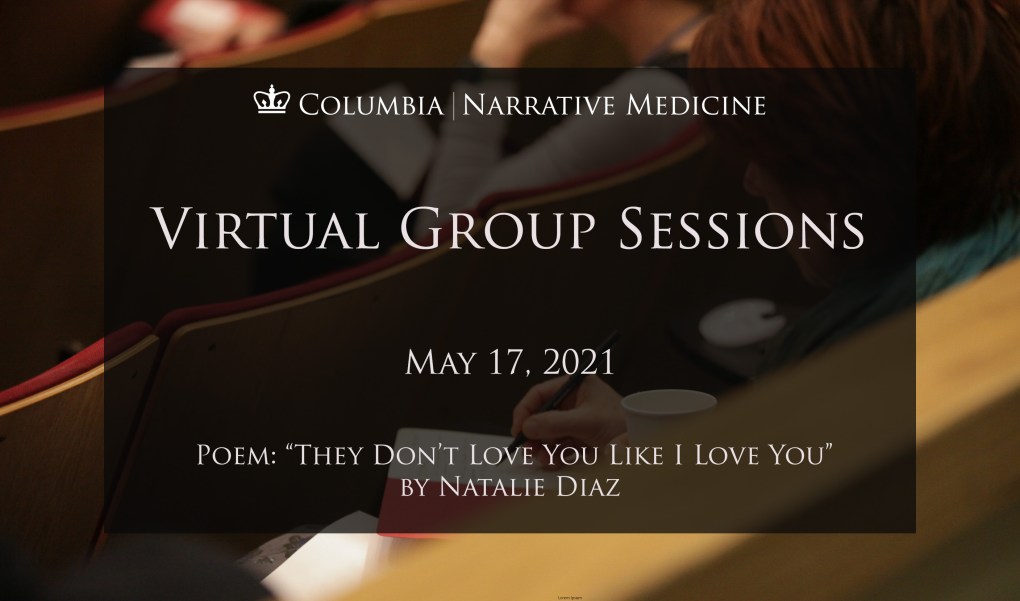
Live Virtual Group Session: 6pm EDT May 17th 2021

Thank you to everyone who joined for this session!

Our text for this session was the poemย โ€œThey Don’t Love You Like I Love Youโ€ byย Natalie Diaz, posted below.

Our prompt for this session was: โ€œWrite about wait or weight.โ€

More details on this session will be posted, so check back!

Participants are warmly encouraged to share what you wrote below (โ€œLeave a Replyโ€), to keep the conversation going here, bearing in mind that the blog of course is a public space where confidentiality is not assured.

Also, we would love to learn more about your experience of these sessions, so if youโ€™re able, please take the time to fill out a follow-up survey of one to two quick questions!

Please join us for our next sessionย Monday May 24th at 6pm EDT,ย with more times listed on ourย Live Virtual Group Sessionsย page.


They Don't Love You Like I Love You
by Natalie Diaz

My mother said this to me
long before Beyoncรฉ lifted the lyrics
from the Yeah Yeah Yeahs,

and what my mother meant by
Donโ€™t stray was that she knew
all about itโ€”the way it feels to need

someone to love you, someone
not your kind, someone white,
some one some many who live

because so many of mine
have not, and further, live on top of
those of ours who donโ€™t.

Iโ€™ll say, say, say,
What is the United States if not a clot

of clouds? If not spilled milk? Or blood?
If not the place we once were
in the millions? America is Mapsโ€”

Maps are ghosts: white and 
layered with people and places I see through.
My mother has always known best,

knew that Iโ€™d been begging for them,
to lay my face against their white
laps, to be held in something more

than the loud light of their projectors
of themselves they flickerโ€”sepia
or blueโ€”all over my body.

All this time,
I thought my mother said, Wait,
as in, Give them a little more time

to know your worth,
when really, she said, Weight,
meaning heft, preparing me

for the yoke of myself,
the beast of my countryโ€™s burdens,
which is less worse than

my countryโ€™s plow. Yes,
when my mother said,
They donโ€™t love you like I love you,

she meant,
Natalie, that doesnโ€™t mean
you arenโ€™t good.


*The italicized words, 
with the exception of the final stanza, 
come from the Yeah Yeah Yeahs song "Maps."

Copyright ยฉ 2019 by Natalie Diaz. 
Originally published in Poem-a-Day on June 20, 2019, 
by the Academy of American Poets.

Encuentros virtuales en vivo: Sรกbado 15 de Mayo, 13:00 EST (17:00 UTC)

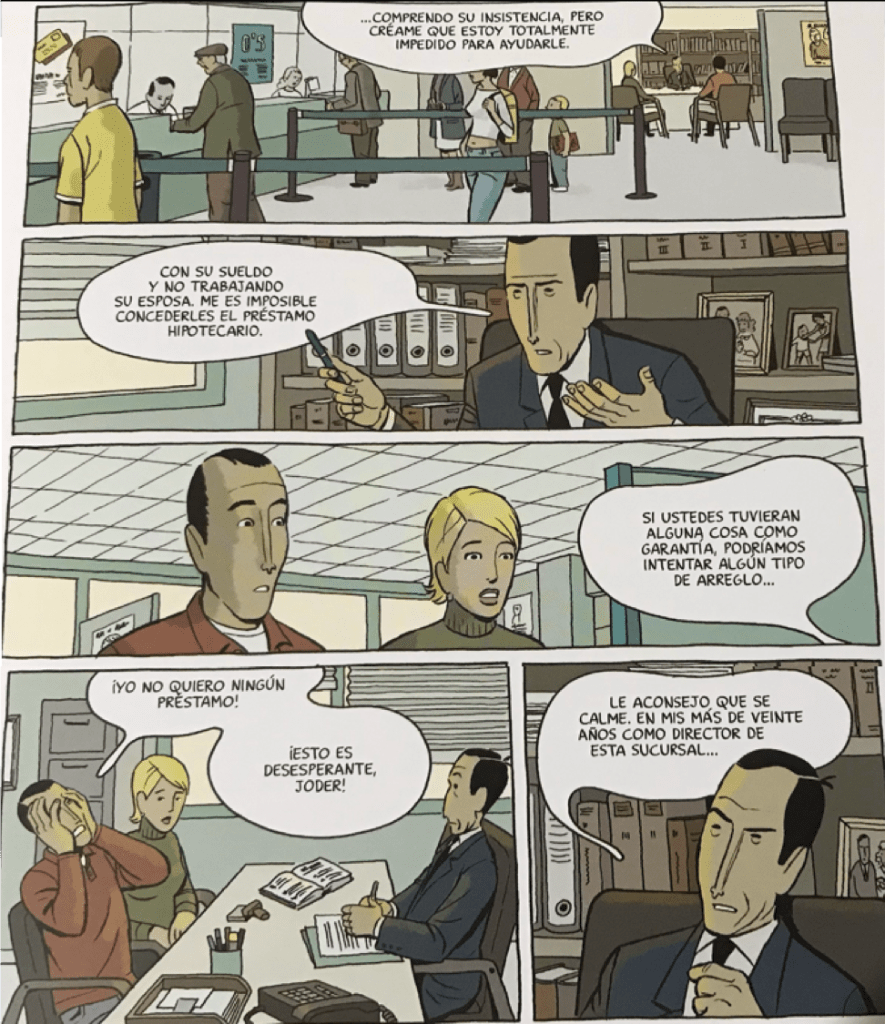
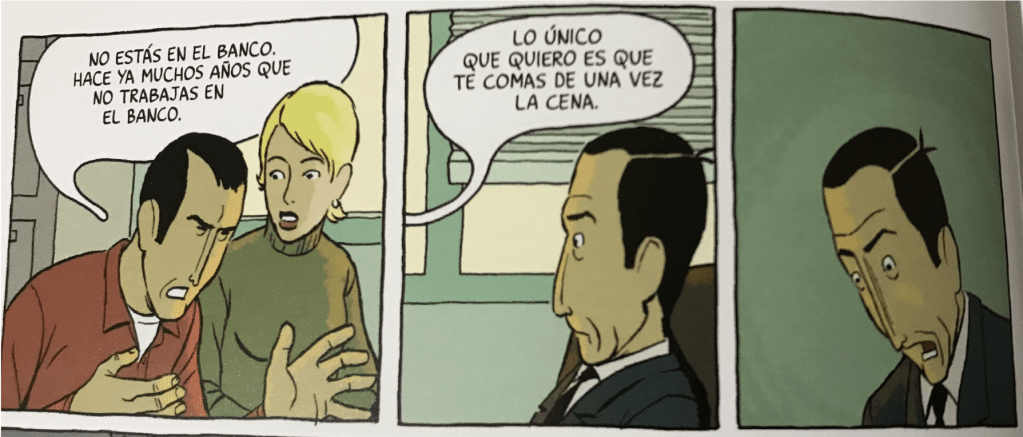
Leรญmos un fragmento de Arrugas by Paco Roca.

“Escribe sobre un momento en el que la realidad fue diferente.”

Se alienta a las/los participantes a compartir lo que escribieron a continuaciรณn (โ€œDeja una respuestaโ€), para mantener la conversaciรณn aquรญ, teniendo en cuenta que el blog, por supuesto, es un espacio pรบblico donde no se garantiza la confidencialidad.

Por favor, รบnase a nosotros para nuestra prรณxima sesiรณn en espaรฑol: a definir, con mรกs veces listadas en inglรฉs en nuestra pรกgina deย sesiones grupales virtuales en vivo.

ยกEsperamos verte pronto!