Today we celebrated our 100th English-language session, and we were thrilled to welcome at least seven first-time participants among the 33 people who joined us from around the country and around the world. Some veterans shared why they have come back, including unlocking creativity, being inspired to write again, and being part of an international community with a shared interest in discovery.
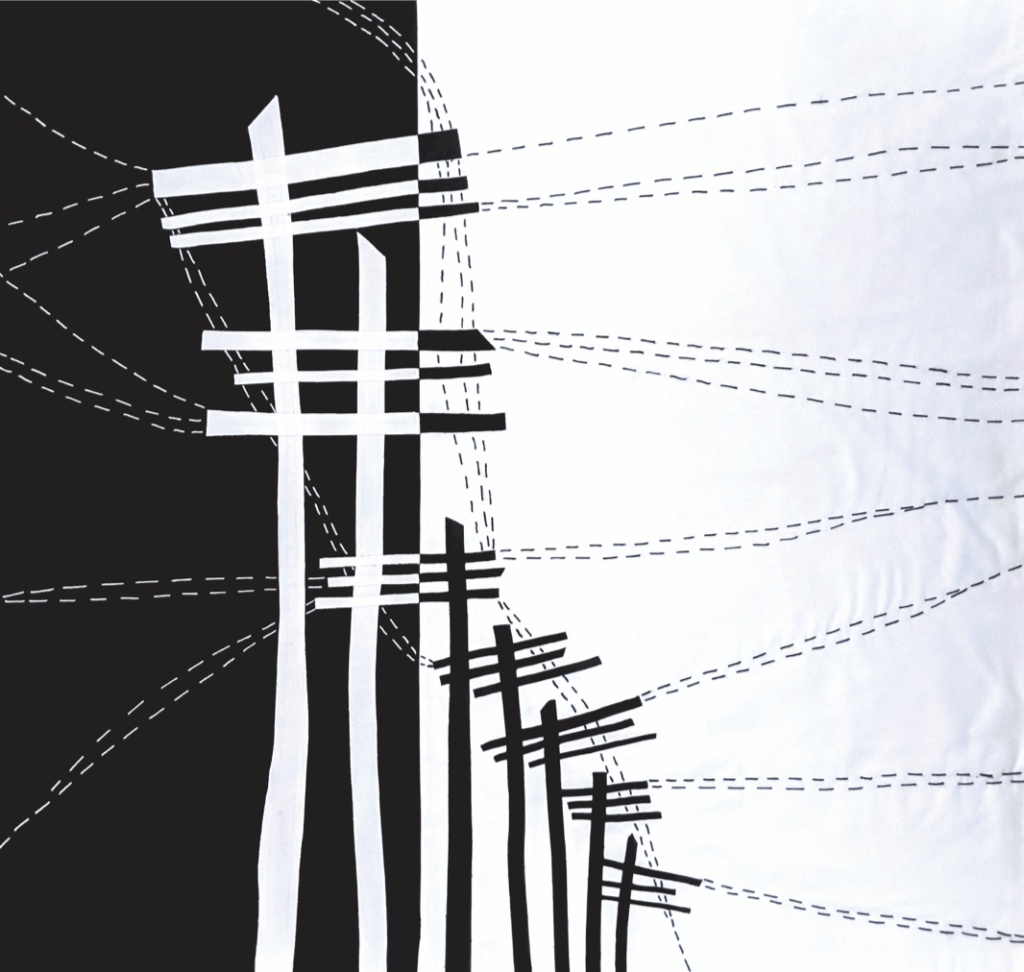
Our session centered on a genre new to these virtual sessions: a quilt. To try to experience this material object online, we looked at slides of the front and back, as well as detail of the stitching. Only at the end did we reveal that the quilt is called Lines of Communication, created in 2020 by Susan Sadilek.
We began with three questions about this text: What do you see? What do you feel? Where does it take you?
We thought about the actual objects depicted – many of us saw telephone or telegraph poles and wires, minus the birds that often perch atop them – and the division implied by the strong vertical line that defines the quilt. Its dramatic style made us question whether it was ever intended to be used traditionally, as a bed covering, or it was strictly an art piece — challenging our notion of what a “quilt” is.
We explored the graphic nature in the contrast of the black and white, and how, even looking at it online, the piece changed depending on how close we were. One person who was attending via her phone noted that she wouldn’t have known the text was a quilt had she not been told.
The angles of the lines on the front suggested an eerie, forbidding quality to some of us, while the checkered back reminded us of static. The hand-stitching was not perfectly straight and reminded us that the text had a creator, and we wondered whether the paths of the stitches were spontaneous or planned in advance. One participant wrote, “There is beauty in imperfection with the uneven stitches and frayed edges.” The visible work reminded us of the time that was spent in creating the work. We also noticed how the lines ran all the way to the edges, and presumably beyond, making us think about where they were going. The word “connection” came up again and again.
When asked to title the quilt, participants noted, “Stream of Bridges,” “Drive at Dawn,” “Life Disjointed but Joined,” and “Beyond Borders.”
The group wrote to the prompt, “Write about a connection…or disconnection” in a variety of forms, voices, cadences and tones, including verbal simplicity with stark contrast (“White to black and no looking back”), the wireless expansiveness of the internet deconstructed to the point of a tense “Sorry, our systems are down” moment in a drug store (“Can’t you just write this down?”), and a prayerful reflection (“I am lost in this world…who gets to live, who gets to die?/Who receives justice/who is downtrodden?). The last writer described an “in between day” that was a celebratory marker of time present, recognition of time past, and time “lost in the explosion of my life.”
The group expressed gratitude for the writings reminding us that we move in and out of relationships — all important in some way — in some space in time. Some threads hold and others may break — “In these times it feels like polarization (black/white) but instead quilt is about connection.”
Participants are warmly encouraged to share what you wrote below (“Leave a Reply”), to keep the conversation going here, bearing in mind that the blog of course is a public space where confidentiality is not assured.
Also, we would love to learn more about your experience of these sessions, so if you’re able, please take the time to fill out a follow-up survey of one to two quick questions!
Lines of Communication Susan Sadilek 2020 33.5” x 31.6” Telephone poles: raw edge applique (straight stitched, not zigzagged stitched) and machine quilted.
Telephone lines: hand quilted
Experimental “binding”: created by undercutting the batting and backing, then wrapping and hand stitching the front panel around the back to finish the outer edges.
Thank you to everyone who joined us for this session!
We welcomed 31 participants into our Zoom room, including at least 4 newcomers. We entered the chat sharing some of our occupations as doctors, teachers, writers, and preoccupations such as teaching online effectively or figuring out a commute in the snow.
After watching the film short “What do we have in our pockets?” by Doran Dukic (2013) and then took a few minutes to read the text of the original short story (text below) by Israeli author Edgar Keret, before sharing our impressions, thoughts, and observations. Our first commenter reported “smiling throughout the entire video” and then reading the written text in which “things got more serious” without the colors, the background music, and the upbeat narrator. Another echoed these thoughts, adding that the two versions were “two different works of art.”
One person thought that the text was about a man saying people only ask surface questions and that the man wished there was more depth to asking and wanting to get to know another. More than one participant resonated with the narrator who wanted to fill his pockets in order to be prepared. Another participant remembered feeling like a pack mule, when her children were young, and also the lovely exchanges she had with people who needed a band-aid or Kleenex or something she carried.
Another commented on the gender difference of having pockets and having a purse/bag, which feels like a burden for women to carry. Still another was disappointed that the story was an encounter between people of the opposite sex. “Why couldn’t there have been another kind of story told?” she wondered. A contrasting response expressed relief at the wish to find a girl who is ‘charming’ rather than beautiful. There was a suspicion that the title leaned on Tim O’Brien’s The Things They Carried, a very serious account of what soldiers carried in Vietnam. Someone wondered if the narrator takes the Boy Scout Motto to extremes.
Despite what she called “perked-up music”, one participant said feeling sorry for the narrator, who “sounds like he is preplanning so as not to find himself unprepared.” We wondered if “you miss out on a lot if everything has to be staged.” We talked about the many objects as possible bridges to connect with others and that “all the objects together create comfort.” Another person heard that the narrator’s list of things in his pocket could lead to a tender exchange between people.
The majority of participants expressed enjoyment while watching the short about what one man called “practical optimism” and a “tiny chance not to be embarrassed” while admitting it was only a tiny chance. “I’m not stupid,” the narrator says. We thought that “Pockets” might suggest “being open to happiness – whether it happens or not.”
Comparing the visual and the written text one person mentioned the former as a collage art. Another said, perhaps, the short story is about wish and the animation is wish fulfillment. Another said they responded to the elements of magical realism–the narrator’s pockets magical enough to hold so many things and the way the girl drops out of the sky. “The animation wasn’t quite real but wasn’t entirely out of this world.” We considered the “magic” of being young, with resources, and a willingness to freely offer those resources.
We wrote to the prompt “Write about what is in your pockets”. We read out loud the many directions in which this prompted writing led us:
after eleven months of family being together almost constantly, how reaching for Airpods offers the chance to tune out squabbling tweens and be able to listen to an author read a book. The case of the earbuds like a pocket.
still hearing a mother’s words on “how to be a lady.” The reader told us that being taught it was “bad form, a bad habit” for a woman to carry more than a Metro card in her pocket. She still carries only that slim card until using it in the subway, and then slipping even the card back in her purse with the rest of her things. “So there!” the author throws out in her final sentence.
Memories of girls having to wear skirts to school, how then the rules changed in highschool and even blue jeans were allowed. How liberating – blue jeans have pockets!
what is needed in the pockets to ski in Quebec in 2021: a face mask, Kleenex, a phone for COVID alerts, a granola bar, a health card “in case I break my neck,” and $30 “even though all the shops and restaurants are shuttered.”
the varied nature of elements in one’s pockets: a mask, hand sanitizer, scraps of paper, three pens, a penknife, a miraculous medal, a walnut palm cross (a gift from the family of a former patient), a rosary–the touch of which calms and quiets the man who carries these items.
Listening to these readings, we realized how what is in our pockets reveals identity.
Participants are warmly encouraged to share what you wrote below (“Leave a Reply”), to keep the conversation going here, bearing in mind that the blog of course is a public space where confidentiality is not assured.
Also, we would love to learn more about your experience of these sessions, so if you’re able, please take the time to fill out a follow-up survey of one to two quick questions!
A cigarette lighter, a cough drop, a postage stamp, a slightly bent cigarette, a toothpick, a handkerchief, a pen, two five-shekel coins. That’s only a fraction of what I have in my pockets. So is it any wonder they bulge? Lots of people mention it. They say, “What the fuck do you have in your pockets?” But most of the time I don’t answer, I just smile, sometimes I even give a short, polite laugh. As if someone told a joke. If they were to persist and ask me again, I’d probably show them everything I have. I might even explain why I need all that stuff on me, always. But they don’t. What the fuck, a smile, a short laugh, an awkward silence, and we’re on to the next subject.
The fact is that everything I have in my pockets is carefully chosen so I’ll always be prepared. Everything is there so I can be at an advantage at the moment of truth. Actually, that’s not accurate. Everything’s there so I won’t be at a disadvantage at the moment of truth. Because what kind of advantage can a wooden toothpick or a postage stamp really give you? But if, for example, a beautiful girl—you know what, not even beautiful, just charming, an ordinary-looking girl with an entrancing smile that takes your breath away—asks you for a stamp, or doesn’t even ask, just stands there on the street next to a red mailbox on a rainy night with a stampless envelope in her hand and wonders if you happen to know where there’s an open post office at that hour, and then gives a little cough because she’s cold, but also desperate, since deep in her heart she knows that there’s no post office in the area, definitely not at that hour, and at that moment, that moment of truth, she won’t say, “What the fuck do you have in your pockets,” but she’ll be so grateful for the stamp, maybe not even grateful, she’ll just smile that entrancing smile of hers, an entrancing smile for a postage stamp—I’d go for a deal like that anytime, even if the price of stamps soars and the price of smiles plummets.
After the smile, she’ll thank you and cough again, because of the cold, but also because she’s a little embarrassed. And I’ll offer her a cough drop. “What else do you have in your pockets?” she’ll ask, but gently, without the fuck and without the negativity, and I’ll answer without hesitation: Everything you’ll ever need, my love. Everything you’ll ever need.
So now you know. That’s what I have in my pockets. A chance not to screw up. A slight chance. Not big, not even probable. I know that, I’m not stupid. A tiny chance, let’s say, that when happiness comes along, I can say yes to it, and not “Sorry, I don’t have a cigarette/toothpick/coin for the soda machine.” That’s what I have there, full and bulging, a tiny chance of saying yes and not being sorry.
Keret, Etgar (Israel, 1967-) Translated from the Hebrew by Sondra Silverston Short. Ziegler, Alan, Ed. Persea Books: New York. 2014. Pp. 238-39.

 Connections in Narrative Medicine