Thank you to everyone who joined us for this session!
Our text for this session was “When Giving Is All We Have” by Alberto Ríos, posted below.
Our prompt was: “You gave me…”
More details about this session will be posted soon, so check back!
Participants are warmly encouraged to share what you wrote below (“Leave a Reply”), to keep the conversation going here, bearing in mind that the blog of course is a public space where confidentiality is not assured.
Also, we would love to learn more about your experience of these sessions, so if you’re able, please take the time to fill out a follow-up survey of one to two quick questions!
Please join us for our next session Monday, November 30th at 6pm EST, with more times listed on our Live Virtual Group Sessions page.
 When Giving Is All We Have  by Alberto Ríos (1952)

                                     One river gives
                                     Its journey to the next.

 We give because someone gave to us.
 We give because nobody gave to us.

 We give because giving has changed us.
 We give because giving could have changed us.

 We have been better for it,
 We have been wounded by it—

 Giving has many faces: It is loud and quiet,
 Big, though small, diamond in wood-nails.

 Its story is old, the plot worn and the pages too,
 But we read this book, anyway, over and again:

 Giving is, first and every time, hand to hand,
 Mine to yours, yours to mine.

 You gave me blue and I gave you yellow.
 Together we are simple green. You gave me

 What you did not have, and I gave you
 What I had to give—together, we made

 Something greater from the difference.
Thank you to everyone who joined us for this session!
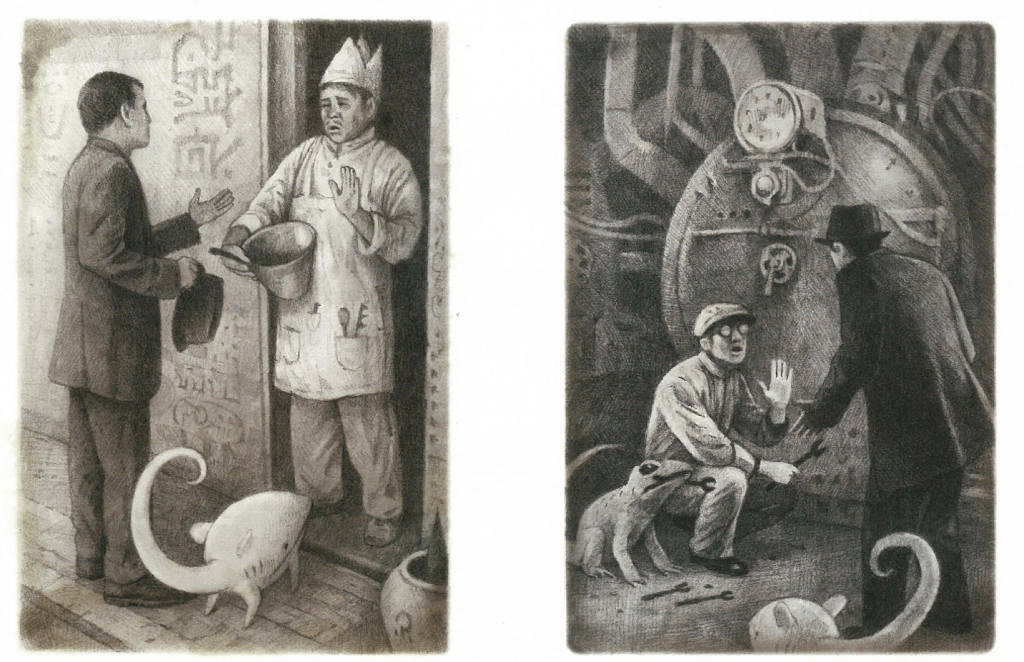
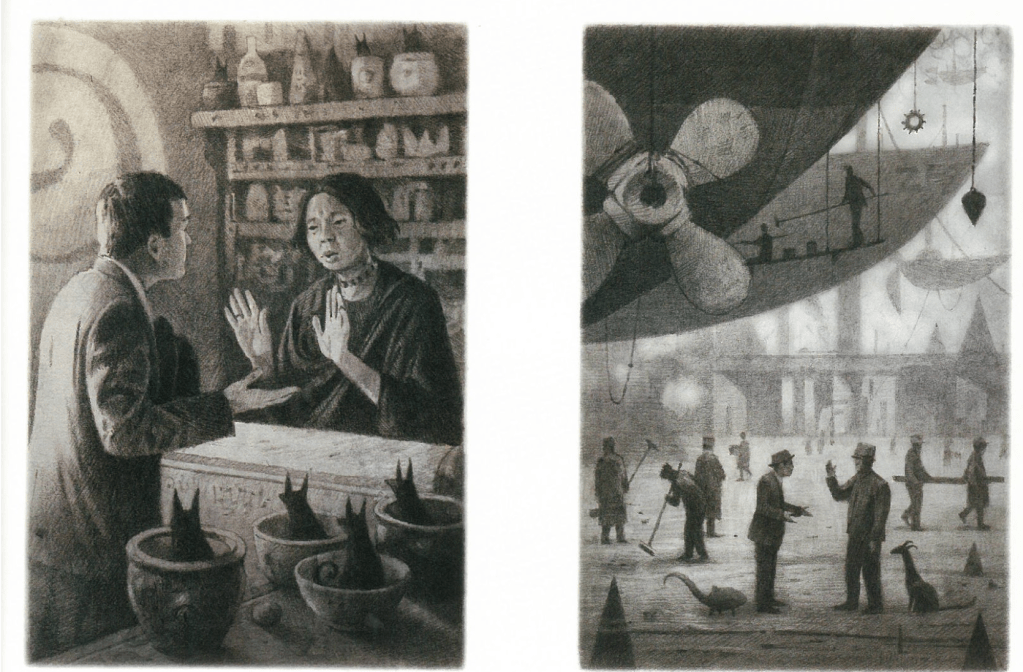
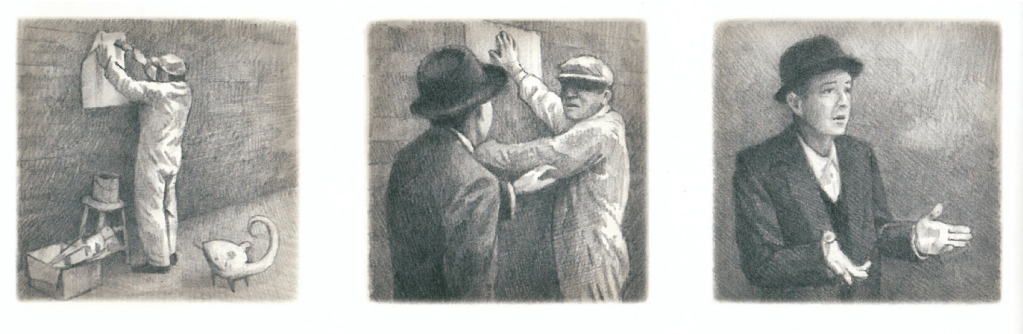
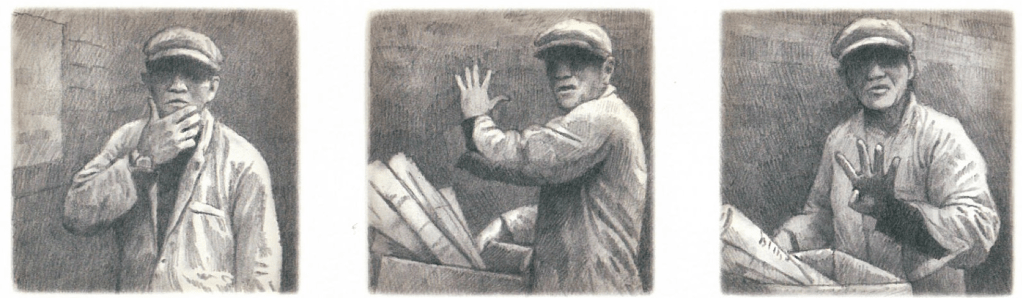
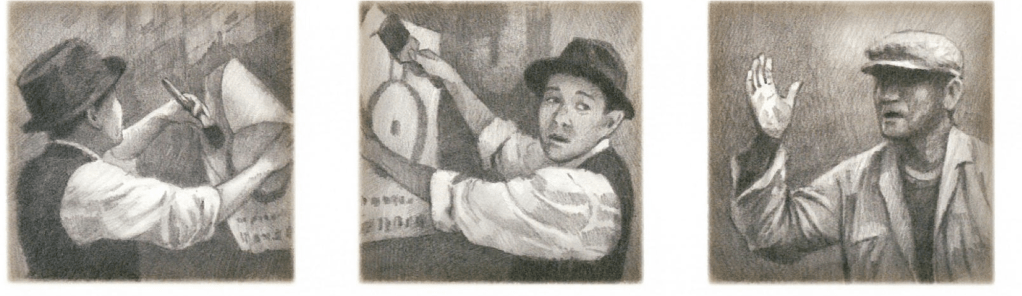
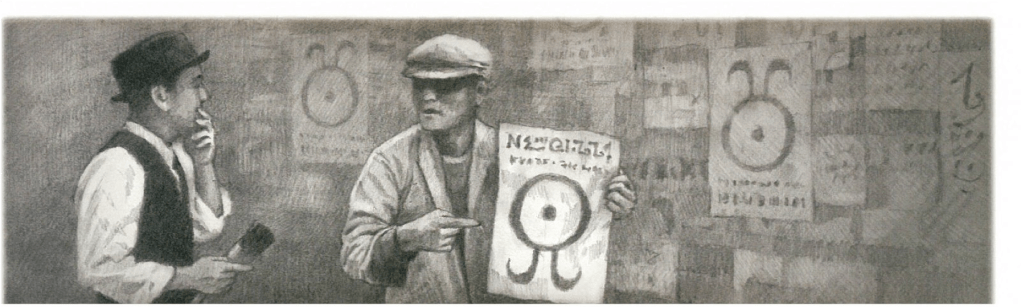
Our text for this session was an excerpt from the graphic novel “The Arrival” by Shaun Tan, posted below.
Our prompt was: “Write or draw an encounter when it was difficult to ask for what you needed.”
More details about this session will be posted soon, so check back!
Participants are warmly encouraged to share what you wrote below (“Leave a Reply”), to keep the conversation going here, bearing in mind that the blog of course is a public space where confidentiality is not assured.
Also, we would love to learn more about your experience of these sessions, so if you’re able, please take the time to fill out a follow-up survey of one to two quick questions!
Twenty-two people (including two new participants!), from Canada, Greece, ME, MI, NJ, NY, PA, OR, and UT, gathered via Zoom to discuss a prose passage from A Low and Quiet Sea (2018) by Donal Ryan, posted below. Participants imagined a parent talking to a child before bedtime. Some heard a mother speaking; others a father. One felt the narrator was speaking to her and then felt disappointed when, at the last line, she realized that the narrator was addressing someone else One explicit “rule,” which, apparently, is being repeated is “Be kind.” Because of the information about trees–how they slowly form communities, communicate, and feed each other root to root–we heard embedded in the text that patience is also being taught. Patience + Kindness = Survival. One person told the group that the oldest trees in the US is a stand of aspens in Utah. We wondered, when hearing the parent settle the child for the night and say, “Tomorrow will be long,” what would transpire in that near future. Were they going to visit grandparents, their “roots”? Or is this beginning setting a scene in a story about growing up with children separating child and parent in time and space?
Intertextually, there were references to John Lennon’s “Imagine” and the novel “Braided Sweetgrass.”
Writing for four minutes to the prompt: “Write a dialogue between two or more trees” brought rich narratives of trees, a few of which were even given names – “Marcus” and “Greenleaf”. We saw trees weathering the seasons and imagined the consciousness of trees that sometimes ignore humans and sometimes wonder why the humans do what they do and also welcome their embraces. One asked if trees are competitive, if they feel pain, and if they grieve when another tree dies. One wondered whether the trees learn something from us. Another narrative, evoking the unintentional damage that humans inflict on trees, seemed a plea to reflect and understand our stewardship of the natural world.
Participants are warmly encouraged to share what you wrote below (“Leave a Reply”), to keep the conversation going here, bearing in mind that the blog of course is a public space where confidentiality is not assured.
Also, we would love to learn more about your experience of these sessions, so if you’re able, please take the time to fill out a follow-up survey of one to two quick questions!
Please join us for our next session Wednesday, November 18th at 12pm EST, with more times listed on our Live Virtual Group Sessions page.
LET ME TELL you something about trees. They speak to each other. Just think what they must say. What could a tree have to say to a tree? Lots and lots. I bet they could talk for ever. Some of them live for centuries. The things they must see, that must happen around them, the things they must hear. They speak to each other through tunnels that extend from their roots, opened in the earth by fungus, sending their messages cell by cell, with a patience that could only be possessed by a living thing that cannot move. It would be like me telling you a story by saying one word each day. At breakfast I would say it, the word of the story, then I’d kiss you and I’d go to work and you’d go to school and all you’d have of the story is that single word each day and I would give no more until the next day, no matter how you begged. You’ll have to have the patience of a tree, I’d say. Can you imagine how that would be? If a tree is starving, its neighbors will send food. No one really knows how this can be, but it is. Nutrients will travel in the tunnel made of fungus from the roots of a healthy tree to its starving neighbor, even one of a different species. Trees live, like you and me, long lives, and they know things. They know the rule, the only one that’s real and must be kept. What’s the rule? You know. I’ve told you lots of times before. Be kind. Now sleep, my love, tomorrow will be long.
We welcomed 21 participants to our session today. Many had attended four or more times and there were three newcomers. Our text was an excerpt from the novel “In Country” by Bobbie Ann Mason, chosen in honor of Veteran’s Day.
Discussion began with consideration of who we found present in this short paragraph of writing – the narrator (Sam), all the many people mentioned and the Moon. There was a connection made to the photograph of a young soldier being both present and missing. It was mentioned that photographs never change but that Sam imagines what this young soldier, her father Dwayne, might be thinking, what questions he might ask or what he might feel, as she seeks a connection. There was also recognition of a political construct that built temporality through a plotting of events that had occurred and that her father had missed – the Moon landing, Watergate and Nixon’s resignation. These cultural markers have impacted the family and as Sam speaks of her grandfather, father, and brother the participants noted that these male authority figures create the history that dominates Sam’s thoughts. However we get the idea that she is ready and capable of making HERSTORY in response. The passage ends with what one person reflected as a gesture of affection: Sam sets Sgt Pepper’s Lonely Hearts Band on to play and says to the photograph, “You missed this too.”
The prompt (“Write about what’s missing”) inspired Interpretations ranging from missing people, missing caring, and missing mindfulness. In the shadow of the father/daughter relationship in today’s text, one writer described a caregiver/caregiving dynamic that was marked by a sense of strength (“Even if he was just being strong for me”) and vulnerability (“Once he gripped my hand in the hospital”). Direct quotes of the paternal influence (“Don’t get hysterical”) effectively brought us into the moment. Another writer’s piece centered us in the current political climate and declared “What’s missing is compassion” and asked, “Without listening, what can we expect to hear?” before affirming “You are within me, I am within you.” One more writer (“Queen of grief’) brought us to “the cusp of the time of your leaving” and although the narrator did “all the right things,” the weight of loss and the sad/angry grieving process was substantial. Although each piece of creative reflective writing differed in form, voice and content, the theme of legacy was present in all.
Participants are warmly encouraged to share what you wrote below (“Leave a Reply”), to keep the conversation going here, bearing in mind that the blog of course is a public space where confidentiality is not assured.
Also, we would love to learn more about your experience of these sessions, so if you’re able, please take the time to fill out a follow-up survey of one to two quick questions!
The soldier-boy in the picture never changed. In a way that made him dependable. But he seemed so innocent.
“Astronauts have been to the moon,” she blurted out to the picture. “July 20, 1969. Armstrong, Aldrin, and Collins. Collins didn’t get to walk on the moon. He had to stay in the command module.” Her father never knew things like command module and LEM, she thought, despairing at the idea of explaining to someone the history of the world since 1966. How did teachers do it?
For probably the first time now, it occurred to Sam how amazing it was that men had walked on the moon. Her father had missed so many important events. Watergate, for instance. Sam could not remember exactly what it was about. Her history teacher, Mr. Harris, had said, “The biggies in your lifetime were the moon landing, the assassinations, Vietnam, and Watergate.” Mr. Harris said everything was downhill after Kennedy was killed. Sam could probably name all the other assassinations if she thought about it.
“You missed Watergate,” Sam said to the picture. “I was in the second grade.” She remembered Emmett absorbed in it, watching it on schedule. It was a TV series one summer. When Nixon resigned, Emmett and Irene were ecstatic, but their parents had voted for Nixon and said the country would fall apart if he was forced out. Sam wondered if that was why nobody could get jobs and the world was in such a mess. She stared at the picture, squinting her eyes, as if she expected it to come to life. But Dwayne had died with his secrets. Emmett was walking around with his. Anyone who survived Vietnam seemed to regard it as something personal and embarrassing. Granddad had said they were embarrassed that they lost the war, but Emmett said they were embarrassed that they were still alive. “I guess you’re not embarrassed,” she said to the picture. The face in the picture ruled the room, like the picture of the President on the wall of the high school auditorium. Sam set Sgt. Pepper’s Lonely Hearts Club Band on the stereo.
Twenty-eight people from Brazil, Canada, GA, MA, ME, MI, NH, NY, NJ, PA, and OR gathered on Zoom to close read the poem “Life While-You-Wait” by Wislawa Szymborska.
When the group was asked which words or lines first stood out to them, the responses included:
The title “Life While-You-Wait” is repeated in the first line.
The dashes make those three words an expression that urges the reader to quickly run them together in a sound that happens in less time then it takes to sound “Wait.”
On tombstones there is a dash between two dates representing birth and death. That’s why some people use the expression: “Live in the dash.”
There is no control, no way to make time go forward or backward or repeat.
The word “raincoat” provides texture.
It sounds as if life comes “nonstop”– like rapids in a river.
The play/performance is “just happening” on a stage rotated by an unseen force.
These words from theatre call to mind Shakespeare and “All the world’s a stage.”
Other intertextual associations included: Waiting for Godot and The Truman Show
Questions were raised such as:
Is this a sudden realization by the speaker of the poem?
What is the age and gender of the speaker?
Does the speaker of the poem have stage fright? Some of us identified with speaker and others thought that the speaker lacks confidence or might believe there is only one “right way.”
Several people reported anxiety as they encountered the poem, though were not able to say, exactly, what in the poem elicited that feeling.
Others warmed to the idea of improvisation, free-style dancing, the chance to choose to live life as a “joyous crapshoot” with hiccups and a frog in the throat, perhaps awkward and uncomfortable, or to let life go by.
One person dropped into the chat the notion that an unscripted play can have not only dread but also excitement.
Another asked, “After all, what are we waiting for? It’s a bit of a philosophical conundrum.”
The prompt: Write about not having a rehearsal.
We had three readers.
One imagined the “wait” to be over. Aware of her final heartbeats and breaths, the narrator is awake to the impossibility of rehearsing the moment of death. Another represented a contemporary play in which rehearsal has been cancelled due to Covid-19 or lack of transportation, and the one act, one person show includes the line, “Yes, but…” And the last reader began with a written realization of being “a drop in the universe” wondering if she had wasted time looking for a compass, looking to the sky for answers before remembering to turn inward and find guidance. With that realization it is possible to look forward to: Showtime!
Participants are warmly encouraged to share what you wrote below (“Leave a Reply”), to keep the conversation going here, bearing in mind that the blog of course is a public space where confidentiality is not assured.
Also, we would love to learn more about your experience of these sessions, so if you’re able, please take the time to fill out a follow-up survey of one to two quick questions!
Please join us for our next session Wednesday, November 11th at 12pm EST, with more times listed on our Live Virtual Group Sessions page.
Life While-You-Wait by Wisława Szymborska

Life While-You-Wait.
Performance without rehearsal.
Body without alterations.
Head without premeditation.

I know nothing of the role I play.
I only know it’s mine. I can’t exchange it.

I have to guess on the spot
just what this play’s all about.

Ill-prepared for the privilege of living,
I can barely keep up with the pace that the action demands.
I improvise, although I loathe improvisation.
I trip at every step over my own ignorance.
I can’t conceal my hayseed manners.
My instincts are for happy histrionics.
Stage fright makes excuses for me, which humiliates me more.
Extenuating circumstances strike me as cruel.

Words and impulses you can’t take back,
stars you’ll never get counted,
your character like a raincoat you button on the run —
the pitiful results of all this unexpectedness.

If only I could just rehearse one Wednesday in advance,
or repeat a single Thursday that has passed!
But here comes Friday with a script I haven’t seen.
Is it fair, I ask
(my voice a little hoarse,
since I couldn’t even clear my throat offstage).

You’d be wrong to think that it’s just a slapdash quiz
taken in makeshift accommodations. Oh no.
I’m standing on the set and I see how strong it is.
The props are surprisingly precise.
The machine rotating the stage has been around even longer.
The farthest galaxies have been turned on.
Oh no, there’s no question, this must be the premiere.
And whatever I do
will become forever what I’ve done.
Per prima cosa abbiamo osservato insieme, con cura,La condizione umana di René Magritte, nella versione del 1933. Abbiamo riflettuto sulla presenza del quadro nel quadro, con il fianco chiaro della tela a segnare, idealmente, un limite tra la rappresentazione della realtà e la realtà rappresentata, un confine visibile. Ci siamo interrogati su questa dinamica e su questa dialettica, senza negare la possibilità che, oltre la bellezza della scena, potesse nascondersi qualcosa di terribile o misterioso. Siamo arrivati a chiederci che cosa avremmo scoperto se avessimo avuto la possibilità di scivolare nella Condizione umana e, come in un gioco di specchi, spostare la tela, per guardare, oltre il quadro, nel riquadro della finestra. Sempre che di una finestra si trattasse, e non di un trompe-l’oeil, come è stato suggerito nella nostra chat…
All’insegna della scoperta, abbiamo guardato per due volte, con attenzione, un minuto e mezzo da La grande bellezza, il film di Paolo Sorrentino del 2013. In particolare, ci siamo concentrati sulla scena in cui l’attore Toni Servillo, che interpreta Jep Gambardella, racconta fuori campo:
«La più consistente scoperta che ho fatto pochi giorni dopo aver compiuto sessantacinque anni, è che non posso più perdere tempo a fare le cose che non mi va di fare. Quando sono arrivato a Roma, a ventisei anni, sono precipitato abbastanza presto, quasi senza rendermene conto, in quello che si potrebbe definire “il vortice della mondanità”. Ma io non volevo essere semplicemente un mondano. Volevo diventare il re dei mondani, e ci sono riuscito. Io non volevo solo partecipare alle feste. Volevo avere il potere di farle fallire».
Le prime sette parole di questo monologo fuori campo sono servite da stimolo per l’esercizio di scrittura, che aveva, per l’appunto, come titolo: «La più consistente scoperta che ho fatto».
Con la stessa concisione di La grande bellezza, con lo stesso passo filosofico ma anche con un pizzico di ironia, non senza metafore visive e artistiche, abbiamo condiviso alcuni testi sulle più consistenti scoperte che abbiamo fatto.
Abbiamo concluso tirando le fila sull’esperienza della Medicina narrativa, alla luce della «scoperta», per l’appunto, che ne ha fatto una nuova partecipante, e ci siamo dati appuntamenti al prossimo laboratorio, che si svolgerà il primo sabato di dicembre.
Chiunque abbia partecipato, può condividere il proprio scritto alla fine della pagina (“Leave a Reply”). Attraverso questo forum speriamo di creare uno spazio per continuare la nostra conversazione!
Stiamo raccogliendo impressioni e breve feedback sui nostri laboratori di medicina narrativa su Zoom!
Questo breve questionario (anonimo, e aperto a chiunque abbia frequentato almeno un laboratorio) è molto importante per noi, e ci permetterà di elaborare sul valore dei nostri laboratori e sul ruolo dello spazio per riflettere e metabolizzare il momento presente. Vi preghiamo quindi di condividere le nostre riflessioni con noi!
“La condition humaine” (La condizione umana), René Magritte (1933)
Thank you to everyone who joined us for this session!
An intimate group of 16 gathered today to watch a 2-minute scene from the movie, “Tree of Life,” from director Terrence Malick. We oriented ourselves in the scene by considering place; where are we? What appeared to be a 1950s American dream-like “all is good” mythology brought with it questions: who is the messenger? Can nature be antithetical, antagonistic and punishing? We agreed that the imagery and language in the scene were open to multiple levels of understanding and affiliation, based on each viewer’s life experience and definition of nature and grace. “Nature” might refer to flora and fauna, but what about human nature? Is grace possible in the moment? There seemed to be forces at play (good, bad and neutral) that evoked a range of feelings: nostalgia, awe, and an unsettling nervousness (“Something bad is about to happen”). We noticed how the soft and soothing “church music” heard throughout contrasted sharply with the forceful waterfall near the scene’s conclusion, one of several imagery-rich juxtapositions that seemed to be manipulated cinematically for dramatic effect.
We heard from six writers in response to the prompt, ““Take us to a place of nature and grace.”
Our first writer situated us in Brazil, and led with the line “There is zero grace in Brazil”, opening us to the emotionally charged current social injustice that allows for the release of a rapist, who has preyed upon women. This narrative was followed by one that situated us in yet another place entirely — a mountain in Syria, where we contemplated the millennia of struggle that the sweeping fields below had experienced. Our next writer invited us to a view of loons and ducks from the eye level of a kayaker in the cottage country of Canada, a place where nature and grace are married forever. Another marriage of experiences was explored as our next narrative took us into the physiologic and psychic connection of two people touching — a sensual occurrence we are missing in this time of COVID. Following this a writer explored our interactions with one another but through the eyes and smiles of two children finding common ground and the melting of hate and the grace that comes from acceptance. Our final reflection returned us to the question of nature versus grace as we considered the wolf hunting the elk. Is this tragedy? Triumph? Is this grace?
Participants are warmly encouraged to share what you wrote below (“Leave a Reply”), to keep the conversation going here, bearing in mind that the blog of course is a public space where confidentiality is not assured.
Also, we would love to learn more about your experience of these sessions, so if you’re able, please take the time to fill out a follow-up survey of one to two quick questions!
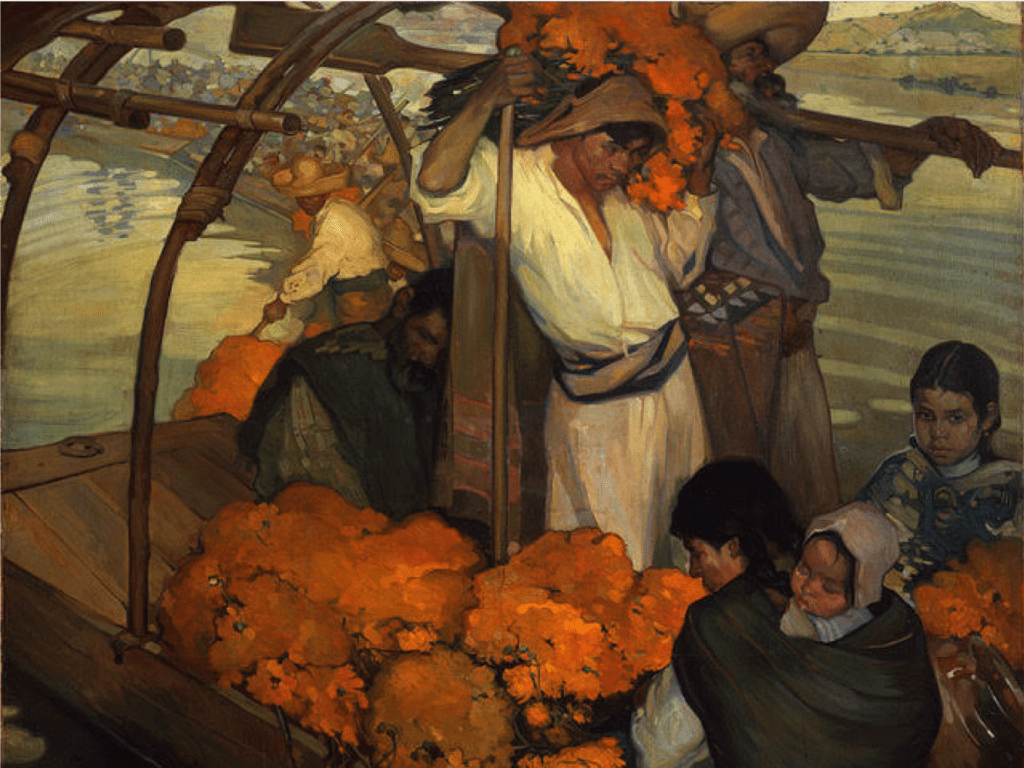
Twenty-nine people from Canada, India, CT, GA, MA, ME, NC, NJ, NY, and PA participated in this evening’s slow-looking at La Ofrenda (1914) a painting by Mexican modernist Saturnino Herrán. The abundance of gold-orange flowers first called our attention: “The artist’s palette challenges nature.” Were the flowers a family’s harvest, which they were transporting to market on a small flat-bottomed boat? What is in the background? There appears to be a parade of boats (trajineras) filled with people. Where are all these people going? Paying close attention to the structure of the boat provided clues to handwork in a bygone era: “These are the people who do the work…they are ordinary people earning their living.” As always, there are as many perspectives in our room as there are people. We all bring our own lenses to this painting: are we in Thailand?
As we moved to look at the characters, we wondered about the relationship between these figures. To many, they do not appear to look at each other or be in conversation: “They are in their own minds.” and “There are two levels at the same time – collective narrative and individual narrative.”
We began to look closely at the faces of the six people on the boat in the foreground. The young girl in the lower right-hand corner looks directly at the viewer. The others are in profile and, indeed, do not seem to look at each other. There are people of each gender and every age. Everyone carries something (a baby, flowers, a paddle) except the oldest man, dressed in black, who leans against a wooden structure in the center of the boat. Are those wings on his right shoulder? Is he confessing, grieving, praying?
Our attention turned to the white-robed man in the center. Is he the father of the young girl?
He has a soft, compassionate look. A religious figure? Is he the Good Shepherd? He has a staff in his right hand and is holding a bunch of flowers (the cempasúchitl/marigolds) on his left shoulder where, in icons, there is usually a lost lamb. Or is he Charon ferrying souls across the River Styx? Is this a group portrait of the living or the dead? In which direction are they traveling?
We then noticed that the paddle lies across one of the men’s shoulder. No one is rowing. These are human beings, of different genders and stages of development, who are drifting on the river of life to their final destination. They honor and remember; they are honored and remembered.
Intertextually, the 2017 animated film “Coco” came to mind, with its music and story depicting the belief that, as long as someone remembers them, the dead are able to cross from the other side and visit the living on All Saints Day and All Souls Day.
Before we moved to reflective writing, we looked at a self-portrait of the artist as well as a photograph of a 2020 Day of the Dead altar in Mexico, which is decorated with these brilliant, gold-orange flowers, photographs of relatives who have died, their favorite food and drink.
Writing to the prompt: “Write about honoring the ancestors” brought writing which continued our conversation about connections between the living and the dead.
The first piece, which was read aloud, suggested that we honor the dead with our lives. There was mention of rituals such as lighting candles, before three questions were addressed to the dead: “Do you see me? Are you proud? What would you do?”
We often remind each other how each viewer brings to an image “the beholder’s share”—the times and places in which we find ourselves, our lived experiences, exposure to art, literature, music, our desires, beliefs, rituals and traditions. Here on the eve of the national election in the United States, the passion that many people have for the right to vote–as a way for our voices to be heard–made its way into the final reading. With a strong rhythm building, in the third piece, a stirring march messaged: honoring the ancestors is a way to honor the future. The repetition of “I vote because I can” elicited deeply felt responses from other participants. One commented on the sound, “the rhythm like the lub dub of a strong heart.” Some remembered the stories their parents told of why their families immigrated to the United States. Still others, in this international group that has been gathering on Zoom these past seven months: “We are watching,” providing the important function of witnessing that which many of us are experiencing with great anxiety and uncertainty.
Participants are warmly encouraged to share what you wrote below (“Leave a Reply”), to keep the conversation going here, bearing in mind that the blog of course is a public space where confidentiality is not assured.
Also, we would love to learn more about your experience of these sessions, so if you’re able, please take the time to fill out a follow-up survey of one to two quick questions!
We welcomed 26 participants from across the U.S., Canada, France and India to our virtual workshop today, with many returning and several newcomers. Inspired by the recent “Creative Impulse” weekend workshop, we departed from our traditional visual text format and listened to “Steroid-Induced Gastronomy” an episode from CHONY Corps, a new podcast series created by MS alum and pediatrician, Anoushka Sinha.
We played the 5-minute recording just once, asking participants to listen closely and jot down words, phrases, imagery and sounds they heard. Then we invited them to write for 3 minutes the story that they heard. Some participants shared what they wrote, and these writings focused on themes of creativity, determination, relationships and resilience. It was noted that the boy, Jake, though only 10, seemed wise beyond his years, exploring his experiences with food and taste during his treatment with curiosity and the irony of how he had changed since he was ”younger”. It was observed that only his mother spoke of his treatment-related symptoms of bad tastes and mouth sores, which drew an arc for the listener between child, food, and illness recognizing food as a gift of strength. One participant observed the background music of a xylophone seeming to be childlike, or a soundtrack to a children’s story. The preparation and sharing of food within the family was likened to a “table of ministry.”
After the story sharing, we opened it up for a group discussion. One participant noted with interest how differently some people had approached the writing exercise: from a historian’s point of view it was about documenting a series of events while others interpreted what they heard instead. Several physicians spoke to the importance of engaging a patient to talk about what they’re interested in as presented in this podcast. Jake’s acknowledgement that food “doesn’t just appear” (once he slowed down to appreciate it and cook for himself) reminded us that we could better appreciate his story once we slowed down and listened to it, uninterruptedly. Finally, it was also clear that love is often shown through food, as Jake and his mother had no trouble in declaring their love and mutual pride in each other’s strength and support.
Our writing prompt, “Write about a hunger,” inspired a variety of forms and creative expressions: a list that reminded us of a recipe or a children’s book with its repetition and rhythm, an introspective look at one’s privilege of being able to care for others while defining success by one’s ability to guarantee survival, a medical-care memory of a surprise reunion and a miracle of hope, a search for tranquility marked by “growling words,” and a visceral description falling asleep with a full belly: reality or folly?
Participants are warmly encouraged to share what you wrote below (“Leave a Reply”), to keep the conversation going here, bearing in mind that the blog of course is a public space where confidentiality is not assured.
Also, we would love to learn more about your experience of these sessions, so if you’re able, please take the time to fill out a follow-up survey of one to two quick questions!
Σας ευχαριστούμε που συμμετείχατε σε αυτήν τη συνεδρία.
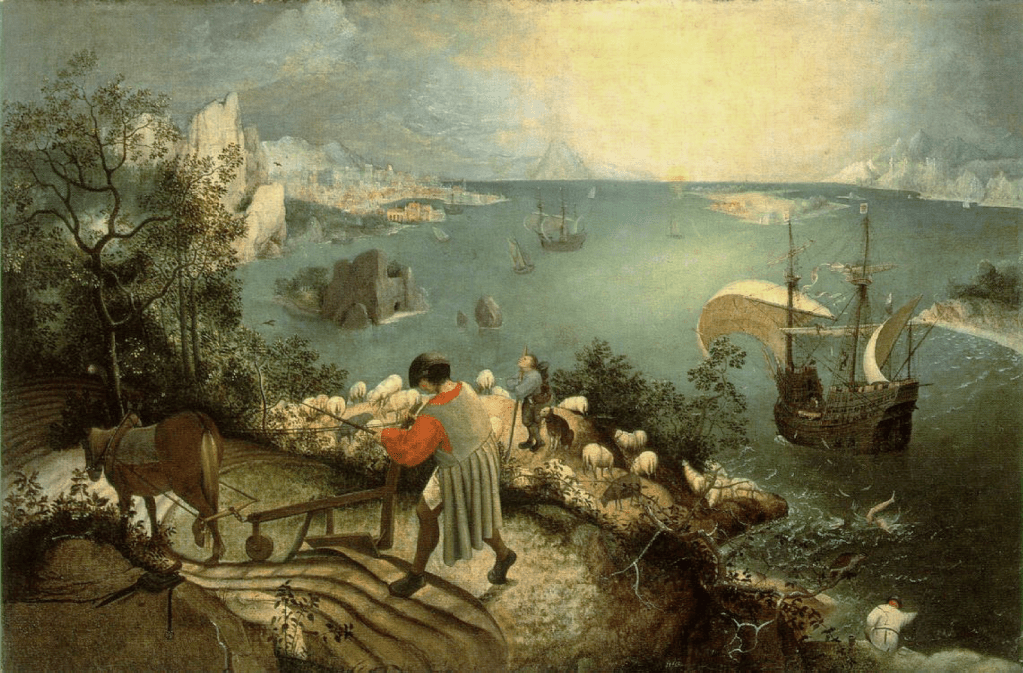
πίνακας: Πίτερ Μπρέγκελ ο Πρεσβύτερος, Τοπίο με την πτώση του Ικάρου, 1558.
Θέμα: Γράψτε για έναν ασήμαντο παφλασμό
Σύντομα θα μοιραστούμε περισσότερες πληροφορίες σχετικά με αυτήν τη συνεδρία, γι ‘αυτό επιστρέψτε ξανά.
Σας προσκαλούμε να μοιραστείτε τα γραπτά σας μαζί μας παρακάτω.
Καλούμε όλες και όλους που συμμετείχατε να μοιραστείτε όσα γράψατε κατά τη διάρκεια της συνεδρίας μας παρακάτω (“Leave a reply”) και να κρατήσουμε αυτή την τόσο ενδιαφέρουσα συζήτησή μας ζωντανή, υπενθυμίζοντάς σας, βεβαίως, ότι αυτή είναι μια δημόσια πλατφόρμα και η πρόσβαση ανοιχτή στο κοινό.
Θα θέλαμε να μάθουμε περισσότερα για την εμπειρία σας με αυτές τις συνεδρίες. Αν το επιθυμείτε, παρακαλούμε αφιερώστε λίγο χρόνο σε μια σύντομη έρευνα δύο ερωτήσεων!
Πίτερ Μπρέγκελ ο Πρεσβύτερος, Τοπίο με την πτώση του Ικάρου, 1558.
 Τοπίο με την πτώση του Ικάρου (1962)
 Ουίλιαμ Κάρλος Ουίλιαμς

 Σύμφωνα με τον Μπρύγκελ
 όταν ο Ίκαρος έπεσε
 ήταν άνοιξη

 ένας αγρότης
 όργωνε το χωράφι του
 το πανηγύρι

 της φύσης μόλις
 είχε αρχίσει
 ολόλαμπρο κάτω

 απ’ τον πυρωμένο
 ήλιο που έλιωσε
 το κερί των φτερών

 ανεπαίσθητα, λίγο
 πιο πέρα απ’ την ακτή
 ακούστηκε ένας

 ασήμαντος παφλασμός
 αυτό ήταν
 το τέλος του Ικάρου

 Μετάφραση: Νάσος Βαγενάς






 Connections in Narrative Medicine