Live Virtual Group Session: 2pm EST April 25th 2020

Thank you to everyone who joined us for this session! On a sunny Saturday afternoon, we had 52 participants joining from across the United States and many from overseas, including Portugal, Bahrain, Bristol, India, Canada, France, Italy, and Morocco.

Our text was an excerpt from “The House of Broken Angels,” by Luis Alberto Urrea, posted below. We read the excerpt once and discussed how language helps us assimilate and the emotional and intellectual labor involved with assimilation, how culture is an integral part of language, and the many ways that language recreates us.

Our prompt was: “Write about a time language re-created your reality.” The responses were in the shadow of the text, with many sharing their experiences of learning a new language and how difficult that could be, the places one recreates language, and even dreaming in the foreign language one is learning (Français was the predominant second language of the day). The words used were colorful and poignant and reminded us of how powerful language can be.

Participants are warmly encouraged to share what you wrote below (“Leave a Reply”), to keep the conversation going here, bearing in mind that the blog of course is a public space where confidentiality is not assured.

Please join us for our next session: Monday, April 27th at 6pm EST, with more times listed on our Live Virtual Group Sessions page.

We look forward to seeing you again soon!

Excerpt from The House of the Broken Angels by Luis Alberto Urrea

He was temporarily out of words. He, who had taught himself English by memorizing the dictionary. Competing with his estranged father to see who learned newer, stranger, more American words. His father, once a monument of a man, later small and gray and watery-eyed, charming and brutal as ever, but whittled down. Sleeping in Big Angel’s back bedroom for a season—Big Angel ascending to patriarch. Nobody could imagine such things. No Mexicano or gringo.

No way of knowing how language re-created a family. His own children didn’t want to learn Spanish, when he had given everything to learn English. The two men at the kitchen table with cigarettes and coffee and used dictionaries. They captured new words and pinned them like butterflies of every hue. “Aardvark,” “bramble,” “challenge,” “defiance.” One called out a word: “Incompatible.” The other had to define it in less than three minutes. Five points per word. Scores tallied on three-by-five-inch index cards. At the end of each month, a carton of Pall Malls was at stake. If the caller’s accent was too hard to understand, he lost three points. And so, with verbs and nouns, they built their bridge to California.

English exams, followed by paperbacks bought at the liquor store. His favorite gringo phrase at work, which he seldom used at home, was “By golly.” He learned that a mighty lover, in James Bond books, was known as a “swordsman.” He learned from a John Whitlatch action novel that a man with a prostitute for a wife was an “easy rider.” Americans in the ’60s said “easy ice” to bartenders when ordering a cocktail, thus sounding very current and ensuring a bit more liquor in the glass. Big Angel maintained a mental data bank of American secret spells and incantations. Hard-on. Johnny Law. What can I do you for?

Why was he thinking about work? About the past? It was over. It was all over. He was never going to work again. “This second,” his father liked to tell him, “just became the past. As soon as you noticed it, it was already gone. Too bad for you, Son. It’s lost forever.”

(Muy filosófico.)

Publisher: Little, Brown and Company; 1st Edition edition (March 6, 2018)

Live Virtual Group Session: 7pm EST April 23rd 2020

Thank you to everyone who joined us for this session!Thank you to everyone who joined us for this session! This Wednesday evening we had over 35 participants connected to us from across the United States, with some joining from Colorado, California, and Texas, and international visitors from India and Tokyo!  There were many first timers and we really appreciated their willingness to jump in to the activities and share their work.

Our text was: “I Have a Time Machine” by Brenda Shaughnessy, posted below. After hearing the poem read aloud, the group discussed the ways the references to time in the text allowed us to reflect on our own memories and the connections they make for us between ourselves and the people and places we have encountered.  

Our prompt was: “I have a time machine, but…” Participants’ written responses to the prompt ranged from the very individual experience of sifting through one’s memories of a specific event all the way to larger commentary about universal fears, desires, and experiences that we share when we evaluate past choices and their impact on our futures. The discussion after hearing the creative works shared was rich with observation about the commonalities and unique features present in the writing.  As always, we were grateful to everyone who attended and encouraged by the openness and support that all of the participants conveyed to one another throughout the session.

Participants are warmly encouraged to share what you wrote below (“Leave a Reply”), to keep the conversation going here, bearing in mind that the blog of course is a public space where confidentiality is not assured.

Please join us for our next session: Saturday, April 25th at 2pm EST, with more times listed on our Live Virtual Group Sessions page.

We look forward to seeing you again soon!

I Have a Time Machine
BY BRENDA SHAUGHNESSY


But unfortunately it can only travel into the future
at a rate of one second per second,

which seems slow to the physicists and to the grant
committees and even to me.

But I manage to get there, time after time, to the next
moment and to the next.
 
Thing is, I can't turn it off. I keep zipping ahead—
well not zipping—And if I try

to get out of this time machine, open the latch,
I'll fall into space, unconscious,

then desiccated! And I'm pretty sure I'm afraid of that.
So I stay inside.

There's a window, though. It shows the past.
It's like a television or fish tank.

But it's never live; it's always over. The fish swim
in backward circles.

Sometimes it's like a rearview mirror, another chance
to see what I'm leaving behind,

and sometimes like blackout, all that time
wasted sleeping.

Myself age eight, whole head burnt with embarrassment
at having lost a library book.

Myself lurking in a candled corner expecting
to be found charming.

Me holding a rose though I want to put it down
so I can smoke.

Me exploding at my mother who explodes at me
because the explosion

of some dark star all the way back struck hard
at mother's mother's mother.

I turn away from the window, anticipating a blow.
I thought I'd find myself
 
an old woman by now, traveling so light in time.
But I haven't gotten far at all.
 
Strange not to be able to pick up the pace as I'd like;
the past is so horribly fast.


Brenda Shaughnessy,
"I Have a Time Machine" from So Much Synth.
Copyright © 2016 by Brenda Shaughnessy. 
Reprinted by permission of Copper Canyon Press, www.coppercanyonpress.org.

Live Virtual Group Session: 12pm EST April 22nd 2020

Thank you to everyone who joined us for this session! The sea was present in both text and group as several transatlantic participants joined us from Morocco, France, England, and Italy. We were glad to welcome back those who have become a source of warmth and comfort week to week.

The text we chose (posted below) was a song, “Alfonsina and the Sea” (Alfonsina y el mar)originally written in Spanish by Argentinian writer and lyricist Félix Luna, and composed by Argentinian composer Ariel Ramírez. Luna wrote the song in homage to Alfonsina Storni (1892-1938), one of the most revered poets of Latin American literature. The song echoes the influence that the sea had on Storni’s writing and life, alluding to her suicide on La Perla beach in Mar del Plata, Argentina. While this text was particularly delicate, our participants were up for the challenge; together we persevered through the poignancy of its content in both English and Spanish, calling attention to the beauty in its form, voice, and sound. Participants commented on the melodious quality of the work, where the text’s lines themselves seemed to ebb and flow like ocean waves. We concluded that the song was like a ballad, having a rhythm of an embodied performance. The switches in narrative voice, the balance between passive and active elements (what is choice vs. what is taken away), and the wavering between the absolute and the variable/the universal and the particular, were unique features that allowed us to dive all the more into the text’s depths. One participant was reminded of refugees in the Mediterranean, and noted the myriad of ways that texts can be interpreted and appropriated. We are grateful for the willingness of the group to engage with “Alfonsina and the Sea,” which explored difficult subject matter during a particularly difficult time.

Our prompt was: Write about what you are looking for… The facilitators were struck by the original ways that participants incorporated multiple languages, aquatic imagery, and senses into their writing.

Participants are warmly encouraged to share what you wrote below (“Leave a Reply”), to keep the conversation going here, bearing in mind that the blog of course is a public space where confidentiality is not assured.

Please join us for our next session: Thursday, April 23rd at 7pm EST, with more times listed on our Live Virtual Group Sessions page.

We look forward to seeing you again soon!

Alfonsina and the sea
Félix Luna & Ariel Ramírez
 
Por la blanda arena que lame el mar
Su pequeña huella no vuelve más
Un sendero solo de pena y silencio
Llegó hasta el agua profunda
Un sendero solo de penas mudas
Llegó hasta la espuma
 
Sabe Dios qué angustia te acompañó
Qué dolores viejos calló tu voz,
Para recostarte arrullada en el canto
De las caracolas marinas.
La canción que canta en el fondo oscuro del mar
La caracola
 
Te vas Alfonsina con tu soledad,
¿Qué poemas nuevos fuiste a buscar?
Una voz antigua de viento y de sal
Te requiebra el alma
Y te está llevando
Y te vas, hacia allá como en sueños
Dormida, Alfonsina, vestida de mar

Cinco sirenitas te llevarán
Por caminos de algas y de coral
Y fosforescentes caballos marinos harán
Una ronda a tu lado.
Y los habitantes del agua
Van a jugar pronto a tu lado
 
Bájame la lámpara un poco más
Déjame que duerma, nodriza, en paz
Y si llama él no le digas que estoy
Dile que Alfonsina no vuelve
Y si llama él no le digas nunca que estoy
Di que me he ido
 
Te vas Alfonsina con tu soledad,
¿Qué poemas nuevos fuiste a buscar?
Una voz antigua de viento y de sal
Te requiebra el alma
Y te está llevando
Y te vas, hacia allá como en sueños
Dormida, Alfonsina, vestida de mar


Álbum: Mujeres Argentinas
Publicación:1969
Género: zamba
Duración: 4:35
Compositor: Ariel Ramírez
Letrista: Félix Luna
Alfonsina and the sea
Félix Luna & Ariel Ramírez
 
Across the soft sand that the waves lick
Her small footprints are not coming back anymore
Only one path made of sorrow and silence
Reached the deep water
Only one path made of untold sorrows
Reached the foam
 
Only God knows about the anguish that
accompanied you
And about the old pains your voice never told
That caused you to go to sleep, lulled by the song
Of the seashells
The song sung in the depths of the dark sea by
The seashell
 
You're going away, Alfonsina
Along with your loneliness
What kind of new poems did you go looking for?
An ancient voice made of wind and salt
Is shattering your soul and taking you away
And you go there, like in a dream
Asleep, Alfonsina, dressed with the sea

Five little mermaids will escort you
Through paths made of seaweed and corals
And phosphorescent sea horses will sing
A round, by your side
And the aquatic dwellers
Will soon play by your side
 
Dim the light of the lamp a bit for me
Let me sleep in peace, nurse
And if he calls don't tell him I'm here
Tell him that Alfonsina is not coming back
And if he calls never tell him I'm here
Tell him that I have left
 
You're going away, Alfonsina
Along with your loneliness
What kind of new poems did you go looking for?
An ancient voice made of wind and salt
Is shattering your soul and taking you away
And you go there, like in a dream
Asleep, Alfonsina, dressed with the sea

Live Virtual Group Session: 6pm EST April 20th 2020

Thank you to everyone who joined in kicking off our fourth week of Narrative Medicine Virtual Group Sessions! We loved seeing regular participants and welcoming new faces from around the globe.

In previous sessions we have been close-reading poems and prose. This evening we chose to explore a text in another medium, as one of our participants put it, “to open our minds to new ways of seeing.”

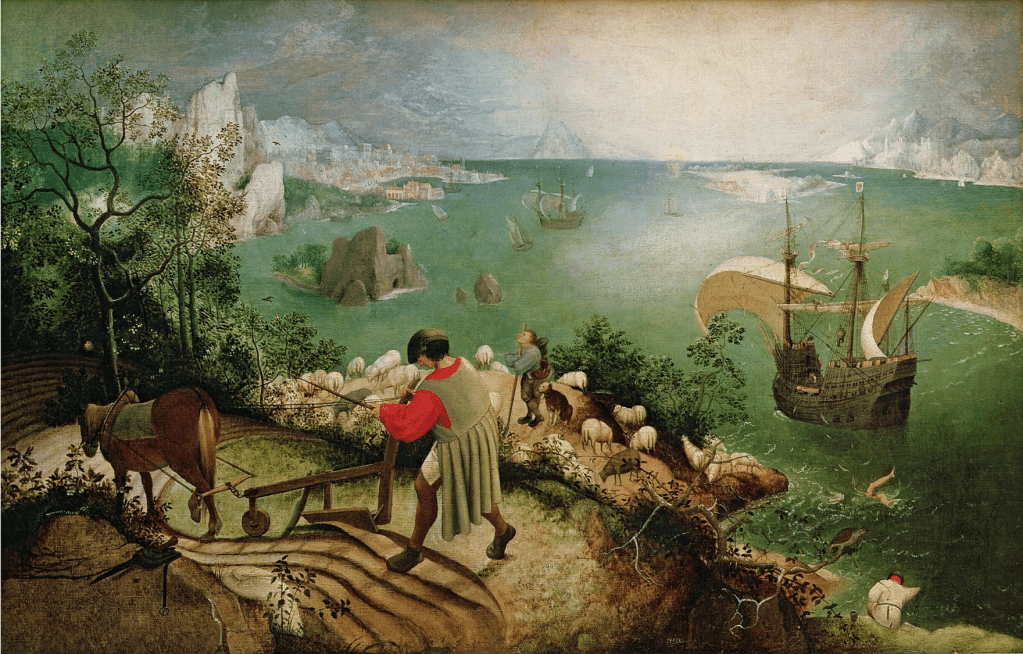
We ‘slow-looked’ at the painting “Landscape with the Fall of Icarus” by Pieter Bruegel (posted below). Participants noticed the juxtaposition of earth, water, and sky; warm climate in the foreground and colder in the background; the incongruity of calm water and wind-filled sails; the different directions in which the painting’s figures gaze. Two keen observers noted a small but important detail in the bottom right corner: two legs sticking out of the water at odd angles and the ruffling of otherwise calm water. That brought us to the title of the painting and its reference to both place and Greek myth. Together we wondered: What is the role of the farmer, the sheep, an island fortress, and everything “yonder”? What is the center of the painting? Is it the landscape? What of Icarus, who is off to one side, and has already made his descent? Why did he fall so far from the sun that melted his beeswax wings? Where is Daedalus, his father, who constructed the wings as a way to free his son and himself? We considered the painting’s composition, and how it invites us to follow the gaze of various figures in the landscape, invites us to look down at the earth, up to the sky, and into the water. Most people agreed that neither man nor beast represented in the painting concern themselves with Icarus. Do they focus solely on their work? Do they “know” Icarus and dismiss his pride and daring? Do they not see? Do they not care? The discussion allowed us not only to appreciate how much can be discovered when we take time to slow-look but also to recognize how many questions and possible understandings we were able to generate.

This evening’s prompt: “Write about an unseen splash” took people to swimming pools and other bodies of water with accidents, collisions, and rescues. Others wrote of metaphorical splashes taking place now in hospitals as patients and healthcare workers battle Covid-19 and the rippling effect into our communities.

Participants are warmly encouraged to share what you wrote below (“Leave a Reply”), to keep the conversation going here, bearing in mind that the blog of course is a public space where confidentiality is not assured.

Please join us for our next session: Wednesday, April 22nd at 12pm EST, with more times listed on our Live Virtual Group Sessions page.

We look forward to seeing you again soon!


Pieter Bruegel the Elder

c. 1560

oil on canvas

73.5 cm × 112 cm (28.9 in × 44 in)

Royal Museums of Fine Arts of BelgiumBrussels

Live Virtual Group Session: 1pm EST April 19th 2020

Thank you to everyone who joined us for this session! We had 51 participants from the UK, Bahrain, Morocco, Turkey, Canada and 12 states including Michigan, Nebraska, New Jersey, and California.

Our text for the session was “Sci-Fi” by Tracy K. Smith. Looking at this poem, we considered the tension at the core of the poem. “Sci-fi” begins with promising language “no edges,” but quickly accumulates into a space that is empty, “unhinged.” The language of the poem creates discomfort with sibilant sounds, relentless future-tense verbs, and the turn of the poem on the word “but” that moves the mood from one of  hope to one of dread.  Participants seemed particularly struck by the contradictions in the text— the sense of control in an uncontrollable universe, the presence of realism/reality in a sci-fi universe, hope in a hopeless place. The final commenter turned the group discussion on its head, pointing to such hopeful images as the falling away gender distinctions, the absence of sexual threat, the eradication of early death, and the possibility of positive change. The poem, we concluded, in its very ambiguity trains us to entertain multiple readings and multiple ideas whenever we come together.

Our prompt for the session was “Write your Sci-Fi story.”

Participants are warmly encouraged to share what you wrote below (“Leave a Reply”), to keep the conversation going here, bearing in mind that the blog of course is a public space where confidentiality is not assured.

Please join us for our next session: Monday, April 20th at 6pm EST, with more times listed on our Live Virtual Group Sessions page.

We look forward to seeing you again soon!

Sci-Fi
 
There will be no edges, but curves.
Clean lines pointing only forward.
 
History, with its hard spine & dog-eared
Corners, will be replaced with nuance,
 
Just like the dinosaurs gave way
To mounds and mounds of ice.
 
Women will still be women, but
The distinction will be empty. Sex,
 
Having outlived every threat, will gratify
Only the mind, which is where it will exist.
 
For kicks, we'll dance for ourselves
Before mirrors studded with golden bulbs.
 
The oldest among us will recognize that glow—
But the word sun will have been re-assigned
 
To the Standard Uranium-Neutralizing device
Found in households and nursing homes.
 
And yes, we'll live to be much older, thanks
To popular consensus. Weightless, unhinged,
 
Eons from even our own moon, we'll drift
In the haze of space, which will be, once
 
And for all, scrutable and safe.


Tracy K. Smith, "Sci-Fi" from Life on Mars. Copyright © 2011 by Tracy K. Smith.  Reprinted by permission of Graywolf Press. www.graywolfpress.org
Source: Life on Mars (Graywolf Press, 2011)

Live Virtual Group Session: 7pm EST April 17th 2020

Thank you to everyone who joined us for this session! On a Friday evening we had approximately 40 participants connected to us from across the United States, with some joining from Virginia, California, and Massachusetts, and even some international friends from Canada.

Our text was “Speaking Tree” by Joy Harjo, posted below. After two readings of our poem, the group discussed the sense of trees as humans and humans as trees, and the relationship between poetry/poe-tree. What does being rooted and grounded mean without movement but with the desire to move?

Our prompt was: “Write about a longing.” Prompted writing revealed poetic language in the shadow of the text where time is slowed, there is a longing to dance, and a wind threading rings. In discussion of the writing shared, participants noted the rich descriptions of the connections between individual and communal experiences, the interdependence between our bodies and the natural environment, and the variance in our perceptions of the passage of time.

Participants are warmly encouraged to share what you wrote below (“Leave a Reply”), to keep the conversation going here, bearing in mind that the blog of course is a public space where confidentiality is not assured.

Please join us for our next session: Sunday, April 19th at 1pm EST, with more times listed on our Live Virtual Group Sessions page.

We look forward to seeing you again soon!

Speaking Tree

I had a beautiful dream I was dancing with a tree.
                                                - Sandra Cisneros

Some things on this earth are unspeakable:
Genealogy of the broken—
A shy wind threading leaves after a massacre,
Or the smell of coffee and no one there—

Some humans say trees are not sentient beings,
But they do not understand poetry—

Nor can they hear the singing of trees when they are fed by
Wind, or water music—
Or hear their cries of anguish when they are broken and bereft—

Now I am a woman longing to be a tree, planted in a moist, dark earth
Between sunrise and sunset—

I cannot walk through all realms—
I carry a yearning I cannot bear alone in the dark—

What shall I do with all this heartache?

The deepest-rooted dream of a tree is to walk
Even just a little ways, from the place next to the doorway—
To the edge of the river of life, and drink—

I have heard trees talking, long after the sun has gone down:

Imagine what would it be like to dance close together
In this land of water and knowledge. . .

To drink deep what is undrinkable.


From Conflict Resolution for Holy Beings
by Joy Harjo
Copyright © 2015 by Joy Harjo
W.W. Norton & Company

Live Virtual Group Session: 12pm EST April 15th 2020

Thank you to everyone who joined us for this session! We are so glad to be back and running, and to have so many of you join for this mid-day break (or evening activity – given the exciting range of time zones we had in our session today).

Our text was “Cutting Greens” by Lucille Clifton, posted below. Just as Lucille Clifton does with the greens, we tenderly dissected and embraced our text. Our discussion revolved around the many juxtapositions and connections we found in the poem, as the narrator “builds a connection to the living things that she is holding”, as one participant observed. Together, we looked to the “embrace” and the “kinship” woven into the text, and explored the contrast between the black and the green (“a dance between difference”, one participant observed).  We wondered about the significance of the kitchen setting (“one so mundane, yet it’s used to bring people together, to tie relationships, to mix and add things”, someone else commented). In the last few lines of the poem, many found “a peaceful sense of resolution”, as we experienced – as one of our participants said – “a new beautiful bond through the narrator’s awareness of what is going on”.

Our prompt was: Write about the bond of live things. Participants shared wonderful pieces exploring a range of situations – the tenderness of a caregiver, the importance of giving love to the self, a meditation on watching the world through a window pane, feeling the connection between us all even as we are separated, and an exploration of the idea of the virus as “equalizer,” even as it exposes the inequities in our systems and our communities. 

Participants are warmly encouraged to share what you wrote below (“Leave a Reply”), to keep the conversation going here, bearing in mind that the blog of course is a public space where confidentiality is not assured.

Please join us for our next session: Friday, April 17th at 7pm EST, with more times listed on our Live Virtual Group Sessions page.

We look forward to seeing you again soon!

cutting greens
Lucille Clifton

curling them around
i hold their bodies in obscene embrace
thinking of everything but kinship.
collards and kale
strain against each strange other
away from my kissmaking hand and
the iron bedpot.
the pot is black,
the cutting board is black,
my hand,
and just for a minute
the greens roll black under the knife,
and the kitchen twists dark on its spine
and I taste in my natural appetite
the bond of live things everywhere.

Lucille Clifton, "cutting greens" from The Collected Poems of Lucille Clifton. Copyright © 1987 by Lucille Clifton.  

Live Virtual Group Session: 6pm EST April 13th 2020

Thank you to everyone who joined the April 13th virtual live session. It was so great to be with 57 people joining in from Australia, Brazil, Canada, and across the continental USA.

Our text for the session, “Last Letter to My Son” by Nazim Hikmet, is posted below. Choosing today’s text is a gesture toward continuity with Hikmet’s “The Mailman”, which we read last Monday before needing to end our virtual session abruptly. Just as the poem’s father and son are separated, we, too, are separated over long distances and yearning to connect. Sharing the poem this evening also seemed like a mutual, simultaneous delivery of Hikmet’s precious letter.

Reading aloud, two volunteers gave voice to thoughts and feelings embedded in the poem. Closely reading for language and craft, participants pointed to the blending of darkness and light, commonalities among all beings and things,and the experience of being alone, especially now. Multiple participants noted the repetition of “but people above all” (four times in 23 lines). Others highlighted the father’s call for his son to respect where he lives, by invoking “your father’s house,” which someone suggested could refer to an earthly or a heavenly father. The facilitators were moved by the comment about grief being for “what was not dead but rather what was dying” and by someone calling today’s text “a lesson in connection.” As we moved throughout the text, we kept returning to the first word: Still. One person spoke of the various uses of “still” as “ongoing” or “motionless.”

This session’s prompt was: Write about a habit worth cultivating.

Participants’ writings included habits of journaling, keeping still, listening (as a language to convey what is not possible to put into words), looking both inward and outward, making a clearing, and fostering compassion —a suffering with — so that compassion becomes a way of walking with others.

Participants are warmly encouraged to share what you wrote below (“Leave a Reply”), to keep the conversation going here, bearing in mind that the blog of course is a public space where confidentiality is not assured.

Please join us for our next session: Wednesday, April 15th at 12pm EST, with more times listed on our Live Virtual Group Sessions page.

We look forward to seeing you again soon!

From “Last Letter to My Son” by Nazim Hikmet
From Poems of Nazim Hikmet, trans. Randy Blasing & Mutlu Konuk. NY: Persea Books, 1994 (revised 2nd ed., 2002).

Still,
                it's no fun
                                    to startle in the middle of work sometimes
or count the days
                     before falling asleep alone.
You can never have enough of the world,
                     Memet, never enough . . .
 
Don't live in the world as if you were renting
or here only for the summer,
but act as if it was your father's house . . .
Believe in seeds, earth, and the sea,
but people above all.
Love clouds, machines, and books,
but people above all.
Grieve
                    for the withering branch,
                                    the dying star,
                                                       and the hurt animal,
                    but feel for people above all.
Rejoice in all the earth's blessings –
darkness and light,
the four seasons,
but people above all.

Live Virtual Group Session: 6pm EST April 6th 2020

Dear Participants,

We want to start by acknowledging that we all just experienced something very difficult. Despite our efforts to increase security over the last few days, obviously we were unsuccessful, and what we feared would happen, did. We share your horror and we need to extend apologies and solidarity in acknowledging the hateful act we experienced today. 

We will be pausing all of our upcoming sessions while we explore new options to make our meetings more secure. As we hope most of you know, creating the safest spaces possible is of utmost priority for us. We worry a lot about this new virtual world we find ourselves in now, and while we very much want to continue to do this work with you — we feel how vital it is in this moment — we also want to do it as securely as we can.

Please check back on our blog in the coming week with updates on our new course of action — rest assured we will be working to get back up and running, in some form, as soon as possible. 

In the meantime, although we had to cut the session short, we want to share the prompt we had planned on using following our discussion of this session’s text – “The Mailman” by Nazim Hikmet. The prompt was: “Write a letter you’d like to deliver.” When you can and if you wish, please take a few minutes to write to this prompt. We encourage you, as well, to post what you write below. 

The full text we read in our session is posted below. So many of you shared such wonderful things in response to the poem; we all looked to the different ways in which the mailman carries his messages of hope “in the bag of my heart,” “heaven is in my bag,” and “a mailman bears all manner of pain.” We also spoke about the presence of landscape as a place in which life occurs, and how everything seems to be packaged into this landscape. We discussed the sense of motion and travel (carrying news, crossing the Bering Strait), the different metaphors of what the mailman carries, both the political and the deeply personal dimensions of the poem as well as the construction of the city and the different perception from within and outside of it. Our participants pointed to the parallels between the challenges of the mailman and those of healthcare professionals delivering news to patients and families – a context that resonates with so many of us, especially during this difficult time. 

In our session today, we read about a mailman’s travels and deliveries. We are determined that our message and work continues to reach you.

Sincerely,

The Narrative Medicine Team

The Mailman, Nazim Hikmet  from Hungarian travel notes
Author(s): NAZIM HIKMET, Randy Blasing and Mutlu Konuk
Source: The American Poetry Review, Vol. 23, No. 2 (MARCH/APRIL 1994), pp. 38-39
Published by: Old City Publishing, Inc.

 
Whether at dawn or in the middle of the night,
I've carried people news
– of other people, the world, and my country,
of trees, the birds and the beasts –
in the bag of my heart.
I've been a poet,
which is a kind of mailman.
As a child, I wanted to be a mailman,
not via poetry or anything
but literally – a real mail carrier.
In geography books and Jules Verne's novels
my colored pencils drew a thousand different pictures
of the same mailman– Nazim.
Here, I'm driving a dogsled
over ice,
canned goods and mail packets
glint in the Arctic twilight:
I'm crossing the Bering Strait.
Or here, under the shadow of heavy clouds on the steppe,
I'm handing out mail to soldiers and drinking kefir.
Or here, on the humming asphalt of a big city,
I bring only good news
and hope.
Or I'm in the desert, under the stars,
a little girl lies burning up with fever,
and there's a knock on the door at midnight:
"Mailman!"
The little girl opens her big blue eyes:
her father will come home from prison tomorrow.
I was the one who found that house in the snowstorm
and gave the neighbor girl the telegram.
As a child, I wanted to be a mailman.
But it's a difficult art in my Turkey.
In that beautiful country
a mailman bears all manner of pain in telegrams
and line on line of grief in letters.
As a child, I wanted to be a mailman.
I got my wish in Hungary at fifty.
Spring is in my bag, letters full of the Danube's shimmer,
the twitter of birds,
and the smell of fresh grass –
letters from the children of Budapest
to children in Moscow.
Heaven is in my bag . . .
One envelope
writes:
"Memet, Nazim Hikmet's son,
Turkey."
Back in Moscow I'll deliver the letters
to their addresses one by one.
Only Memet's letter I can't deliver
or even send.
Nazim's son,
highwaymen block the roads –
your letter can't get through.

Live Virtual Group Session: 12pm EST April 5th 2020

Thank you to the 58 of you who joined us for this session!

Our text for this session was an excerpt from There, There by Tommy Orange. (2018) New York: Alfred A. Knopf (text posted below).

Our prompt for the session was: “Write about a rhythm.”

It was wonderful to see new and familiar faces today.  Our group of 58 people zoomed in from Athens, Jerusalem, Lisbon, the UK, many points in Canada and across the USA, from the South Bronx to Santa Monica, from Jacksonville to Shaker Heights.

The Tommy Orange excerpt brought up themes of journeying, dreams of the future, randomness, the inevitable, tempo and time, and being out of step.  And participants responded with clarity and precision to one another’s writing, to the  particularity of images: “an epigenetic storm of immigrant dreams and bereavement,” “a blue light,” “a red rooster clock,” with its tick tock that traveled from home to hospital and back, a balm to one and a bomb to the other.

Participants are warmly encouraged to share what you wrote below (“Leave a Reply”), to keep the conversation going here, bearing in mind that the blog of course is a public space where confidentiality is not assured.

Please see below for some examples of the kind of writing people produced in just four minutes!

Please join us for our next session: Monday, April 6th at 6pm EST, with more times to be announced shortly.

AND PLEASE NOTE: in an effort to make these sessions more secure, there will be an individual link for each session with a quick registration. Allow an extra minute to do this when logging in.

Please bookmark the Live Virtual Sessions page (or access directly from the navigation above) – this is where you should always come to find access instructions before each live session.

We look forward to seeing you again soon!


Text Excerpt from There, There by Tommy Orange:

Before you were born you were a swimmer. You were a race, a dying off, a breaking through, an arrival. Before you were born, you were an egg in your mom who was an egg in her mom. Before you were born, you were the nested Russian grandmother doll of possibility in your mom’s ovaries. You were two halves of a thousand different kinds of possibilities, a million heads or tail, flip-shine on a spun coin. Before you were born, you were the idea to make it to California for gold or bust. You were white, you were brown, you were red, you were dust. You were hiding, you were seeking. Before you were born, you were chased, beaten, broken, trapped on a reservation in Oklahoma. Before you were born, you were an idea your mom got into her head in the seventies, to hitchhike across the country and become a dancer in New York. You were on your way when she did not make it across the country but sputtered and spiraled and wound up in Taos, New Mexico, at a peyote commune named Morning Star. Before you were born, you were your dad’s decision to move away from the reservation, up to northern New Mexico to learn about a Pueblo guy’s fireplace. You were the light in your parents’ eyes as they met across that fireplace in ceremony. Before you were born, your halves inside them moved to Oakland. Before you were born, before your body was much more than heart, spine, bone, brain, skin, blood, and vein, when you’d just started to build muscle with movement, before you showed, bulged in her belly, as her belly, before your dad’s pride could belly-swell from the sight of you, your parents were in a room listening to the sound your heart made. You had an arrhythmic heartbeat. The doctor said it was normal. Your arrhythmic heart was not abnormal.

“Maybe he’s a drummer,” your dad said.
“He doesn’t even know what a drum is,” your mom said.
“Heart,” your dad said.
“The man said arrhythmic. That means no rhythm.”
“Maybe it just means he knows the rhythm so good he doesn’t always hit it when you expect him to.”

Orange, Tommy. There, There. (2018) New York: Alfred A. Knopf