Live Virtual Group Session: 6pm EDT October 19th 2020

At least two new people joined our group of 21 participants tonight as we gathered around a poem by William Carlos Williams. People chatted in greetings and weather reports from MA, ME, NJ, NY, OR, PA, RI, TX, India and Canada, before discussing elements of the โ€œThe Artist,โ€ noting the surprising balletic movement of Mr. T, a man in seeming disarray. We identified four people in the space of the poem โ€“ the speaker of the poem, a woman who is identified as โ€œmy mother,โ€ the de-identified โ€œMr. Tโ€ and his wife. Mr. T is presented as โ€œbareheaded in a soiled undershirt, with his hair sticking out on all sides.โ€ Has he been wearing a hat? Has he been working, or is he known for neglecting his โ€œtoilette?โ€ No matter: with no introduction or visible cue or musical accompaniment, he executes an entrechat bounding into the air and โ€œwhirling aboutโ€ in an instant. We commented on the shape of the poem on the page: โ€œcenteredโ€ on the page and its short lines leaping. One person related this telling to a Lewis Carroll text, which she had recently read, about elderly people who perform remarkable physical feats. One participant commented that he, initially, entered the text as the woman described as an โ€œinvalidโ€. And then began to identify as the artist looking at that woman and deciding to perform. Before returning to what transpires in the text, we commented on the poet, William Carlos Williams, known for his practice of writing as well as his practice of medicine in Paterson, NJ.

We noticed that the poem begins in third person (describing Mr. T) before switching (whirling about) midway to first person as the speaker calls attention to โ€œmy motherโ€ who, before exclaiming, โ€œBravoโ€ is stunned into wordlessness at what Mr. T wordlessly communicates.  This brought our attention to what is given and what is received in every performance.

One participant had a strong reaction to the fourth person who makes an appearance in the poem: โ€œ[t]he manโ€™s wife who came in from the kitchen.โ€ She asks if the wife misses what merited applause because she has been working in the kitchen. Whatever the reason, she misses the brief beauty. In the poem, the wifeโ€™s โ€œworkโ€ is to orient readers to space, suggesting that the action takes place indoors rather than out-of-doors as many people sensed at the beginning of the read. Other than the cry โ€œBravoโ€ the wife is the only character with a spoken line. โ€œWhat goes on here?โ€ she asks before the poem ends, โ€œBut the show was over.โ€

ย ย ย ย ย ย ย ย ย ย ย  Our session was not over. Given a choice of prompts: Write about an unexpected moment of beauty or Write about a missed performance, we all wrote for four minutes. Four people read their work. One was about the camera on their iPhone being a constant companion and, yesterday, looking into the sun, being blinded by the sun, they took a leap of faith and took a photograph. There was also reflection on the possibility that a camera interferes with pure looking at moments of beauty. One participant commented on the authorโ€™s openness and expectation of finding beauty. Another noted that she had re-captured the image in words. The second reader had written about a walk in the woods in search of autumn leaves falling and leaving their impression on the ground. This piece contains dialog between two hikers, about which trail to take, when coming upon markers. The authors of these first two readings both shared the images they had caught on camera.

The third reading was a reflection on missing a performance: parentsโ€™ performance that led to conception. There was much amusement and also some discomfort, as participants contemplated or avoided contemplating their own beginnings.

The fourth and final reading, this evening, sounds like a play or film with two residents in a nursing home talking about the images one of them sees on the wall of their room.

Thank you everyone for bringing so much to the discussion of text and for sharing your prompted writing.

Participants are warmly encouraged to share what you wrote below (โ€œLeave a Replyโ€), to keep the conversation going here, bearing in mind that the blog of course is a public space where confidentiality is not assured.

Also, we would love to learn more about your experience of these sessions, so if youโ€™re able, please take the time to fill out a follow-up survey of one to two quick questions!

Please join us for our next session Wednesday, October 21st at 12pm EDT, with more times listed on our Live Virtual Group Sessions page.


The Artist by William Carlos Williams

Mr. T.
          bareheaded
                    in a soiled undershirt
his hair standing out
          on all sides
                    stood on his toes
heels together
           arms gracefully
                    for the moment
curled above his head.
            Then he whirled about
                     bounded
into the air
             and with an entrechat
                     perfectly achieved
completed the figure.
             My mother
                     taken by surprise
where she sat
             in her invalidโ€™s chair
                      was left speechless.
Bravo! she cried at last
             and clapped her hands.
                       The manโ€™s wife
came from the kitchen:
            What goes on here? she said.
                        But the show was over.

Live Virtual Group Session: 12pm EDT October 14th 2020

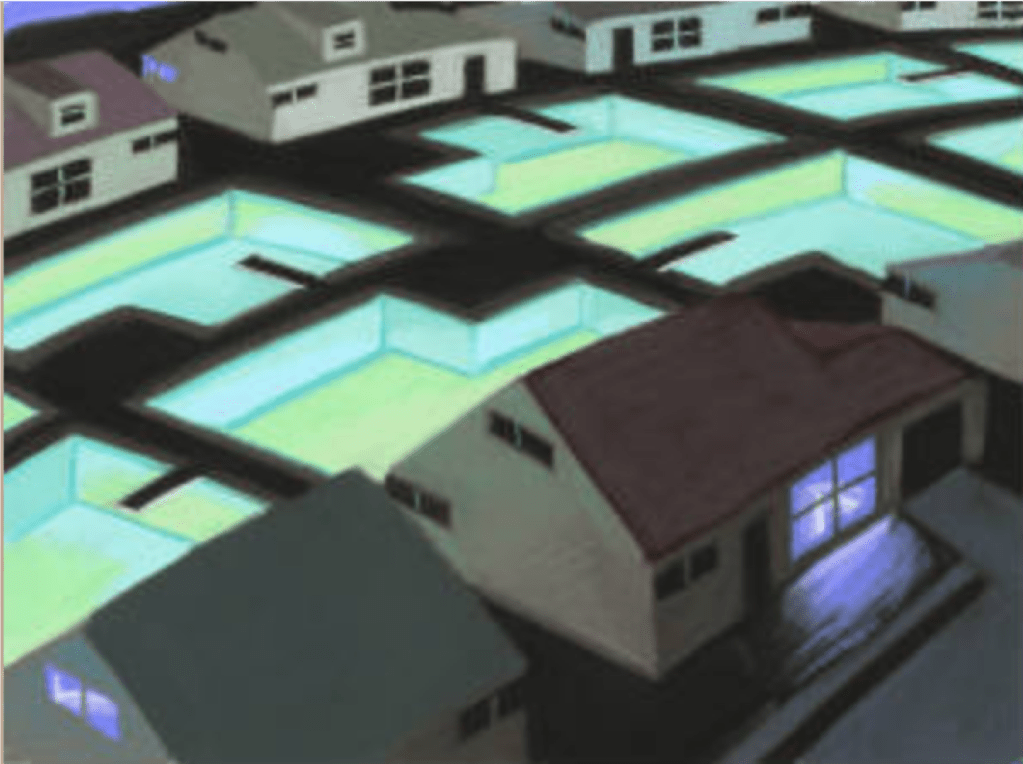
We welcomed 21 people to our virtual workshop session, including many returning participants and two newcomers. The text today was a pastel artwork by Richard Wommack, โ€œTelevision Snow.โ€ With intent, the title was withheld from the participants, who were asked to spend 2 minutes close reading the painting. Then in a break from tradition, participants were asked to consider what the title of this painting might be and to type their thoughts into the chat.

Here are just a few of the many responses: Empty Spaces, The Puzzle, Backyard Monotony, Ghost โ€˜burbs, Sweet Dream, Fordist Neonscape, Uniformity & Catastrophe and Radioactive Neighborhood. In the discussion that followed, feelings of isolation, sameness, and even danger due to the lack of fences were shared. Several noted the lack of human form and nature, though a sliver of purple sky was observed. The color purple that glowed was seen as either comforting or toxic. The arc of the scene and preponderance of pools (or were they basements minus rooves) prompted discussion of the surreal and dream/nightmare quality of the art. The mood was eerie, dystopian and even angry. Someone noted that this depiction of night felt like the lonliest of times, that though there were no fences to divide the inhabitants they were separate and not communicating, each in their own โ€œcastleโ€. The sense of smell was explored eliciting chlorine, ozonate, metallic, or simply nothing. Finally we โ€œlistenedโ€ and heard crickets, radiostatic, white noise and silence.

Writing to the prompt โ€œTake us someplace after hoursโ€ brought us to internal spaces of โ€œa desperate desire to matterโ€ and an external space where โ€œThe night is about to settleโ€ฆlawnmowers, leaf blowersโ€ฆthe stars would gradually accompany me with their stories as I arrived home.โ€ One writer described a long day with a patient followed by dizziness and blindness that muddles our memory; another wrote a dialogic scene with two rocks in conversation that asked โ€œWas there any life before we came? Are we the only stones to people this land?โ€ Another writer in a medical context described โ€œears filled with beeps, my heart broken with death.โ€ The group resonated with the description of stepping outside a hospital into the crisp air, a feeling like a resuscitation. Our last writer described a peaceful pandemic space (her daughterโ€™s former bedroom) where she can โ€œlower the light..lightย  my candle.โ€ย 

Participants are warmly encouraged to share what you wrote below (โ€œLeave a Replyโ€), to keep the conversation going here, bearing in mind that the blog of course is a public space where confidentiality is not assured.

Also, we would love to learn more about your experience of these sessions, so if youโ€™re able, please take the time to fill out a follow-up survey of one to two quick questions!

Please join us for our next session Monday, October 19th at 6pm EDT, with more times listed on our Live Virtual Group Sessions page.


Television Snow by R. Michael Wommack


Encuentros virtuales en vivo: Martes 13 de octubre, 16:30 EST

Tuvimos la primera sesiรณn en espaรฑol de Octubre y fue una muy bonita experiencia! Fuimos 13 participantes en total representando a Chile, Estados Unidos (NY y NJ), Espaรฑa, Mรฉxico y Argentina. Para algunos de los participantes era la primera vez en estas sesiones!

El texto que elegimos para esta sesiรณn fue un poema de Mario Benedetti, llamado โ€œNo te rindas,โ€ publicado a continuaciรณn. Dos voluntarias leyeron el texto en voz alta. En esta oportunidad, la conversaciรณn girรณ en torno a varios aspectos, no se centrรณ en uno solo. Por un lado, una participante notรณ un โ€œtonoโ€ propio de una canciรณn, con una estructura que simulaba incluso un estribillo pegadizo. Por otro lado, varios participantes se fijaban y notaban un tono de esperanza, de luz en el poema que incluso lo hacรญa de sus favoritos. Ideas como que siempre hay una salida, que se puede lograr lo que uno quiere, fueron nombradas mรกs de una vez. Varios sentรญan que entrega apoyo e invita a continuar en tiempos difรญciles. Para otros, el poema tenรญa su fuerza en la frase โ€œno te rindas porque yo te quieroโ€, en el sentido de que interpelaba al lector, lo rescata y da fuerza, da sentido a la vida. Sin embargo, aunque fueran todo visiones positivas, todos evitaban hablar de un poema demasiado โ€œpositivistaโ€, dado que por un lado el โ€œyo te quieroโ€ interpela al lector, obliga al lector, โ€œa ese Otroโ€. Por otro lado, para varios fue interesante subrayar que el โ€œyo te quieroโ€ hace vulnerable al autor, que se hace dependiente del lector, generรกndose una relaciรณn de interdependencia entre ambos digna de ser reflexionada, dado que bajo este prisma, el poema se hace mรกs humano que nunca. Quรฉ le pasa a uno si el otro se rinde? Se debilita la relaciรณn, se debilita la persona? Otros participantes veรญan el poema como una arenga a comenzar y recomenzar (asรญ es la vida, sostienen).

La invitaciรณn a escribir fue bajo el tรญtulo โ€œescribe acerca de un momento en que no te rendisteโ€. Aunque no hubo tiempo para muchas intervenciones, dado lo extenso de la discusiรณn y lectura detallada (close reading) del poema, los participantes que compartieron su texto mostraron, una vez mรกs, un nivel excelso. Por un lado, una participante ahondรณ mรกs, a la sombra del texto, en la relaciรณn de interdependencia entre autor y lector. Otro participante subrayรณ en su texto que nos necesitamos todo el tiempo, que necesitamos al Otro para no rendirnosโ€ฆ lo que somos, en suma, es porque hay un Otro.

Se alienta a los participantes a compartir lo que escribieron a continuaciรณn (“Deja una respuesta”), para mantener la conversaciรณn aquรญ, teniendo en cuenta que el blog, por supuesto, es un espacio pรบblico donde no se garantiza la confidencialidad.

Por favor, รบnase a nosotros para nuestra prรณxima sesiรณn en espaรฑol, con fecha por anunciar, con mรกs oportunidades de sesiones en otros idiomas listadas en nuestra pรกgina de sesiones grupales virtuales en vivo, asรญ que siguenos en nuestras redes sociales!

ยกEsperamos verte pronto!


No Te Rindas | Mario Benedetti

No te rindas, aรบn estรกs a tiempo
de alcanzar y comenzar de nuevo,
aceptar tus sombras, enterrar tus miedos,
liberar el lastre, retomar el vuelo.

No te rindas que la vida es eso,
continuar el viaje,
perseguir tus sueรฑos,
destrabar el tiempo,
correr los escombros y destapar el cielo.

No te rindas, por favor no cedas,
aunque el frรญo queme,
aunque el miedo muerda,
aunque el sol se esconda y se calle el viento,
aรบn hay fuego en tu alma,
aรบn hay vida en tus sueรฑos,
porque la vida es tuya y tuyo tambiรฉn el deseo,
porque lo has querido y porque te quiero.

Porque existe el vino y el amor, es cierto,
porque no hay heridas que no cure el tiempo,
abrir las puertas quitar los cerrojos,
abandonar las murallas que te protegieron.

Vivir la vida y aceptar el reto,
recuperar la risa, ensayar un canto,
bajar la guardia y extender las manos,
desplegar las alas e intentar de nuevo,
celebrar la vida y retomar los cielos.

No te rindas, por favor no cedas,
aunque el frรญo queme,
aunque el miedo muerda,
aunque el sol se ponga y se calle el viento,
aรบn hay fuego en tu alma,
aรบn hay vida en tus sueรฑos,
porque cada dรญa es un comienzo,
porque esta es la hora y el mejor momento,
porque no estรกs sola,
porque yo te quiero.

Live Virtual Group Session: 6pm EDT October 12th 2020

Sixteen participants from India, Maine, Mexico, Michigan, New Hampshire, New Jersey, New York, and Pennsylvaniaโ€”one who was new to our circleโ€”gathered to close read the poem โ€œSnow Mareโ€ by N. Scott Momaday, cognizant of todayโ€™s holiday that celebrates indigenous Peoples. Momaday is a member of the Kiowa nation. He is best known for his novel House Made of Dawn, which won the Pulitzer Prize, although he prefers to be recognized as a poet.

The words and phrases that called many peopleโ€™s attention included:

            bursts of soft commotion

            the burden of being 

(Sorry, everyone, the capitalized โ€œOfโ€ was our transcription error.)

We discussed color, properties of hardness and softness, verbs of being, memory, and the dissolving nature of dreams and memories. We imagined porcelain fields and dreams that bring comfort, all in a background of confectionersโ€™ sugar and gentle hooves. Tonight we also generated a sizeable number of auditory, visual, and literary texts elicited by Momadayโ€™s:

            The Dream of the Blue Turtles (Sting)

            Blue Horses (Mary Oliver poetry collection)

            Big Blue Horses (Franz Marc)

            The Snowman (Wallace Stevens)

            The Unbearable Lightness of Being (Kundera)

Three people read what they wrote to the prompt: Write about bursts of soft commotion.

Each were scenes involving childrenโ€”a childโ€™s near-death experience of eating/inhaling flour; children romping and squealing in a park; โ€œbrain burstsโ€ after falling on ice. One person noted that Momadayโ€™s line โ€œShe shears the web of winterโ€ brought her back to last weekโ€™s text โ€“ Pablo Nerudaโ€™s Ode To A Pair of Scissors. We were sorry to lose our fourth reader to an interrupted internet connection. Perhaps she will post her writing on the narrativeblog.com.

Tonightโ€™s session concluded with a three-minute trailer, from a documentary on N. Scott Momaday featured at the Seattle Film Festival in 2019, which is titled โ€œWords from a Bear.โ€

Participants are warmly encouraged to share what you wrote below (โ€œLeave a Replyโ€), to keep the conversation going here, bearing in mind that the blog of course is a public space where confidentiality is not assured.

Also, we would love to learn more about your experience of these sessions, so if youโ€™re able, please take the time to fill out a follow-up survey of one to two quick questions!

Please join us for our next session Monday, October 14th at 12pm EDT, with more times listed on our Live Virtual Group Sessions page.


The Snow Mare by N. Scott Momaday

In my dream, a blue mare loping,
Pewter on a porcelain field, away.
There are bursts of soft commotion
Where her hooves drive in the drifts,
And as dusk ebbs on the plane of night,
She shears the web of winter,
And on the far, blind side
She is no more. I behold nothing,
Wherein the mare dissolves in memory,
Beyond the burden Of being.

Live Virtual Group Session: 12pm EDT October 7th 2020

Thank you to everyone who joined us for this session!

Our text was the poem โ€œThe Death of Marilyn Monroeโ€ by Sharon Olds, posted below.

Our prompt was: โ€œWrite about a time you stood in a doorway.โ€

More details about this session will be posted soon, so check back!

Participants are warmly encouraged to share what you wrote below (โ€œLeave a Replyโ€), to keep the conversation going here, bearing in mind that the blog of course is a public space where confidentiality is not assured.

Also, we would love to learn more about your experience of these sessions, so if youโ€™re able, please take the time to fill out a follow-up survey of one to two quick questions!

Please join us for our next sessionย Monday, October 12thย at 6pm EDT,ย with more times listed on ourย Live Virtual Group Sessionsย page.


The Death of Marilyn Monroeย  by Sharon Olds

The ambulance men touched her cold
body, lifted it, cold as iron,
onto the stretcher, tried to close the
mouth, closed the eyes, tied the
arms to the sides, moved a caught
strand of hair, as if it mattered,
saw the shape of her breasts, flattened by
gravity, under the sheet,
carried her, as if it were she,
down the steps.

These men were never the same. They went out
afterwards, as they always did,
for a drink or two, but they could not meet
each otherโ€™s eyes.

ย  ย ย ย ย                        Their lives took
a turn--one had nightmares, strange
pains, impotence, depression. One did not
like his work, his wife looked
different, his kids. Even death
seemed different to himโ€“a place where she
would be waiting,

and one found himself standing at night
in the doorway to a room of sleep, listening to a
woman breathing, just an ordinary
woman
breathing.


"Death of Marilyn Monroe," by Sharon Olds 
fromย The Dead and the Livingย (Alfred A. Knopf).

Live Virtual Group Session: 6pm EDT October 5th 2020

Thank you to everyone who joined us for this session!

Our text was the poem โ€œOde to a Pair of Scissorsโ€ by Pablo Neruda, posted below.

Fourteen participants gathered in the clearing this evening, arrived from around the globe (like the well-traveled scissors in Nerudaโ€™s ode) representing Bar Harbor, central Pennsylvania, Detroit, India, Manhattan, Montreal, Philadelphia, Pittsford, Sao Paulo, and Staten Island.

Two people read aloud this ode, an extended metaphor that fell down the page. One of the first comments made, after hearing the escapades and serious functions of scissors, was that it will be impossible to ever again look at a pair of scissors in the same wayโ€”which is often to take them for granted. Yes, โ€œthemโ€–two blades united in an instrument that cuts.

Neruda left a litany of objects: fabric such as bridal gowns, diapers, suits, and shrouds; fingernails, flags, flesh, hair, knots, and umbilical cords, abstractions: happiness and sadness cut by scissors that look like  birds or fish or schooners or shining armor. as they cut โ€œthe fabric of our livesโ€ from cradle to grave.  

In drawing our attention, which someone described as a โ€œclose upโ€ of a common thing

To several participants the most puzzling: scissors that fold and fit safely in a pocket. One participant said that she had a pair of folding scissors. One of us remembers โ€œbandage scissorsโ€ with one angled/blunt edge that we, as student nurses, kept in a uniform pocket years ago. Safe to tuck into a pocket and safe to introduce under a patientโ€™s bandage and cut off.

Anotherpuzzle: how was the scent of the poemโ€™s speakerโ€™s seamstress aunt left on the metal scissors? What was the scent of that woman?

The poem took one person to her motherโ€™s sewing basket, to the pinking shears (that have given way in this day and age to โ€œfast fashionโ€โ€”whatever that is some of us wonderedโ€”and to all the items her mother sewed, including skating costumes.

Another person told of his mother and father meeting because his mother and his fatherโ€™s sisters having been seamstresses during the war. He, too, knew pinking shears.

As we discussed the double-ness of โ€œa pair of scissorsโ€ a person, who spoke Portuguese noted that the equivalent โ€œtesouraโ€ is a singular noun as it is in Spanish (la tijeras), the language in which Neruda wrote.

Neruda concludes having decided to โ€œcut shortโ€ his ode with โ€œthe scissors of good sense.

Our prompt was: “Write an ode to something common.”

The humor that we heard, just below the surface, in Nerudaโ€™s writing seemed to prompt playfulness in participantsโ€™ writing odes to toothbrushes, scavenged pens, the sun, and the flame of a candle. ย ย 

Participants are warmly encouraged to share what you wrote below (โ€œLeave a Replyโ€), to keep the conversation going here, bearing in mind that the blog of course is a public space where confidentiality is not assured.

Also, we would love to learn more about your experience of these sessions, so if youโ€™re able, please take the time to fill out a follow-up survey of one to two quick questions!

Please join us for our next session Wednesday, October 7th at 12pm EDT, with more times listed on our Live Virtual Group Sessions page.


"Ode to a Pair of Scissors" by Pablo Neruda

Prodigious scissors
(looking like birds, or fish),
you are as polished as a knightโ€™s
shining armor.
 
Two long and treacherous
knives
crossed and bound together
for all time,
two
tiny rivers
joined:
thus was born a creature for cutting,
a fish that swims among billowing linens,
a bird that flies
through
barbershops.
 
Scissors
that smell of
my seamstress
auntโ€™s
hands
when their vacant
metal eye
spied on
our
cramped childhood,
tattling
to the neighbors
about our thefts of plums and kisses.
There,
in the house,
nestled in their corner,
the scissors crossed
our lives,
and oh so
many lengths of
fabric
that they cut and kept on cutting:
for newlyweds and the dead,
for newborns and hospital wards.
They cut
and kept on cutting,
also the peasantโ€™s
hair
as tough
as a plant that clings to rock,
and flags
soon
stained and scorched
by blood and flame,
and vine
stalks in winter,
and the cord
of
voices
on the telephone.
 
A long-lost pair of scissors
cut your motherโ€™s
thread
from your navel
and handed you for all time
your separate existence.
Another pair, not necessarily
somber,
will one day cut
the suit you wear to your grave.
 
Scissors
have gone
everywhere,
theyโ€™ve explored
the world
snipping off pieces of
happiness
and sadness
indifferently.
Everything has been material
for scissors to shape:
the tailorโ€™s
giant
scissors,
as lovely as schooners,
and very small ones
for trimming nails
in the shape
of the waning moon,
and the surgeonโ€™s
slender
submarine scissors
that cut the complications
and the knot that should not have grown inside you. 
 
Now, Iโ€™ll cut this ode short
with the scissors
of good sense,
so that it wonโ€™t be too long or too short,
so that it
will
fit in your pocket
smoothed and folded
like
a pair
of scissors.
 
                                                                       
Pablo Neruda
Ode to Common Things 
New York: Bullfinch Press: 1994
Translator Ken Krabbenhoft

Laboratori Di Medicina Narrativa: sabato 3 ottobre dalle 16 alle 17.30

Siamo stati molto lieti di avervi avuti con noi!

Abbiamo letto insieme estratti da Questa libertร  di Pierluigi Cappello, che trovate alla fine.ย 

Poi, abbiamo scritto ispirati dallo stimolo: “Descrivi la muraglia che ti accompagna”.

Al piรน presto, condivideremo un breve riassunto della sessione. Vi invitiamo a visitare di nuovo questa pagina nei prossimi giorni.

Se avete partecipato al laboratorio, potete condividere i vostri scritti alla fine della pagina (โ€œLeave a Reply”). Attraverso questo forum speriamo di creare uno spazio per continuare la nostra conversazione!

Stiamo raccogliendo impressioni e breve feedback sui nostri laboratori di medicina narrativa su Zoom!

Questo breve questionario (anonimo, e aperto a chiunque abbia frequentato almeno un laboratorio) รจ molto importante per noi, e ci permetterร  di elaborare sul valore dei nostri laboratori e sul ruolo dello spazio per riflettere e metabolizzare il momento presente. Vi preghiamo quindi di condividere le nostre riflessioni con noi!ย 


(Pierluigi Cappello, Questa libertร , 2013)

Si era affacciato il sole dopo che durante la mattinata era piovuto, ora tutto accecava nel riflesso della luce sulle cose ancora bagnate. Tra un lembo di nuvola e lโ€™altro si apriva un azzurro che pareva appena battuto dal conio della creazione. In basso cโ€™era una strada con un paio di utilitarie parcheggiate allโ€™ombra di un muro che si levava altissimo, superava il mio sguardo. In cima graffiavano lโ€™aria, con i loro segni neri, dei ferri ritorti in mezzo ai quali, battuti dal sole, dei cocci di bottiglia brillavano come diamanti nellโ€™azzurro immacolato di quel pezzo di cielo.

Sentire con triste meraviglia / come tutta la vita e il suo travaglio / in questo seguitare una muraglia / che ha in cima cocci aguzzi di bottiglia. I quattro versi non uscirono zampillanti, lucidi e di un colpo solo, cosรฌ come li riporto adesso sulla pagina: affiorarono un poco per volta. Dalla nebbia, come il profilo di unโ€™isola misteriosa.  Solo lโ€™ultimo risalรฌ la memoria tutto intero, il resto si agganciรฒ a parole forti come โ€œmeravigliaโ€, โ€œtravaglioโ€, โ€œseguitareโ€, finchรฉ la catena di suoni si ricompose, proveniente da chissร  quale pomeriggio trascorso in sala studio quando ero in collegio.

Cosรฌ il muro, che seppi poi cingere un magazzino dei Monopoli di Stato, fece irruzione nella poesia di Montale, dando concretezza a quei versi che, a loro volta, ne illuminavano la superficie bruta in cemento armato, i ferri dentro la pancia del cielo, i cocci di bottiglia battuti dalla luce. E lโ€™impressione che quelle parole fossero state scritte proprio per me, rompendo la solitudine di quel preciso momento in cui venni tentato dallโ€™appoggiare la fronte sul vetro, diventรฒ il sangue e lโ€™ossigeno che attraversavano la mia carne, lasciandomi lโ€™idea che, in qualche caso, il dolore puรฒ essere compreso. Che il dolore puรฒ essere portato dentro intatto e inoffensivo, come un proiettile che si รจ fermato accanto al cuore e che nessun chirurgo รจ stato capace di estrarre. Tutto qui, se hai la fortuna che le parole ti vengano incontro e che, nella comprensione, sciolgano il nodo del male in una forma di desolata serenitร  che ti accompagna per il resto della vita. (โ€ฆ)

Da quel giorno la muraglia venne con me fino al momento delle dimissioni, mi seguรฌ mentre andavo in palestra, dove lโ€™obiettivo non era piรน di limare di un decimo di secondo il mio tempo sui cento metri, ma fare male le cose che prima facevo con naturalezza: stava accanto a me quando andavo al bar dellโ€™ospedale; era lรฌ nel momento in cui i miei genitori capirono che non ci sarebbero stati nรฉ stampelle nรฉ bastoni a sorreggermi. Mi accompagnรฒ ogni giorno di quei giorni e di quei mesi, la muraglia, mettendomi dentro la consapevolezza che ognuno di noi porta in sรฉ un limite che รจ anche una soglia. Delle colonne dโ€™Ercole che rappresentano lโ€™invito a essere superate.

Sono entrato in pronto soccorso la sera del dieci settembre 1983. Sono uscito dallโ€™istituto di riabilitazione nella mattinata del sedici marzo del 1985. Sono date che si possono scrivere anche cosรฌ: 10/09/1983 โ€“ 16/03/1985, con il trattino in mezzo. E benchรฉ inizio e fine abbiano importanza, รจ quel trattino teso fra loro come una fune che riempie di senso lโ€™una e lโ€™altra e, illuminando, avvicina le due sponde. Come un funambolo, quella fune mi sono impegnato a percorrerla tutta, cercando di rimanere in equilibrio tra soprassalti e incertezze e, soprattutto, evitando di farmi sbilanciare dalla paura di un baratro spalancato sotto i miei piedi. (โ€ฆ) Dentro quel trattino fra due date posso metterci poche certezze. (โ€ฆ) Ma ciรฒ che รจ rimasto in piedi e che ha rappresentato la linea continua tra la vita di prima e la vita di dopo, รจ stata la letteratura. Anzi, la passione si รจ liberata dal peso delle regole del branco. Ridotta a una vita clandestina durante gli anni di collegio e di studio, ora bruciava piรน che mai. Mostrava i segni del suo divampare nellโ€™affollato strepito di libri e riviste che ormai ingombrava per intero il lungo davanzale della finestra e della mia parte di armadietto. Non mi accontentavo piรน di utilizzare i libri come un mezzo di trasporto per andare via lontano, ora volevo catturarne e trattenerne la polpa via (โ€ฆ)

Il sedici marzo del 1985 avevo paura. Custodito dal ventre tiepido dellโ€™ospedale, avrei voluto rimanere lรฌ, nella mia camera, a fare il monaco amanuense. Mi sarei accontentato di poco, qualche libro, qualche quaderno, una biro. Sarei stato un prigioniero intorpidito e felice. Mentre aspettavo mio padre, guardai il lungo davanzale vuoto, il letto ancora sfatto che era stato la mia isola di Circe. Le sue pieghe, nascondendomelo, mi avevano nascosto al mondo. Allโ€™arrivo di mio padre ero sul punto di piangere. (โ€ฆ)

Quando Cortez sbarcรฒ sulle coste del Messico, fece bruciare le navi. Con quel gesto intendeva spingere dentro la polpa di un mondo sconosciuto il coraggio dei suoi archibugieri. Innervato dalla disperazione, quel coraggio sarebbe diventato ferocia e quella ferocia avrebbe abbattuto un impero. Nel momento in cui mio padre prese la borsa da viaggio, io, senza la ferocia di Cortez, con una spinta decisa alla carrozzina, lasciai bruciare le mie caravelle alle spalle. Davanti la porta automatica si spalancรฒ su un continente ignoto.


Live Virtual Group Session: 12pm EDT September 30th 2020

Our workshop today included 18 participants from across the U.S. as well as
Angola, Athens, Bahrain, and Canada. The group engaged in a silent, slow looking at
the painting Profile/Part I, The Twenties: Pittsburgh Memories, Mill Handโ€™s Lunch
Bucket, 1978 by Romare Bearden.
They then typed into the chat what they saw
immediately and upon closer study. Responses spanned form, function, and a range of
feelings. We noted human figures, open doors, a stove, big hands, multiple frames,
photographs and images, texture, scraps, a window, a ceiling, smoke, and pollution.
Deeper discussion explored what the layered collageโ€™s elements represent — what
meaning could we make? Participants contrasted the flatness of the visual texture
(โ€œwater stains or wallpaper?โ€) with its movement (โ€œalmost chaoticโ€) with a blend of light,
shadow, hands (offering help, or reaching for help?), exploitation of labor, violence,
unspoken truths, family lineage, and a sense of shared experiences. One participant
recognized how multiple margins create a sense of self-referentiality โ€“ the process of
creating something despite the pieces refusing to cohere into a narrative. We were left
wondering: are estrangement and fragmentation connected, leading to alienation?

Our writing prompt, โ€œTell the story of a moment in scraps and remnantsโ€ inspired six
readers to share what they wrote in four minutes. The diverse responses included a list
of items that formed a collage, a palimpsest (a manuscript or piece of writing material on
which the original writing has been effaced to make room for later writing but of which
traces remain), and a car trip through Detroit (โ€œEverywhere I lived or worked is
goneโ€โ€ฆโ€Not ruins, something ruinedโ€). Another writer picked up on the paintingโ€™s
intergenerational theme by recognizing a grandmother of 14 and describing a history
through war and across generations. The reading of the piece itself was noted as
sounding staccato, which added to the impact of listening. Imagery in other writings
brought to mind people, places and texture (โ€œHis hand, his garden, his flannel shirtโ€) as
well as purpose (a teacher surrounded by books, bricks, and students with a Pink Floyd
mindset โ€œWe donโ€™t need no education.โ€) Our final writer-reader wrote about picking up
the pieces of memory โ€“ lifeโ€™s moments floating away like a kaleidoscope flipping.

Participants are warmly encouraged to share what you wrote below (โ€œLeave a Replyโ€), to keep the conversation going here, bearing in mind that the blog of course is a public space where confidentiality is not assured.

Also, we would love to learn more about your experience of these sessions, so if youโ€™re able, please take the time to fill out a follow-up survey of one to two quick questions!

Please join us for our next session Monday, October 5th at 6pm EDT, with more times listed on our Live Virtual Group Sessions page.


Romare Bearden

 (American, 1911โ€“1988)
Mill hand’s lunch bucket (Pittsburgh memories)
 , 1978โ€“1978
Collage and Watercolor
34.9 x 46 cm. (13.7 x 18.1 in.)

Encuentros virtuales en vivo: Martes 29 de septiembre, 16:30 EST

Tuvimos la segunda sesiรณn en espaรฑol manteniendo el cambio de dรญa y hora y fue una grata experiencia! Fuimos 9 participantes en total representando a Chile, Estados Unidos, Espaรฑa, Bolivia, Colombia y Argentina. Ademรกs, para la mayorรญa de los participantes era la primera vez que participaban en estas sesiones!   

El texto que elegimos para esta sesiรณn fue un poema de Cรฉsar Vallejo, llamado โ€œMasa,โ€ publicado a continuaciรณn. Dos voluntarias leyeron el texto en voz alta. Fue un texto que dio pie a muchas interpretaciones, desde muy diversos puntos de vista, y que posibilitรณ la participaciรณn de varios! Por un lado, generรณ pena de forma muy visceral en un participante al leerlo, cosa que fue compartida por otros, pero a la vez surgiรณ la idea de que aunque fรญsicamente no estรฉ presente porque estรฉ muerto (o muriรฉndose), sigue presente en el pensamiento de aquellos que lo recuerdan (surgiรณ un paralelismo con la pelรญcula Coco de Pixar Studios). De la mano con esta idea alguien observรณ que el poder de la masa es lo que posibilita que alguien โ€œvuelvaโ€ a la vida, o nunca muera del todo. Otra participante se fijรณ en la estructura romboidal del poema como un todo y en la misma estructura de cada verso (persona-masa-conclusiรณn), lo que motivรณ a que otro participante leyera el poema en sentido inverso, desde el final hacia el principio, lo que generรณ mucha sorpresa en el resto, a la vez que un poema que siendo distinto, hacรฌa tanto sentido como el original. Un elemento que generรณ bastante discusiรณn fue el principio del รบltimo verso cuando se refiere al abrazo al primer hombreโ€ฆ algunos defendรญan que era el primer hombre que veรญa al levantarse, otros que aludรญa al primer hombre que aparece en el texto y se lamenta por su muerte (una relaciรณn amorosa), lo que cambiaba sin duda el significado del final de poema. El elemento sobrenatural o metafรญsico tambiรฉn apareciรณ en la conversaciรณn, dado que una de las participantes veรญa al conjunto de hombres no como personas o seres humanos, sino como almas o representaciones, lo que situarรญa la acciรณn del poema en otro plano, mรกs allรก de este plano terrenal. Otros veรญan el poema a la luz de la pandemia actual como un relato de duelo, del poder de la muerte inexorable. Por รบltimo, alguien se fijรณ en la paradoja de que el โ€œprotagonista muertoโ€ necesita de todos los hombres para levantarse, pero parece que sรณlo le interesa estar con uno (al que abraza?)…ย ย 


Escribir en conjunto: โ€œEscribe acerca de un momento de comuniรณn.โ€ No pudimos compartir muchos escritos, porque se nos hizo corto el tiempo, pero los participantes que compartieron escribieron textos de gran belleza, que generaron paz, y tranquilidad, combinando vida personal y laboral, por ejemplo, recogiendo momentos de gran intimidad y a la vez relatados con mucha naturalidad. Otros dejaban adivinar historias que continuaban mรกs allรก de donde estaba escrito y dejaban ganas de seguir leyendo…ย 

Se alienta a los participantes a compartir lo que escribieron a continuaciรณn (โ€œDeja una respuestaโ€), para mantener la conversaciรณn aquรญ, teniendo en cuenta que el blog, por supuesto, es un espacio pรบblico donde no se garantiza la confidencialidad.

ยกCuรฉntenos mรกs sobre su experiencia en este taller completando esta breve encuesta!

Por favor, รบnase a nosotros para nuestra prรณxima sesiรณn en espaรฑol: martes 13 de octubre a las 16:30 EST, con mรกs veces listadas en inglรฉs en nuestra pรกgina de sesiones grupales virtuales en vivo.


Masa | Cรฉsar Vallejo 

Al fin de la batalla,
y muerto el combatiente, vino hacia รฉl un hombre
y le dijo: โ€œยกNo mueras, te amo tanto!โ€
Pero el cadรกver ยกay! siguiรณ muriendo.

Se le acercaron dos y repitiรฉronle:
โ€œยกNo nos dejes! ยกValor! ยกVuelve a la vida!โ€
Pero el cadรกver ยกay! siguiรณ muriendo.

Acudieron a รฉl veinte, cien, mil, quinientos mil,
clamando โ€œยกTanto amor y no poder nada contra la muerte!โ€
Pero el cadรกver ยกay! siguiรณ muriendo.

Le rodearon millones de individuos,
con un ruego comรบn: โ€œยกQuรฉdate hermano!โ€
Pero el cadรกver ยกay! siguiรณ muriendo.

Entonces todos los hombres de la tierra
le rodearon; les vio el cadรกver triste, emocionado;
incorporรณse lentamente,
abrazรณ al primer hombre; echรณse a andarโ€ฆ

Live Virtual Group Session: 6pm EDT September 28th 2020

Fourteen people gathered to discuss poet and psychologist Hala Alyonโ€™s โ€œSpoiler,โ€ a poem published in todayโ€™s issue of The New Yorker. Via our weekly survey, we ascertained that all of this eveningโ€™s respondents have participated in more than four of our close reading and reflective writing sessions via Zoom on Monday evenings.

After listening to an audio recording by the poet, we silently reviewed this twenty-eight line poem, noting what called to each of us before beginning to share comments with the group.

When we did speak, more than one person said that the poem took them to diagnoses of breast cancer, sharing pain, and listening to othersโ€™ processes of living with thoughts prompted about the meaning of their lives. More than one person connected the multiple metaphors appearing in the poem and the multiple metaphors that are used by women living with cancer. One participant heard the poem as โ€œdream logic.โ€

Other ideas that spoke to us suggested the constancy of โ€œthe tides,โ€ that arrive on our shores–forces over which we have no control but which, in the face of, we persist. 

More than one person was attracted to the idea of banishing โ€œnightmaresโ€ by naming our fears. 

Enriching our conversation through intertextuality, people quoted from classical texts by Ray Bradbury, T.S. Eliot, Ralph Waldo Emerson, and Rumi. Someone suggested that Alyonโ€™s poem โ€œSpoilerโ€ is โ€œa feminist answerโ€ to T.S. Eliot’s โ€œThe Waste Land.โ€ 

โ€œQuite the poem,โ€ said one woman, who represented what many felt: Spoiler opens us to a strange mixture of anxiety, beauty, grief, pessimism, and peace. In thinking about what the future may have in store for us, we were prompted to reflect on the way we perceive the passing of time, including the โ€œarrivalโ€ of the future. It was interesting to compare our modern framework to the way in which the Romans envisioned our relationship with time. Unlike what we think of today (we โ€œlook backโ€ to the past and โ€œaheadโ€ towards the future), the Romans thought of themselves as walking with their front to the past (the only thing they knew) and with their back to the future (an uncertain prospect they had no clear view of, being behind). Would this different perspective change the way we think of the past? Would we look at what weโ€™ve built so far differently it is was vividly in front of our eyes as we walk with our back to the future?

Three people read their four- minutes of writing, in the shadow of this difficult text, to the prompt: Write about what you might build knowing that it will be ruined.ย 

These works were filled with reflections on:

  • ย what has been ruined and why and what can yet be
  • how homo sapiens sapiens (man who knows he knows) could also be called ย ย ย ย 
  • โ€œhomofabulansโ€ for our specieโ€™s ability to imagine and archive stories
  • the unasked for determinants of life and death and our need for meaning-making in โ€œthe gap,โ€ the time and space between them

Participants are warmly encouraged to share what you wrote below (โ€œLeave a Replyโ€), to keep the conversation going here, bearing in mind that the blog of course is a public space where confidentiality is not assured.

Also, we would love to learn more about your experience of these sessions, so if youโ€™re able, please take the time to fill out a follow-up survey of one to two quick questions!

Please join us for our next session Wednesday, September 30th at 12pm EDT, with more times listed on our Live Virtual Group Sessions page.


Spoiler by Hala Alyan

Can you diagnose fear? The red tree blooming from uterus
to throat. Itโ€™s one long nerve, the doctor says. Thereโ€™s a reason
breathing helps, the muscles slackening like a dead marriage.
Mine are simple things. Food poisoning in Paris. Hospital lobbies.
My husband laughing in another room. (The door closed.)
For days, I cradle my breast and worry the cyst like a bead.
Thereโ€™s nothing to pray away. The tree loves her cutter.
The nightmares have stopped, I tell the doctor. I know why.
They stopped because I baptized them. This is how my mother
and I speak of dyingโ€”the thing you turn away by letting in.
Iโ€™m tired of April. Itโ€™s killed our matriarchs and, in the back yard,
Iโ€™ve planted an olive sapling in the wrong soil. There is a droopiness
to the branches that reminds me of my friend, the one who calls
to ask whatโ€™s the point, or the patients who come to me, swarmed
with misery and astonishment, their hearts like newborns after
the first needle. What now, they all want to know. What now.
I imagine it like a beach. There is a magnificent sand castle
that has taken years to build. A row of pink seashells for gables,
rooms of pebble and driftwood. This is your life. Then comes the affair,
nagging bloodwork, a freeway pileup. The tide moves in.
The water eats your work like a drove of wild birds. There is debris.
A tatter of sea grass and blood from where you scratched your own arm
trying to fight the current. It might not happen for a long time,
but one day you run your fingers through the sand again, scoop a fistful out,
and pat it into a new floor. You can believe in anything, so why not believe
this will last? The seashell rafter like eyes in the gloaming.
Iโ€™m here to tell you the tide will never stop coming in.
Iโ€™m here to tell you whatever you build will be ruined, so make it beautiful.

Published in the print edition of 
the September 28, 2020, issue of The New Yorker