
Today we celebrated our 100th English-language session, and we were thrilled to welcome at least seven first-time participants among the 33 people who joined us from around the country and around the world. Some veterans shared why they have come back, including unlocking creativity, being inspired to write again, and being part of an international community with a shared interest in discovery.
Our session centered on a genre new to these virtual sessions: a quilt. To try to experience this material object online, we looked at slides of the front and back, as well as detail of the stitching. Only at the end did we reveal that the quilt is called Lines of Communication, created in 2020 by Susan Sadilek.
We began with three questions about this text: What do you see? What do you feel? Where does it take you?
We thought about the actual objects depicted – many of us saw telephone or telegraph poles and wires, minus the birds that often perch atop them – and the division implied by the strong vertical line that defines the quilt. Its dramatic style made us question whether it was ever intended to be used traditionally, as a bed covering, or it was strictly an art piece — challenging our notion of what a “quilt” is.
We explored the graphic nature in the contrast of the black and white, and how, even looking at it online, the piece changed depending on how close we were. One person who was attending via her phone noted that she wouldn’t have known the text was a quilt had she not been told.
The angles of the lines on the front suggested an eerie, forbidding quality to some of us, while the checkered back reminded us of static. The hand-stitching was not perfectly straight and reminded us that the text had a creator, and we wondered whether the paths of the stitches were spontaneous or planned in advance. One participant wrote, “There is beauty in imperfection with the uneven stitches and frayed edges.” The visible work reminded us of the time that was spent in creating the work. We also noticed how the lines ran all the way to the edges, and presumably beyond, making us think about where they were going. The word “connection” came up again and again.
When asked to title the quilt, participants noted, “Stream of Bridges,” “Drive at Dawn,” “Life Disjointed but Joined,” and “Beyond Borders.”
The group wrote to the prompt, “Write about a connection…or disconnection” in a variety of forms, voices, cadences and tones, including verbal simplicity with stark contrast (“White to black and no looking back”), the wireless expansiveness of the internet deconstructed to the point of a tense “Sorry, our systems are down” moment in a drug store (“Can’t you just write this down?”), and a prayerful reflection (“I am lost in this world…who gets to live, who gets to die?/Who receives justice/who is downtrodden?). The last writer described an “in between day” that was a celebratory marker of time present, recognition of time past, and time “lost in the explosion of my life.”
The group expressed gratitude for the writings reminding us that we move in and out of relationships — all important in some way — in some space in time. Some threads hold and others may break — “In these times it feels like polarization (black/white) but instead quilt is about connection.”
Participants are warmly encouraged to share what you wrote below (“Leave a Reply”), to keep the conversation going here, bearing in mind that the blog of course is a public space where confidentiality is not assured.
Also, we would love to learn more about your experience of these sessions, so if you’re able, please take the time to fill out a follow-up survey of one to two quick questions!
Please join us for our next session Monday February 8th at 6pm EST, with more times listed on our Live Virtual Group Sessions page.
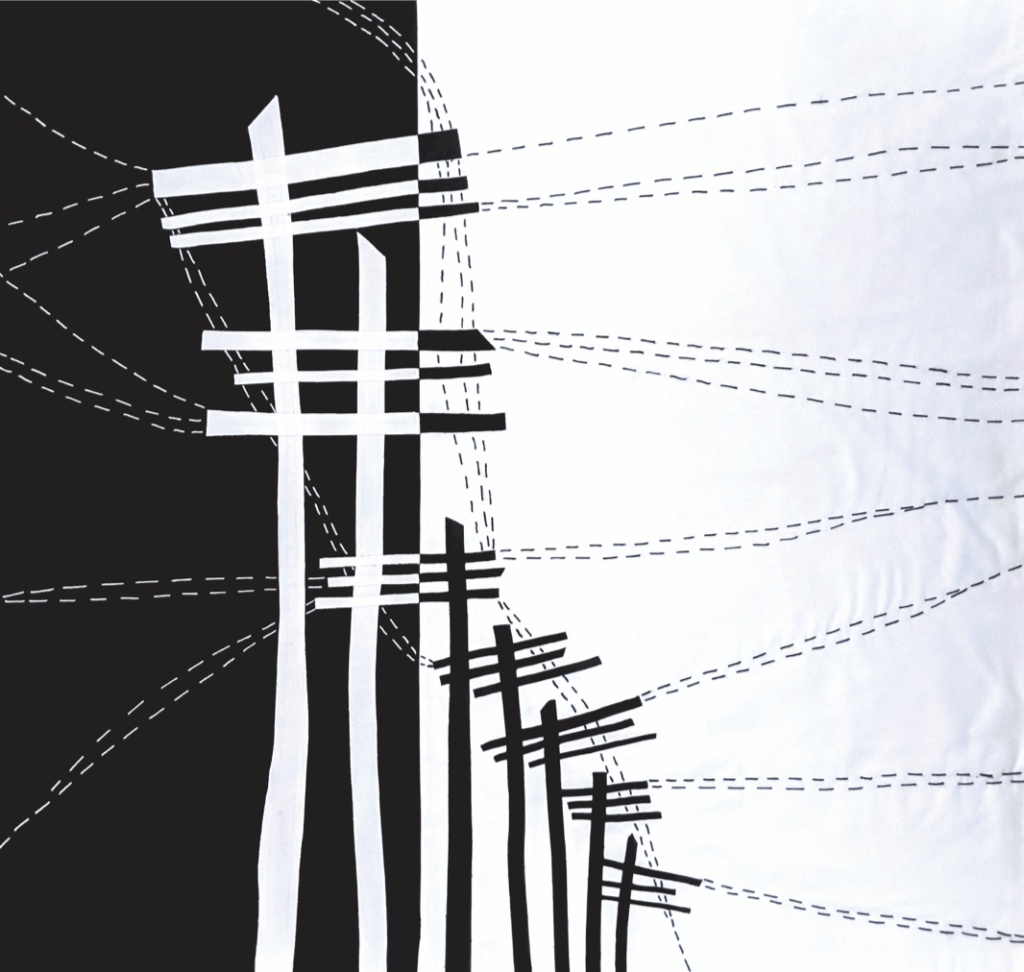
Susan Sadilek 2020
33.5” x 31.6”
Telephone poles: raw edge applique (straight stitched, not zigzagged stitched) and machine quilted.
Telephone lines: hand quilted
Experimental “binding”: created by undercutting the batting and backing, then wrapping and hand stitching the front panel around the back to finish the outer edges.
 Connections in Narrative Medicine