Narrative Medicine Book Club: April 8, 2020

I’m curious to hear what readers make of the priest’s sermon, which goes on for four pages, quite a bit of real estate in the novel! What comment might Camus be making here about the ways the plague can potentially be moralized? The priest literally says ‘my brethren, you have deserved it’ – he likens them to the cities of Sodom and Gomorrah, to the population before the flood (and who else shivered at the reference to Lombardy, Italy, ‘ravaged by a plague’), implying that the plague has been visited on them because of their sins, then arguing that somehow, “‘through the paths of death, anguish and sighs, [it] still guides us toward the silence of God and the principle of all life.'” I wonder what will come of this sermon in the rest of the book, if it is here to show us an example of how suffering can be “used” in various ways, or if Camus will take it back up later and somehow show this thinking to be untrue (Perhaps Paneloux himself will get sick)? 


FOR TOMORROW: Read next 7 pages, to end of the paragraph that begins “On the other hand, when Tarrou came back…” 


Narrative Medicine Book Club: April 7, 2020

In today’s pages we see the toll that the work is starting to have on Rieux. The “abstraction” (for those reading the French, I’m curious if this is the correct translation?) of the disease, and of the personal suffering that follows it, is taken up, the “monotony” of the plague and life under its tyranny. And we see Rieux’s capacity narrowing, in perhaps the most heartbreaking few sentences in the book so far: “[He] found his only consolation for these exhausting days in this feeling of a heart slowly closing around itself. He knew that it would make his task easier. That is why he welcomed it.” I wonder how many of us — healthcare providers or not — recognize ourselves in this statement?  “To struggle against abstraction, one must come to resemble it a little.” This is a statement that makes so much sense, and yet it seems clear this numbness, this “abstraction,” is exactly what we must continue to resist. 

FOR TOMORROW: read next 7 pages, to the section break, paragraph beginning with “But the sounds of running feet returned.” 


Live Virtual Group Session: 6pm EST April 6th 2020

Dear Participants,

We want to start by acknowledging that we all just experienced something very difficult. Despite our efforts to increase security over the last few days, obviously we were unsuccessful, and what we feared would happen, did. We share your horror and we need to extend apologies and solidarity in acknowledging the hateful act we experienced today. 

We will be pausing all of our upcoming sessions while we explore new options to make our meetings more secure. As we hope most of you know, creating the safest spaces possible is of utmost priority for us. We worry a lot about this new virtual world we find ourselves in now, and while we very much want to continue to do this work with you — we feel how vital it is in this moment — we also want to do it as securely as we can.

Please check back on our blog in the coming week with updates on our new course of action — rest assured we will be working to get back up and running, in some form, as soon as possible. 

In the meantime, although we had to cut the session short, we want to share the prompt we had planned on using following our discussion of this session’s text – “The Mailman” by Nazim Hikmet. The prompt was: “Write a letter you’d like to deliver.” When you can and if you wish, please take a few minutes to write to this prompt. We encourage you, as well, to post what you write below. 

The full text we read in our session is posted below. So many of you shared such wonderful things in response to the poem; we all looked to the different ways in which the mailman carries his messages of hope “in the bag of my heart,” “heaven is in my bag,” and “a mailman bears all manner of pain.” We also spoke about the presence of landscape as a place in which life occurs, and how everything seems to be packaged into this landscape. We discussed the sense of motion and travel (carrying news, crossing the Bering Strait), the different metaphors of what the mailman carries, both the political and the deeply personal dimensions of the poem as well as the construction of the city and the different perception from within and outside of it. Our participants pointed to the parallels between the challenges of the mailman and those of healthcare professionals delivering news to patients and families – a context that resonates with so many of us, especially during this difficult time. 

In our session today, we read about a mailman’s travels and deliveries. We are determined that our message and work continues to reach you.

Sincerely,

The Narrative Medicine Team

The Mailman, Nazim Hikmet  from Hungarian travel notes
Author(s): NAZIM HIKMET, Randy Blasing and Mutlu Konuk
Source: The American Poetry Review, Vol. 23, No. 2 (MARCH/APRIL 1994), pp. 38-39
Published by: Old City Publishing, Inc.

 
Whether at dawn or in the middle of the night,
I've carried people news
– of other people, the world, and my country,
of trees, the birds and the beasts –
in the bag of my heart.
I've been a poet,
which is a kind of mailman.
As a child, I wanted to be a mailman,
not via poetry or anything
but literally – a real mail carrier.
In geography books and Jules Verne's novels
my colored pencils drew a thousand different pictures
of the same mailman– Nazim.
Here, I'm driving a dogsled
over ice,
canned goods and mail packets
glint in the Arctic twilight:
I'm crossing the Bering Strait.
Or here, under the shadow of heavy clouds on the steppe,
I'm handing out mail to soldiers and drinking kefir.
Or here, on the humming asphalt of a big city,
I bring only good news
and hope.
Or I'm in the desert, under the stars,
a little girl lies burning up with fever,
and there's a knock on the door at midnight:
"Mailman!"
The little girl opens her big blue eyes:
her father will come home from prison tomorrow.
I was the one who found that house in the snowstorm
and gave the neighbor girl the telegram.
As a child, I wanted to be a mailman.
But it's a difficult art in my Turkey.
In that beautiful country
a mailman bears all manner of pain in telegrams
and line on line of grief in letters.
As a child, I wanted to be a mailman.
I got my wish in Hungary at fifty.
Spring is in my bag, letters full of the Danube's shimmer,
the twitter of birds,
and the smell of fresh grass –
letters from the children of Budapest
to children in Moscow.
Heaven is in my bag . . .
One envelope
writes:
"Memet, Nazim Hikmet's son,
Turkey."
Back in Moscow I'll deliver the letters
to their addresses one by one.
Only Memet's letter I can't deliver
or even send.
Nazim's son,
highwaymen block the roads –
your letter can't get through.

Narrative Medicine Book Club, April 6, 2020

This quote made me think about the many ways we’ve seen populations of people around the world respond to our plague, swiftly or not-so-swiftly accepting “the idea of the disease.” In today’s pages Camus continues to explore the beginning stages of the way this is hitting Oran — shops and offices close, and “many people, …reduced to inactivity, …filled the streets and cafés.” They go to the movies! And the grocer who “stockpiled supplies so he could sell them at a large profit,” found with tins of food under his bed when they took him to the hospital. We have all been seeing behaviors that echo these (as well, of course, as behavior that is in effect the opposite). I was touched too by the conversation with the journalist who is now trapped in Oran, separated from the woman he loves — “‘I wasn’t put on this earth to make reports; but perhaps I was put on earth to live with a woman.'” We are all also experiencing now, for better and worse, the ways our moment is forcing us to wrestle with what really matters; also how difficult it can be to grasp these things, even if we can recognize what they are.


FOR TOMORROW: Read next 7 pages, up to the end of the paragraph that begins “Outside the rain…”


Narrative Medicine Book Club: April 5, 2020

In our first meeting today (thank you again to all who joined!!) we spoke about how Camus’ book, written as an allegory, reads so eerily today as a realistic playbook. Today’s pages were astounding again in this light: here the narrator speaks of “exile,” the citizens of the town cut off from each other and from their loved ones elsewhere, “prisoners” in their quarantine. “…That unreasonable desire to go backwards or, on the contrary, to speed up the march of time, those burning arrows of memory – all this really did amount to a feeling of exile.” He writes of the strange sense of time we are all dealing with — hope for the future, without knowing when the future will arrive, creates despair, but then the lack of  imagination for the future is a different kind of prison. “Impatient with the present, hostile to the past and deprived of a future, we really did then resemble those whom justice or human hatred has forced to live behind bars…But, though this was exile, in most cases it was exile at home.” 


FOR TOMORROW: Read next 7 pages, up to, in dialogue, “‘Perhaps you don’t realize what a separation such as this means for two people who are fond of one another.'” 


Live Virtual Group Session: 12pm EST April 5th 2020

Thank you to the 58 of you who joined us for this session!

Our text for this session was an excerpt from There, There by Tommy Orange. (2018) New York: Alfred A. Knopf (text posted below).

Our prompt for the session was: “Write about a rhythm.”

It was wonderful to see new and familiar faces today.  Our group of 58 people zoomed in from Athens, Jerusalem, Lisbon, the UK, many points in Canada and across the USA, from the South Bronx to Santa Monica, from Jacksonville to Shaker Heights.

The Tommy Orange excerpt brought up themes of journeying, dreams of the future, randomness, the inevitable, tempo and time, and being out of step.  And participants responded with clarity and precision to one another’s writing, to the  particularity of images: “an epigenetic storm of immigrant dreams and bereavement,” “a blue light,” “a red rooster clock,” with its tick tock that traveled from home to hospital and back, a balm to one and a bomb to the other.

Participants are warmly encouraged to share what you wrote below (“Leave a Reply”), to keep the conversation going here, bearing in mind that the blog of course is a public space where confidentiality is not assured.

Please see below for some examples of the kind of writing people produced in just four minutes!

Please join us for our next session: Monday, April 6th at 6pm EST, with more times to be announced shortly.

AND PLEASE NOTE: in an effort to make these sessions more secure, there will be an individual link for each session with a quick registration. Allow an extra minute to do this when logging in.

Please bookmark the Live Virtual Sessions page (or access directly from the navigation above) – this is where you should always come to find access instructions before each live session.

We look forward to seeing you again soon!


Text Excerpt from There, There by Tommy Orange:

Before you were born you were a swimmer. You were a race, a dying off, a breaking through, an arrival. Before you were born, you were an egg in your mom who was an egg in her mom. Before you were born, you were the nested Russian grandmother doll of possibility in your mom’s ovaries. You were two halves of a thousand different kinds of possibilities, a million heads or tail, flip-shine on a spun coin. Before you were born, you were the idea to make it to California for gold or bust. You were white, you were brown, you were red, you were dust. You were hiding, you were seeking. Before you were born, you were chased, beaten, broken, trapped on a reservation in Oklahoma. Before you were born, you were an idea your mom got into her head in the seventies, to hitchhike across the country and become a dancer in New York. You were on your way when she did not make it across the country but sputtered and spiraled and wound up in Taos, New Mexico, at a peyote commune named Morning Star. Before you were born, you were your dad’s decision to move away from the reservation, up to northern New Mexico to learn about a Pueblo guy’s fireplace. You were the light in your parents’ eyes as they met across that fireplace in ceremony. Before you were born, your halves inside them moved to Oakland. Before you were born, before your body was much more than heart, spine, bone, brain, skin, blood, and vein, when you’d just started to build muscle with movement, before you showed, bulged in her belly, as her belly, before your dad’s pride could belly-swell from the sight of you, your parents were in a room listening to the sound your heart made. You had an arrhythmic heartbeat. The doctor said it was normal. Your arrhythmic heart was not abnormal.

“Maybe he’s a drummer,” your dad said.
“He doesn’t even know what a drum is,” your mom said.
“Heart,” your dad said.
“The man said arrhythmic. That means no rhythm.”
“Maybe it just means he knows the rhythm so good he doesn’t always hit it when you expect him to.”

Orange, Tommy. There, There. (2018) New York: Alfred A. Knopf


Narrative Medicine Book Club: April 4, 2020

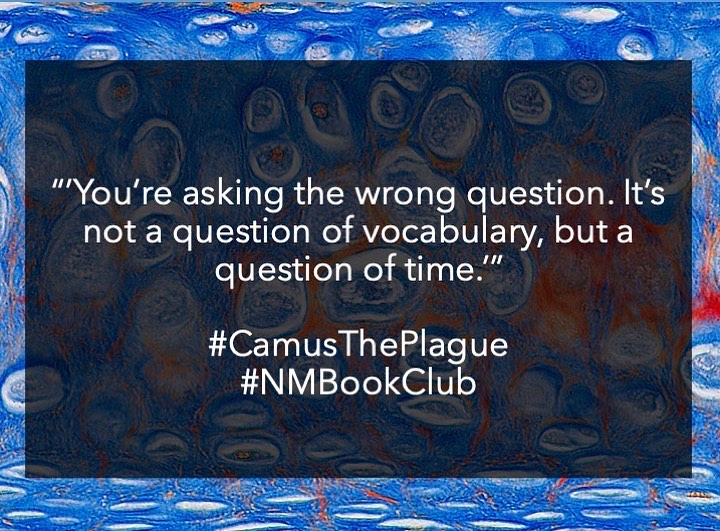
Rieux tells the Prefecture that what they are doing is not enough. In response, the Prefecture says he will ask for “instructions” from the State government, to which Rieux responds with the above. I am struck by the word “imagination” here – is this the correct translation, for those reading the French? – and wonder how Rieux means it. Today’s pages seemed to me to be all about fear – the theme comes up again and again. Rieux is afraid, and pushes it away; the sick are afraid; the townspeople are beginning to be afraid; and at the end of Part One, it seems the State government is afraid, issuing the edict to “close the town.” Somehow I feel that word “imagination” is going to continue to reverberate as we move forward, a need that is perhaps likely to be unmet…? 


FIRST ZOOM CALL TOMORROW AT 2pm EASTERN on the Narrative Medicine zoom: https://zoom.us/j/3572167251 Join us! All are welcome. 

FOR SUNDAY (but not before the meeting!): Read to the end of the first section in Part II. 


Live Virtual Group Session: 6pm EST April 3rd 2020

Thank you to everyone who joined us for this session!

58 participants joined us from all over the country and even the world: from San Francisco to NYC, from Canada to Texas,  from Seattle to West Virginia, and even as far as Greece!

The text we read together was Days by Philip Larkin. In reading the poem out loud more than once, we noticed how we paid attention to different parts of the poem in virtue of our readers’ different voices and expressivity. In our discussion, we pointed to the ways in which time and space converge in the text, aided by the author’s stylistic choices (even just beginning from the punctuation!). We reflected on the ways in which “the days are where we live”, particularly from the perspective of the multitude of roles and identities we each brought into our space. 

After 20 minutes of discussion, we wrote to the prompt “Write about the day that brought you here”. We were amazed at the talent and beauty we heard in the writings shared, each offering insight into the variety of paths that make our community such a rich space. We discussed the presence of time in our responses to the piece: in the recognition of the “precariousness of each precious day” or in the “weight of the variety of responsibilities” accompanying our journeys to the present.

Participants are warmly encouraged to share what you wrote below, to keep the conversation going here, bearing in mind that the blog of course is a public space where confidentiality is not assured.

Please join us for our next session: Sunday April 5th at 12pm EST, with more times to be announced shortly.

AND PLEASE NOTE: in an effort to make these sessions more secure, starting next week we will be having individualized registration for these sessions which will be accessed from the Live Virtual Sessions page of the blog.

We look forward to seeing you again soon!

Days
BY PHILIP LARKIN

What are days for?
Days are where we live.   
They come, they wake us   
Time and time over.
They are to be happy in:   
Where can we live but days?

Ah, solving that question
Brings the priest and the doctor   
In their long coats
Running over the fields.

Philip Larkin, "Days " from Whitsun Weddings. Copyright © Estate of Philip Larkin.  Reprinted by permission of Faber and Faber, Ltd.

Narrative Medicine Book Club: April 3, 2020

The meeting of the doctors at the Prefecture is fascinating. If they declare that the disease is the plague, “then they will have to take stern measures,” so they hesitate to declare it. Rieux argues that it doesn’t matter what you call it – “all that matters is that you stop it killing half the town.” Impossible to read this scene today in America and not think about the language that has and has not been used to describe and warn the public, to lead (and of course to mislead) action and inaction. Is public “panic” a thing that can be avoided? Rieux is rightly concerned with halting the disease, no matter what it is called, which can only be done through preventative health measures – though how interesting that early in this pages he says “‘perhaps we should make up our minds to call this disease by its proper name.'” #camustheplague #nmbookclub

FOR TOMORROW: Read to the end of Part 1!

And don’t forget to join our FIRST ZOOM CALL on Sunday at 2pm Eastern on the Narrative Medicine zoom — https://zoom.us/j/3572167251


Narrative Medicine Book Club: April 2, 2020

The word “plague” is spoken for the first time in today’s pages. So interesting to see Rieux wrestling with his own consciousness, calming himself down, talking himself out of his darkest thoughts, all filtered through the narrator who knows everything that is about to happen. I’m struck by the talk of the historical plagues – that amazing list of ancient images that run through Rieux’s head – and the comparison between a “known” death and a statistic. Rieux attempting to imagine what 10k dead looks like (“five times the audience in a large theater”). “When one has fought a war, one hardly knows any more what a dead person is. And if a dead man has no significance unless one has seen him dead, a hundred million bodies spread through history are just a mist drifting through the human imagination.” This feels so very relevant to today, as more of us in today’s moment come to know the personal toll of our current plague, and see the conversation shifting back and forth between the personal and the statistical. And Rieux’s conclusion seems one that many healthcare providers are also, I imagine, finding comfort in, when they can: “This was certainty: everyday work. The rest hang by threads and imperceptible movements; one could not dwell on it.” 


FOR TOMORROW: read next 7 or so pages, ending with “…was turning her face to him.” 


Join our FIRST ZOOM CALL SUNDAY, 2pm Eastern, on the
Narrative Medicine Zoom!