
17 participants from MA, ME, NJ, NY, PA, Montreal and United Kingdom joined us today for our Monday session. Today, we welcomed three new participants! All together, we close-looked the painting “Before the Shot” by Norman Rockwell (you can find it at the end of this blog). Our Zoom room filled with many smiles as people made connections to their own experiences as children going to the doctor or to our present moment of waiting-for-the-vaccine.
Several participants drew attention to the color dominating the canvas, as they were struck by all the green: even the doctor’s head is green! We followed were the color green took us – whether to the green theme of The Great Gatsby or green as a code for “go!” We saw it all come together in the space conveyed by the painting. Is this a home office? A rural setting?
We wondered who is absent in this painting – are the child’s parents in the room? “We would think so,” someone volunteered; someone else pointed how, at the time the painting was completed, there may have been “different standards, trust, and behaviors”. A coat and a hat, presumably the child’s, are not held by parent. Is the winter cap (with earmuffs) the painter’s way of signaling the season? Another person thought the hat and coat were neatly hung on the chair so it “must have been parent not 8-year-old boy”.
We focused on the boy, with many noting that he was reading the diploma on the wall. “Can he even read”? someone asked. Collectively, we reflected on what this reading of the diploma raises for us. “He’s checking out who is this person about to give him the shot – is he worth trusting?” pointed out one participant.
Before we revealed title and painting, several in the room recognized that the illustrator is Norman Rockwell, transported to the scenes from ordinary life he brought to the canvas in the 1950s. Immediately, we also thought of the COVID-19 vaccine being administered this week for the first time in US, and of the tale-as-old-as-time that is the complex relationship between patients and their healthcare providers. We returned to reading the body language of the boy, with some reading interest (in his reading); some seeing “trust”; several worried about his balance. What was he standing on? Was he instructed to stand on the chair? Was he told to lower his pants… does he know the drill? The “pinch” that is about to come next? “Trust and vulnerability is captured,” one participant concluded. Hinting at the diploma, we, too, wondered – is he qualified to do this? One person said the style of illustration conveys lightness and “Everything Will Be Okay.” Several participants, recalling their childhoods and different practice standards of the past: how “doctors used to deceive the kids”, and how that may come through the painting as well (the physician seems to be drawing the fluid in secret, his back to a kid who likely doesn’t have a clue). “Doctors used to sneak out on kids and did things without instructions and parental involvement,” added another participant. How have things changed today? Do we have more or less trust in the medical establishment, today compared to yesterday? “We are much more open to questions, these days,” someone volunteered. “That’s a good thing,” someone else concluded.
In a second moment, we focused more on the provider. Many recognized the familiar emotion of wanting to be transparent, and caring for patients’ health… while also protecting them from their fears. When should providers do when they don’t want a procedure or experience to be painful, or when they are concerned that one unpleasant experience will set the stage with fear of future clinical encounters? Should we turn our backs? Ask our patients to look away? Say it won’t hurt, or that “it will be over in a minute”? It was helpful to have two practitioners talk of their experiences of knowing they were inflicting pain, while wanting to minimize the pain they knew was a necessity or – at least – a greater good. Finally, we wondered – what would this picture look like two minutes from now? And whose perspective is this painting from?
Before writing to the prompt, we asked participants to drop into the chat possible titles:
Bottoms Up
Any Minute Now
Don’t Worry This Won’t Hurt a Bit
Just Trust Me
Almost Done
The Family Doctor
Full Disclosure
Three people read aloud what they wrote to the prompt: Write about trust and distrust.
One was filled with childhood belief and disbelief: wondering if her parents were aliens–complete with looking for zippers and seams! Another text was filled with questions about what allows for trust and/or mistrust “two sides of the same coin” and if it can be “flipped.” If one crosses the boundary between the two, is it possible to go back? A participant responded to the reader with her interest in the “facets” of trust and associating valuable gems, like diamonds also having facets, and how valuable trust is.
Another reader performed her “worry” but repeating “Yes, I am a worrier” as she reflected on clinical encounters with her primary care doctor and other specialists. How she knows she knows her body and, when her physician doesn’t order tests she wants, it can feel “stingy.” This led to the group discussing the economics of healthcare and, with participants from countries with universal health care, how different our concerns and perspectives can be.
Participants are warmly encouraged to share what you wrote below (“Leave a Reply”), to keep the conversation going here, bearing in mind that the blog of course is a public space where confidentiality is not assured.
Also, we would love to learn more about your experience of these sessions, so if you’re able, please take the time to fill out a follow-up survey of one to two quick questions!
Please join us for our next session Wednesday, December 16th at 12pm EST, with more times listed on our Live Virtual Group Sessions page.
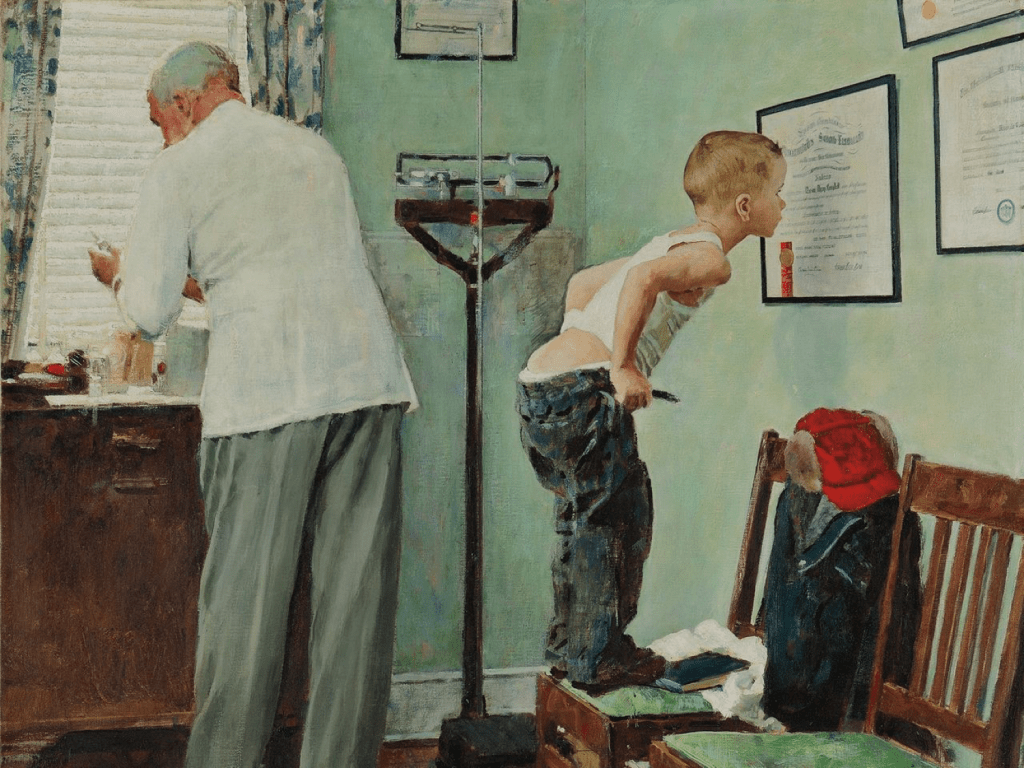
signed “Norman Rockwell” lower center
oil on canvas
29 x 27 in. (73.5 x 68.5 cm.)
Painted in 1958.
 Connections in Narrative Medicine