Live Virtual Group Session: 6pm EST April 3rd 2020

Thank you to everyone who joined us for this session!

58 participants joined us from all over the country and even the world: from San Francisco to NYC, from Canada to Texas,  from Seattle to West Virginia, and even as far as Greece!

The text we read together was Days by Philip Larkin. In reading the poem out loud more than once, we noticed how we paid attention to different parts of the poem in virtue of our readers’ different voices and expressivity. In our discussion, we pointed to the ways in which time and space converge in the text, aided by the author’s stylistic choices (even just beginning from the punctuation!). We reflected on the ways in which “the days are where we live”, particularly from the perspective of the multitude of roles and identities we each brought into our space. 

After 20 minutes of discussion, we wrote to the prompt “Write about the day that brought you here”. We were amazed at the talent and beauty we heard in the writings shared, each offering insight into the variety of paths that make our community such a rich space. We discussed the presence of time in our responses to the piece: in the recognition of the “precariousness of each precious day” or in the “weight of the variety of responsibilities” accompanying our journeys to the present.

Participants are warmly encouraged to share what you wrote below, to keep the conversation going here, bearing in mind that the blog of course is a public space where confidentiality is not assured.

Please join us for our next session: Sunday April 5th at 12pm EST, with more times to be announced shortly.

AND PLEASE NOTE: in an effort to make these sessions more secure, starting next week we will be having individualized registration for these sessions which will be accessed from the Live Virtual Sessions page of the blog.

We look forward to seeing you again soon!

Days
BY PHILIP LARKIN

What are days for?
Days are where we live.   
They come, they wake us   
Time and time over.
They are to be happy in:   
Where can we live but days?

Ah, solving that question
Brings the priest and the doctor   
In their long coats
Running over the fields.

Philip Larkin, "Days " from Whitsun Weddings. Copyright © Estate of Philip Larkin.  Reprinted by permission of Faber and Faber, Ltd.

Narrative Medicine Book Club: April 3, 2020

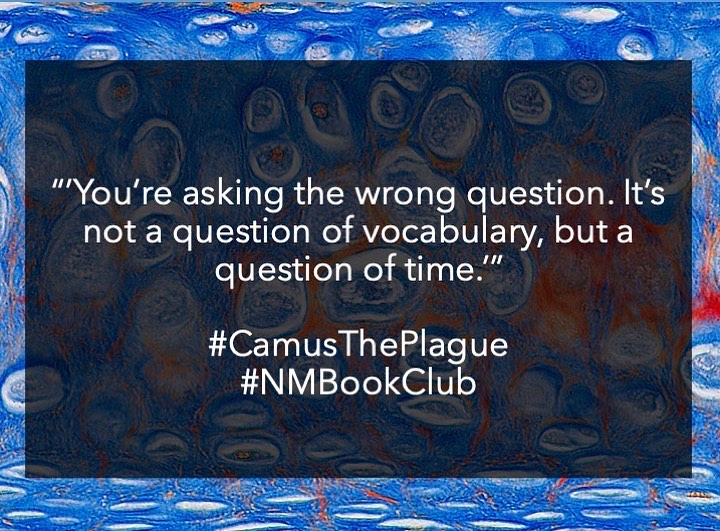
The meeting of the doctors at the Prefecture is fascinating. If they declare that the disease is the plague, “then they will have to take stern measures,” so they hesitate to declare it. Rieux argues that it doesn’t matter what you call it – “all that matters is that you stop it killing half the town.” Impossible to read this scene today in America and not think about the language that has and has not been used to describe and warn the public, to lead (and of course to mislead) action and inaction. Is public “panic” a thing that can be avoided? Rieux is rightly concerned with halting the disease, no matter what it is called, which can only be done through preventative health measures – though how interesting that early in this pages he says “‘perhaps we should make up our minds to call this disease by its proper name.'” #camustheplague #nmbookclub

FOR TOMORROW: Read to the end of Part 1!

And don’t forget to join our FIRST ZOOM CALL on Sunday at 2pm Eastern on the Narrative Medicine zoom — https://zoom.us/j/3572167251


Live Virtual Group Session: 7pm EST April 1st 2020

Thank you to everyone who joined us for this session!

Forty-nine people from around the world (Bahrain, United Kingdom, Qatar, other places typed into the chat?) gathered for an hour in Narrative Medicine’s Zoom Room to read the prologue to Planet of the Blind, Stephen Kuusito’s memoir of living with retinopathy, the result of his being placed in an over- oxygenated incubator soon after his premature birth.   

In the prologue (text posted below), readers meet Kuusito  with his dog Corky navigating Grand Central Station “a temple for Hermes…with no idea …how to find our train.” One Zoom participant responded to the renderings of a man, who is able to see “colors and shapes that seem windblown” and guides the sighted with words and images of “hemlock darknesses and sudden pools of rose-colored electric light.” A close reader drew our attention to a single word in the sentence, “There is something about us…” and considered the possible use of “aboutto reference subjects (in this case a man and his dog) or to point to what surrounds or is “about” them. Another participant noticed the many images, which the narrator conjured from nature: not only animals and hemlocks but also a gibbous moon as he walks through the vaulted railway station. One person liked that he invoked his dog’s name four times. Another mentioned the narrator’s reference to himself and Corky as two slow moving sea lions. She noted that those creatures are awkward on land but, in their element, are graceful and strong. For one reader this text evoked another text. She drew a parallel between Virgil guiding Dante and the railway employee offering to guide the memoirist.

On Zoom we had two senses: vision and hearing, yet, guided in words through the scene, we were able to feel “a breeze from Jerusalem” and a gentle touch when Kuusito decides to trust a stranger, take his elbow, and welcome readers “to the planet of the blind.”

After twenty minutes of discussion, we wrote to the prompt: “Write about your planet.”

Before inviting people to read, the facilitators asked people to respond to each other’s work as they had to the published work, not interviewing the writer or asking more of a piece than what it can furnish in four minutes of writing.

Three people read aloud and a dozen responded to their renderings of “our”planet (as one person wrote) with children playing and flowers blooming; a grocery store aisle where the narrator is afraid of the virus and afraid to talk to another shopper; and a backyard with deer and giant birds (related to dinosaurs), a planet preserved for wildlife.  

Participants are warmly encouraged to share what you wrote below, to keep the conversation going here, bearing in mind that the blog of course is a public space where confidentiality is not assured.

Please join us for our next session: Friday April 3rd at 6pm EST, with more times to be announced shortly.

As before, due to the wonderful turnout for these sessions, we encourage you to join as promptly as possible: After a ten minute grace period, we will be closing the Zoom session to preserve the integrity of the session for those joined. If you try to join past that time and are unable, we encourage you to join the next session! More times and opportunities will be announced soon.

We look forward to seeing you again soon!

I’ve entered Grand Central Station with guide dog Corky, my yellow Labrador. We stand uncertain, man   and dog collecting our wits while thousands of five o’clock commuters jostle around us. Beside them,   Corky and I are in slow motion, like two sea lions. We’ve suddenly found ourselves in the ocean, and   here in this railway terminal, where pickpockets and knife artists roam the crowds, we’re moving in a   different tempo. There is something about us, the perfect poise of the dog, the uprightness of the man, I   don’t know, a spirit maybe, fresh as the gibbous moon, the moon we’ve waited for, the one with the new  light.

So this is our railway station, a temple for Hermes. We wash through the immense vault with   no idea about how to find our train or the information kiosk. And just now it doesn’t matter. None of the   turmoil or anxiety of being lost will reach us because moving is holy, the very motion is a breeze from Jerusalem.

 This blindness of mine still allows me to see colors and shapes that seem windblown; the great   terminal is supremely lovely in its swaying hemlock darknesses and sudden pools of rose-colored electric   light. We don’t know where we are, and though the world is dangerous, it’s also haunting in its beauty.   Even to a lost man with a speck of something like seeing, this minute here, just standing, taking in the air   as a living circus, this is what tears of joy are for.

 A railway employee has offered to guide me to my train. I hold his elbow gently, Corky heeling   beside us, and we descend through the tunnels under the building. I’ve decided to trust a stranger.

 Welcome to the planet of the blind.      

Kuusito, Stephen. Planet of the Blind (1998) New York: Dial Press.


Narrative Medicine Book Club: April 1st, 2020

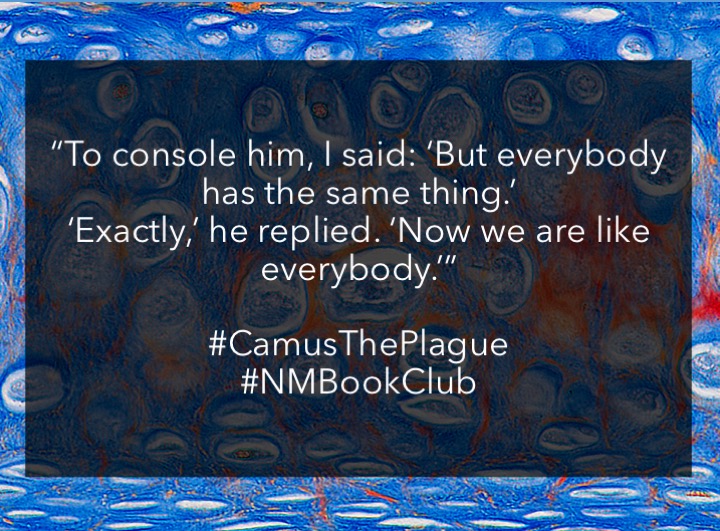
This idea of illness as equalizer (though technically in this quote they are talking about the plague of rats and not yet of humans) really resonates in today’s pages. There’s another moment in these pages where this comes up — when Tarrou is describing the two tram conductors talking about someone who has died: “‘Even so, he seemed like anyone else,'” says one, and the other answers “‘No, he had a weak chest.'” We see people doing this so much these days, too, trying to find the reason why one person succumbs where another doesn’t, as if there is a map to follow, a clear way to reliably separate the population into categories. What happens if we are are all “like everybody?”


I’m also very interested in the way the narrator is taking shape … he reliably refers to “our” town, but then never uses the first person, referring instead repeatedly to “the narrator” in the third person. Also interesting how the narrator is beginning to bring in other “sources,” while maintaining a main narrative voice that nonetheless seems to know things that he probably wouldn’t, unless the narrator is actually Rieux himself? (I’m sure many of you already know the answer here but please don’t reveal it yet!) 


FOR TOMORROW: Read the next 7 or so pages (actually tomorrow it’s more like 8!), up to “The main thing was to do one’s job well.” 

ALSO ANNOUNCING OUR FIRST ZOOM MEETING TIME! Sunday, April 5th, at 2pm Eastern via Narrative Medicine Zoom.


Live Virtual Group Session: 7pm EST March 31st 2020

It was wonderful to meet with last night’s group for our second live session, coming together from around the globe –from Brooklyn to San Francisco, Canada to Qatar. We were profoundly uplifted to see so many people share in this experience. The responses, spoken and written, were unforgettable.

The poem we read together was “Wait” by Galway Kinnell, posted below.  It helped us think about how very strange time has become under the conditions of pandemic, and about trust, and where it can be nurtured, “Distrust everything, if you have to./But trust the hours.”   Recognizing how weary many of us feel at this moment, the poem also opened the topic of fatigue, “You’re tired. But everyone’s tired./But no one is tired enough.”  And very powerful recollections were stirred by the imagery of “second-hand gloves,” “their memories are what give them the need for other hands.”

Our prompt was: “Write about a recent time when you trusted the hours.”  The writing produced and read aloud was rich with imagery and emotion, and our participants listened attentively and showed great appreciation and empathy for one another.  One particular piece drew our attention to the elements of time and hope in our processing of loss.

Participants are warmly encouraged to share what you wrote below, to keep the conversation going, bearing in mind that the blog of course is a public space where confidentiality is not assured.

Please join us for our next session: Wednesday April 1st at 7pm EST, with more times to be announced shortly.

As before, due to the wonderful turnout for these sessions, we encourage you to join as promptly as possible: After a ten minute grace period, we will be closing the Zoom session to preserve the integrity of the session for those joined. If you try to join past that time and are unable, we encourage you to join the next session! More times and opportunities will be announced soon.

We look forward to seeing you again soon!

Wait
Copyright © 1980 by Galway Kinnell. From Mortal Acts, Mortal Words (Mariner Books, 1980).

Wait, for now.
Distrust everything, if you have to.
But trust the hours.  Haven’t they
carried you everywhere, up to now?
Personal events will become interesting again.
Hair will become interesting.
Pain will become interesting.
Buds that open out of season will become lovely again.
Second-hand gloves will become lovely again,
their memories are what give them
the need for other hands.  And the desolation
of lovers is the same: the enormous emptiness
carved out of such tiny beings as we are
asks to be filled; the need
for the new love is faithfulness to the old.

Wait.
Don’t go too early.
You’re tired.  But everyone’s tired.
But no one is tired enough.
Only wait a while and listen.
Music of hair,
Music of pain,
music of looms weaving all our loves again.
Be there to hear it, it will be the only time,
most of all to hear,
the flute of your whole existence,
rehearsed by the sorrows, play itself into total exhaustion.

Narrative Medicine Book Club: March 31st, 2020

For today, Tuesday March 31st, we read up to: “He was now complaining of internal pains.”

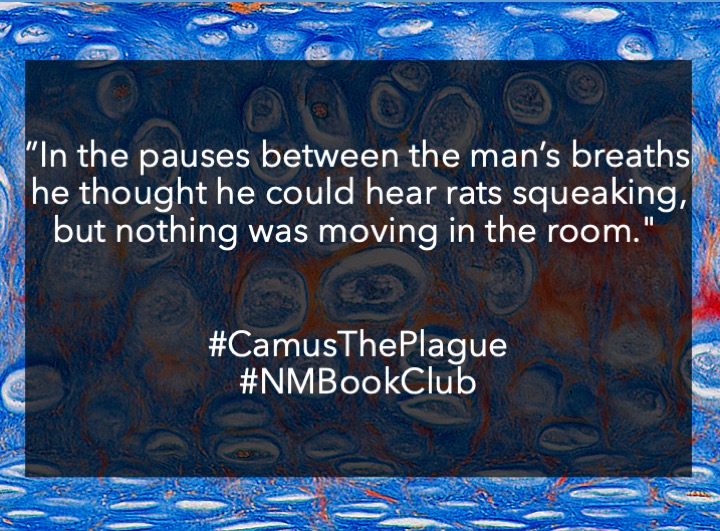
The ominousness is building in today’s pages. I thought the above quote was so powerful for how it shows the way Rieux’s consciousness is changing in the face of the threat; the rats become the symbol of the fear, the sense of what’s on the horizon. Also so interesting the way that class is already playing in here — “some families who had seaside homes were already talking about escaping to them,” and the civil servant who says “‘I have other concerns.'” Struck too by Infodoc, “the agency for information and documentation,” and the fact that when the numbers are shared, it gives “a clear meaning to the daily spectacle that everyone had in front of their eyes” — that disconnect between statistics and lived reality, and how it can be one or the other of these things that brings a truth home to us. (And dare we point to the way the authorities are handling things? “The authorities had not considered or planned anything at all, but started by holding a council meeting to discuss it.” Sounds familiar…) — Nellie.

Please feel free to add to the discussion and join in with Nellie below, or on any of your social media channels using #NMBookClub and #CamusThePlague!

FOR TOMORROW: read the next 7 pages, up to “‘Let me know if you have any other cases,’ said Rieux.”


Live Virtual Group Session: 7pm EST March 30th 2020

Thank you SO MUCH to all who joined us for our first virtual group session!! We had 66 people on the zoom meeting — there were folks from New York and New Jersey but also from Texas, North Carolina, California, Georgia, Alabama, and other countries all over the world — China, Morocco, Argentina, Greece, Brazil, the UK, Poland, and more! Wow. What an incredible thing, to get to come together and feel the collective energy in that virtual space.

The poem that we read together was “Wild Geese,” by Mary Oliver. We spoke about how the poem seems to juxtapose the idea and feeling of loneliness with the concept of the “the family of things,” and how it offers different ideas of intimacy with “the soft animal of your body” and “the world offers itself to your imagination.”

The prompt we wrote to was: “Meanwhile, the world goes on.” We were only able to hear three pieces, but what we heard was incredible — each piece speaking to our current moment, and each piece full of hope. One response, written as a poem, was unfinished due the time constraint for the writing, and it was observed how this was representative of our current moment — we are constructing a response to this global situation, but are not yet finished.

Please, those of you who were on the call with us, we encourage you to share your work with us in the comments below, and to respond to one another there and keep up the conversation. The full text of the poem is below, and please join us for one of our next sessions: Tuesday March 31st at 7pm EST and Wednesday April 1st at 7pm EST, with more times to be announced soon.

Again, due to the wonderful turnout for this first session, we encourage you to join as promptly as possible: After a ten minute grace period, we will be closing the Zoom session to preserve the integrity of the session for those joined. If you try to join past that time and are unable, we encourage you to join the next session! More times and opportunities will be announced soon.

We look forward to seeing you all with us again!

Wild Geese, by Mary Oliver
Originally published in “Dream Work” by Atlantic Monthly Press, 1986.

You do not have to be good.
You do not have to walk on your knees
for a hundred miles through the desert repenting.
You only have to let the soft animal of your body
love what it loves.
Tell me about despair, yours, and I will tell you mine.
Meanwhile the world goes on.
Meanwhile the sun and the clear pebbles of the rain
are moving across the landscapes,
over the prairies and the deep trees,
the mountains and the rivers.
Meanwhile the wild geese, high in the clean blue air,
are heading home again.
Whoever you are, no matter how lonely,
the world offers itself to your imagination,
calls to you like the wild geese, harsh and exciting –
over and over announcing your place
in the family of things.

Narrative Medicine Book Club: March 30th, 2020

Welcome to day one of the Narrative Medicine book club! We will be reading at the pace of about seven pages per day, depending on your chosen edition and mode of reading: print, electronic, or audible book. For today, Monday March 30th, 2020, we will be reading up to the sentence: “he wanted to know if the journalist could tell the truth.”

Remember – no need to register to join us, and don’t worry if you don’t have the book yet! We will be reading very slowly, so it will be easy to catch up, and because the club is virtual, you can follow along at your own pace. Feel free to join the discussion here, or just use #NMBookClub and #CamusThePlague to post comments or questions and follow along on social media. Later this week we will announce our first virtual Zoom meeting for those who want to discuss in person.

Some initial thoughts on today’s reading: 

“Camus very carefully sets up this fictional town, Oran, as an “ordinary,” “neutral” place, a “town without inklings,” “an entirely modern town” – and as such, a town where it is difficult to die. He says this on page 2! I wonder how many of you recognized our capitalist society in this description on the second page. What do you think this brief introduction does for the book, the way we enter the novel, as the narrator sets us up to enter the “history” he is giving us? (Also, given our moment, did anyone else feel a chill of terror when the concierge holds the dead rats by their tails? Wash your hands, concierge!)” – Nellie Hermann

Please feel free to add to the discussion and join in with Nellie below, or on any of our social media channels!

For tomorrow, March 31st 2020, read next seven pages, up to: “He was now complaining of internal pains.”


Text & Prompt: "Little Prayer" By Danez Smith

This poem comes from Narrative Medicine alumni, Joseph Eveld. When we read poetry in group sessions we have printed copies, and often read through the poem twice, aloud, with a volunteer reading. The first time we listen, and the second time we use our pens to circle, underline, or write what stands out to us. We encourage you to do the same on your own with this poem, and follow the steps below to think deeper into the piece and take a moment for reflective writing.

1. Read the poem

“From Don’t Call Us Dead (Graywolf Press, 2017). Copyright © 2017 by Danez Smith. Used and shared from poets.org by permission of The Permissions Company, Inc., on behalf of Graywolf Press, http://www.graywolfpress.org.

LITTLE PRAYER
by Danez Smith

let ruin end here

let him find honey
where there was once a slaughter

let him enter the lion’s cage
& find a field of lilacs

let this be the healing
& if not   let it be

2. Discuss the poem

Ideally, narrative medicine is practiced in a group, and a discussion happens around the text. This is important, not to find answers in the text, or to discover what it “really” means, but to learn how the construction of writing influences our perspectives, and that influence is different for each of us. If you are not bringing this piece to a group and are reading it on your own instead, it’s still good to try to think about how the poem is perceived.

“When I read this poem, I like to think about scale– the poem is called ‘little’ prayer, and it is brief, and yet some of what it contains is massive in scale: ‘slaughter’ and ‘field’ for example. These spaces are contrasted as well, the expanse of the field is found after entering the confined space of a lion’s cage, and slaughter is countered with the intimate and, by comparison, small act of taste. To me this suggests that the poem is giving us the experience that small things have impacts on a larger scale, by paralleling and contrasting these. I also like to think about who ‘he’ is– me or someone else, and where is ‘here?’ A moment in time? A space? I think about the senses– the idea and fear of confinement and predation in the lion’s cage, and the transformation into a visual that engages our sense of smell, much like the change from slaughter to honey engages our sense of taste– the moments of positive transformation in the poem are engaged with the simplest of sense, suggesting that this might be how we process ‘remedies’ for for the larger ideas of fear and ruin. And I like to think about the form of the poem, how the lack of punctuation and capitalization makes it feel soft and quiet, and how the addition of one extra space in the final line allows for a moment of pause before acceptance. These are some of the things the poem does for me, and I encourage you to think of things that I have not noted, or spaces where you disagree or think something different is happening. Those differing perspectives are what narrative medicine helps us to learn from.” – Joseph Eveld, MS, MFA

3. Write to a prompt

Writing in the “shadow” of a text, helps us to learn more about our own perspective and what the text has awakened in us. Set your clock to 3 or 4 minutes, no more. Here is a prompt to try, but feel free to come up with a different one.

Write your own little prayer.

4. Share

You can do this by yourself, but if you have the opportunity to share the experience with a friend, family member, colleague or anyone else, try to read to one another what you wrote. Do not preface your writing with apologies or descriptions (no “Sorry, this was rushed/incomplete/etc…”), and do not change it as you read. Read exactly the words on the page.

If you listen to a partner read, think about the language, mood, narrator, and other aspects of the written story. The plot is important, but so is what you can recognize in the writing itself.

If you would like, you can feel free to share what you wrote by posting a comment below as a means to foster discussion and further connect with others, though this does not guarantee a response. If you comment on what others have shared, comments should remain focused on the elements of the writing, and not include judgements on content, and any inappropriate comments will be removed.