Live Virtual Group Session: 6pm EDT May 11th 2020

This was a lovely evening session with new people who joined faithful participants who return many times to discuss texts and write to prompts.

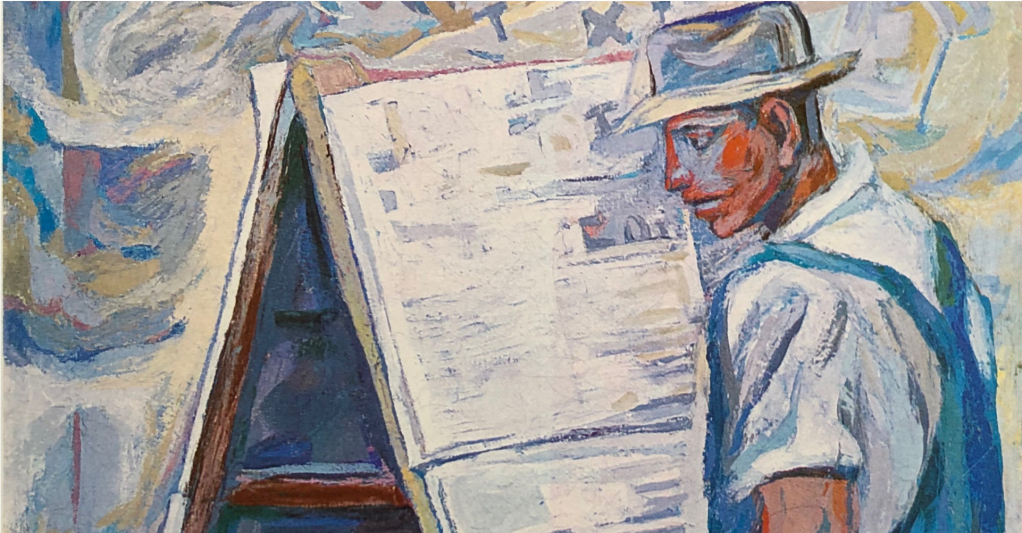
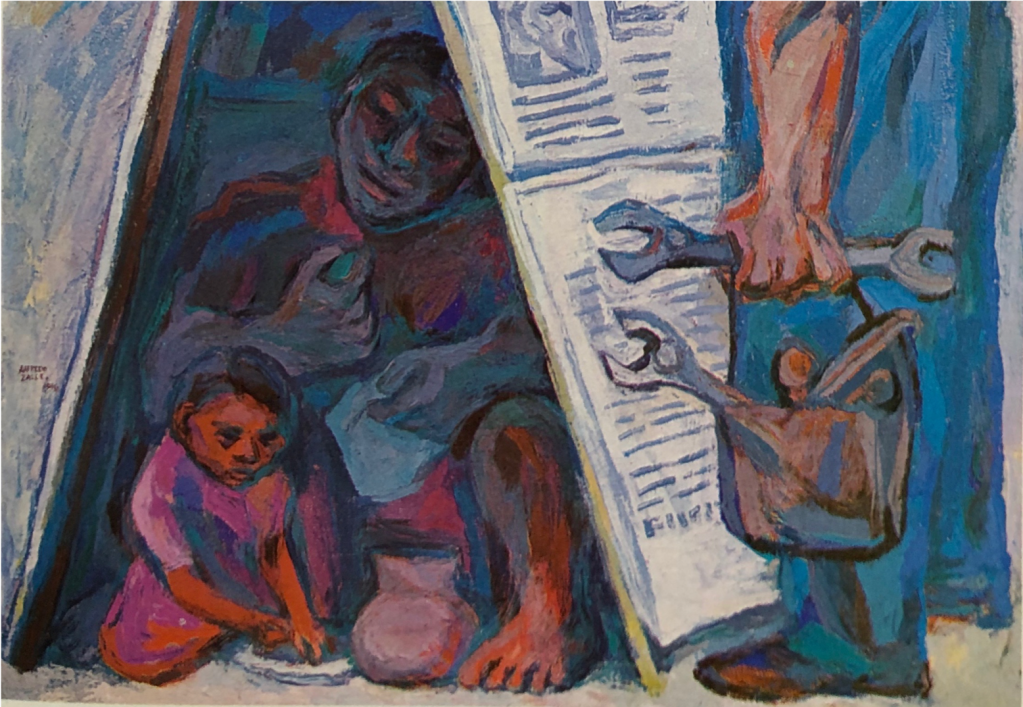
Together we looked at “Vendedora de periódicos,” a painting by Alfredo Zalce, posted below.

After introducing the painting, sans identifying information (artist, title, year), everyone looked closely for two minutes in silence. When invited to share their observations/reactions, participants commented first on the action in the left-hand corner —a falling body, a figure who had either pushed or tried to save the figure plunging to the ground, passinganother figure who appeared to attack a person or an animal. One person said it was “startling.”

Another drew attention to the figures in bolder colors—primary colors mixed with white—in the foreground, and said that the figures sheltering under a newspaper stand called to mind “classic mother and child” images. There were comments on the worker, who is dressed in a blue overall and carries tools in a bucket. Someone saw a man “who can fix things” and another saw the tools as “menacing.”

Before any details of the text were revealed, participants shared their own titles for the painting: “Taking Shelter”, “Between Me and the World”, “Working Man”, “A Mother’s Calm”, “Chaos and Security” .  After sharing a slide with the title added, we asked how words and image together changed what was seen. The Spanish title Vendedora del periódicos (Zalce, 1946) hinted at possible geographical places as well as the action of the woman selling papers and the man stopping to read the news. That brought ideas that the blurry, shapes floating at the top of the newsstand might be what the man was reading—accounts of accidents, lovers, a knife, and money changing hands.

The prompt, “Write about what is swirling in the air” brought list poems and prose rich in images and sounds. Just as people had commented on the juxtaposition of images and ideas discovered in examining the painting, participants included ordinary and extraordinary happenings and the worry, joy, fear, and uncertainty as they walk their dogs, shop for groceries, work in neonatal intensive care units, accompanied by ubiquitous thoughts of Covid-19 present on surfaces and swirling in the air. Many of the responses shared in their connection to the present moment in healthcare, and spoke of both learning how to live in that moment and desiring to escape it. One delightful wish, expressed in the writing, was for the microscopic virus to be visible as red, blue, yellow and gold glitter.

Participants are warmly encouraged to share what you wrote below (“Leave a Reply”), to keep the conversation going here, bearing in mind that the blog of course is a public space where confidentiality is not assured.

Please join us for our next sessions: Wednesday, May 13th at 12pm EDT in English or Tuesday May 12th at 8mm EEST in Greek, with more times listed on our Live Virtual Group Sessions page.

We look forward to seeing you again soon!
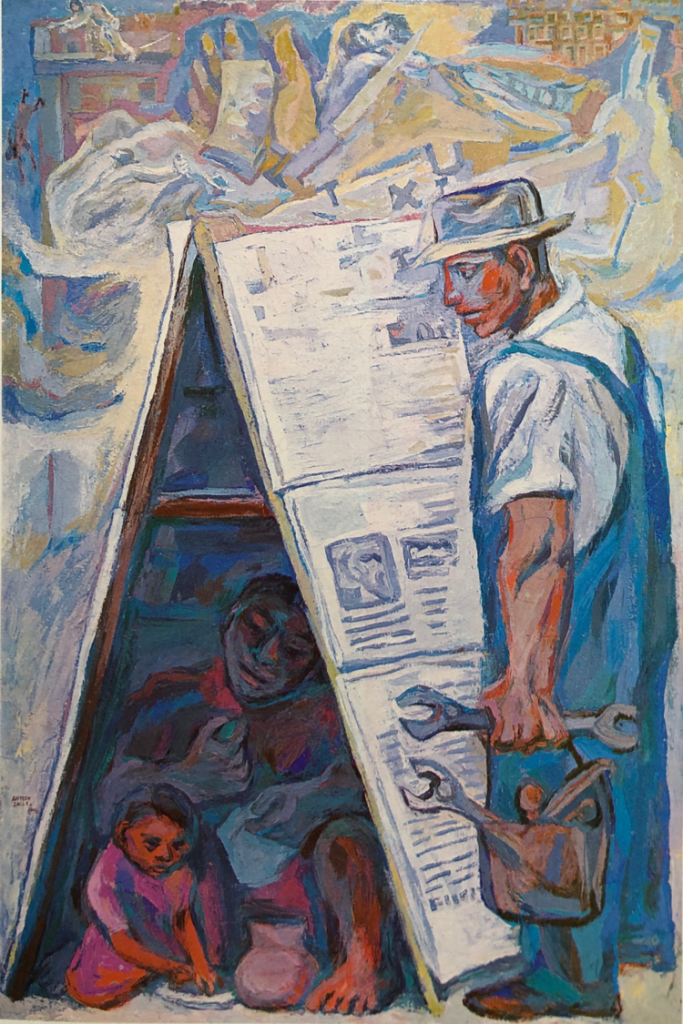
Vendedora de periódicos
(1946, painting by
Alfredo Zalce) 
Live Virtual Group Session: 2pm EDT May 9th 2020

Thank you to everyone who joined us for this session!

Our text was an excerpt from “The Diving Bell and the Butterfly: A Memoir of Life in Death” by Jean-Dominique Bauby, posted below. We read the excerpt once and discussed how the author and father demonstrated care for each other through their actions, without the need for words. We saw the mirror surrounded by photos of loved ones as another sign of affection between father and son. One participant pointed out that the second paragraph describing the father’s “lifetime’s [of] clutter” reminded her of what she and others are living through now, “My life is around me in my house.” 

Our prompt was: Write about a room of care. Two participants shared their writing inspiring a rich array of responses from the listeners. Responders noted that the shared  pieces were written in the shadow of the Diving Bell text. The first sharer’s detailed description of a richly appointed room of care and comfort invited listeners to shelter in a space of vulnerability. The second share moved with spare, short sentences, limited imagery, and rigorous honesty offering listeners permission to experience with the writer the giving and receiving of love and care along with a need for relief.

Participants are warmly encouraged to share what you wrote below (“Leave a Reply”), to keep the conversation going here, bearing in mind that the blog of course is a public space where confidentiality is not assured.

Please join us for our next session: Monday, May 11th at 6pm EDT, with more times listed on our Live Virtual Group Sessions page.

We look forward to seeing you again soon!

The Diving Bell and the Butterfly, excerpt by Jean-Dominique Bauby

Hunched in the red-upholstered armchair where he sifts through the day’s newspapers, my dad bravely endures the rasp of the razor attacking his loose skin. I wrap a big towel around his shriveled neck, daub thick lather over his face, and do my best not to irritate his skin, dotted here and there with small dilated capillaries. From age and fatigue, his eyes have sunk deep into their sockets, and his nose looks too prominent for his emaciated features. But, still flaunting the plume of hair — now snow white — that has always crowned his tall frame, he has lost none of his splendor
 
All around us, a lifetime’s clutter has accumulated; his room calls to mind one of those old persons’ attics whose secrets only they can know — a confusion of old magazines, records no longer played, miscellaneous objects. Photos from all the ages of man have been stuck into the frame of a large mirror. There is dad, wearing a sailor suit and playing with a hoop before the Great War; my eight-year-old daughter in riding gear; and a black-and-white photo of myself on a miniature-golf course. I was eleven, my ears protruded, and I looked like a somewhat simpleminded schoolboy. Mortifying to realize that at that age I was already a confirmed dunce.
 
I complete my barber’s duties by splashing my father with his favorite aftershave lotion. Then we say goodbye; this time, for once, he neglects to mention the letter in his writing desk where his last wishes are set out.
 
 
from The Diving Bell and the Butterfly: A Memoir of Life in Death, by Jean-Dominique Bauby (Vintage: 1998)


Live Virtual Group Session: 7pm EDT May 7th 2020

A warm thank you to everyone who joined us this Thursday for our session! We welcomed many familiar faces and many new faces from across the country and the globe.

Despite the physical distances that may have separated us, we were able to form a close-knit group in our virtual space and dive into a close reading of Danez Smith’s “a note on the body,” posted below. Participants discussed how bodies are regarded and treated, and how their dignity and privacy must be maintained, especially during the current healthcare crisis. Participants also commented on the distinction between “the body” and “your body,” and how the self inhabits the body and lives through it. We discussed how the text can be seen as an anthem to the critically ill patient, a testament to the struggle between body and identity in the context of illness, or a description of illness as a betrayal of the flesh. Participants were struck by the presence of the blank spaces in the poem, and how this forces the reader to confront the poem in a particular way. We also pondered whether the speaker of the poem was speaking to his/her/their self or to an audience, or both.

During the writing portion of our session, participants wrote to the prompt: “Write a note to yourself beginning with ‘you have all you need’”. This prompt led participants to consider the weight of illness on the body, and how those with Covid are somehow regarded and treated as different from bodies with other illnesses. Participants wrote about how the body is related to both the inside and outside, how it has both an interior existence and an exterior existence. Several participants drew from the poem’s tone and incorporated the self-referential aspect, writing as if talking to themselves in a nurturing way. Others played with satiety, identity, and popular culture references. 

Participants are warmly encouraged to share what you wrote below (“Leave a Reply”), to keep the conversation going here, bearing in mind that the blog of course is a public space where confidentiality is not assured.

Please join us for our next session: Saturday, May 9th at 7pm EDT, with more times listed on our Live Virtual Group Sessions page.

We look forward to seeing you again soon!

a note on the body
Danez Smith

your body still your body
your arms still wing
your mouth still a gun
 
          you tragic, misfiring bird
 
you have all you need to be a hero
don’t save the world, save yourself
 
you worship too much & you worship too much
 
when prayer doesn’t work:      dance, fly, fire
 
this is your hardest scene
when you think the whole sad thing might end
 
but you live      oh, you live
 
everyday you wake you raise the dead
 
          everything you do is a miracle


From Don’t Call Us Dead (Graywolf Press, 2017) Copyright © 2017 by Danez Smith. 

Live Virtual Group Session: 12pm EDT May 6th 2020

Thank you to the mix of 45 returning and new participants representing a variety of countries, states, cities and medical/creative disciplines who converged for today’s workshop!

Our text was: “He Has Lived in Many Houses” by Thomas Lux, posted below. After a 10-second centering pause, we listened to two volunteers read this 1996 Thomas Lux poem about being someplace but seeking another, being home regardless of geography, and adapting to one’s surroundings. Participants then considered three questions: “What did you see in the poem? What did you hear in the poem? What did the poem smell like?” In the rich discussion, participants commented on how home is a point of reference, one that can be sacred and personal, and part of both travel and the traveler: an anchor, a sanctuary, an inner space. Participants spoke about the uniqueness of home, and noted the emotional foundation and sacredness intrinsic to the word “home” that may not necessarily be present in the same way with the word “house.” They were struck by the swaying rhythm of the poem, and highlighted how by starting each line with a small preposition, there was an ebb and flow to its rhythmicity. They were struck by the presence of a daily routine, a cycle, and the transition from past, present, and future tenses during the search for home. Briny shores, a fishing village and rust were among the olfactory associations made.

Our prompt was: Write about a sanctuary. Our four-minute prompt inspired writings linked to childhood (“a bestowed sanctuary”), intergenerational voices and tone, an appreciation for a sanctuary that “doesn’t talk back” and a construction of reality of map vs. mind. Participants wrote about how although there may be a journey to find home, home is not the final destination, as it is re-constructed along the journey of life. It moves, evolves, and is shaped by both internal and external forces. It is also both internal and external to the person who inhabits it, perhaps a physical exterior providing protection and safety while remaining internal, intrinsic, sacred to the heart of the inhabitant. On the other hand, we wondered whether what sanctuary is possible in a precarious world, and whether recognizing that childhood is a sanctuary means that the sanctuary’s protection has been broken. Participants were also inspired by the smells in the poem and incorporated sensory experience into their own work.

Participants are warmly encouraged to share what you wrote below (“Leave a Reply”), to keep the conversation going here, bearing in mind that the blog of course is a public space where confidentiality is not assured. If you chose to draw, your are welcome to share as well, simply email your visual file to narrativemedicine@columbia.edu and we will add and credit it to the post here.

Please join us for our next session: Thursday, May 7th at 7pm EDT, with more times listed on our Live Virtual Group Sessions page.

We look forward to seeing you again soon!

He Has Lived in Many Houses
by Thomas Lux

furnished rooms, flats, a hayloft,
a tent, motels, under a table,
under an overturned rowboat, in a villa (briefly) but not,
as yet, a yurt. In these places
he has slept, eaten,
put his forehead to the window glass,
looking out. He's in a stilt-house now,
the water passing beneath him half the day;
the other half it's mud. The tides
do this: they come, they go,
while he sleeps, eats, puts his forehead
to the window glass.
He's moving soon: his trailer to a trailer park,
or to the priory to live among the penitents
but in his own cell,
with wheels, to take him, when it's time
to go, to: boathouse, houseboat
with a little motor, putt-putt,
to take him across the sea
or down the river
where at night, anchored by a sandbar
at the bend,
he will eat, sleep, and press his eyelids
to the window
of the pilothouse
until the anchor-hauling hour
when he'll embark again
toward his sanctuary, harborage, saltbox,
home.


Originally published in The Atlantic Monthly, January 1992

Live Virtual Group Session: 6pm EDT May 4th 2020

Thank you to everyone who joined us for this session!

Together we listened to “Waving Through a Window” from the musical Dear Evan Hansenposted and linked below. So many of our participants shared how this piece moved them – whether it resonated with their “physical distance from others”, “longing to get back in” to old routines, “quite literally, tap tap tapping on windows in the ICU” or feeling trapped behind “the glass that is Zoom”. One participant observed how the lyrics’ progression of “I-you-we” expanded the point of view of the narrator and of the audience. Others were struck by some of the imagery in the song (the sun that “doesn’t rise”, or the “stars in our eyes”…) In looking to the narrator, we wondered about who we could picture behind these lyrics, and what specific elements of our text shaped our perspectives: was it the age of the singer? The depth of their message? The self-awareness of their point of view? In looking to the audience, we wondered about the role of the listener as a witness: do we need an audience to confirm that the “sound” really happened? (“When you’re falling in a forest and there’s nobody around / Do you ever really crash, or even make a sound?”)

After our discussion, we wrote to the prompt: Write about stepping into the sun.

It’s always so interesting to see the many journeys a prompt can bring us on. In this case, the sun was present throughout our writing, yet in so many different ways. Our suns were bright, blinding, smile-inducing, and even next to the moon. One of the texts we read out loud left us with a profound question: “When is the right moment to step out?” 

Thank you all for another night of engaging conversation. We love seeing how our comments in the conversation build upon each previous one, and how our collective discussion helps us gain a deeper insight into our text.

Participants are warmly encouraged to share what you wrote below (“Leave a Reply”), to keep the conversation going here, bearing in mind that the blog of course is a public space where confidentiality is not assured.

Please join us for our next session: Wednesday, May 6th at 12pm EDT, with more times listed on our Live Virtual Group Sessions page.

We look forward to seeing you again soon!

"Waving Through A Window" – From Dear Evan Hansen

I've learned to slam on the brake
Before I even turn the key
Before I make the mistake
Before I lead with the worst of me

Give them no reason to stare
No slipping up if you slip away
So I got nothing to share
No, I got nothing to say

Step out, step out of the sun
If you keep getting burned
Step out, step out of the sun
Because you've learned, because you've learned

On the outside, always looking in
Will I ever be more than I've always been?
'Cause I'm tap, tap, tapping on the glass
I'm waving through a window
I try to speak, but nobody can hear
So I wait around for an answer to appear
While I'm watch, watch, watching people pass
I'm waving through a window, oh
Can anybody see, is anybody waving back at me?

We start with stars in our eyes
We start believing that we belong
But every sun doesn't rise
And no one tells you where you went wrong

Step out, step out of the sun
If you keep getting burned
Step out, step out of the sun
Because you've learned, because you've learned

On the outside, always looking in
Will I ever be more than I've always been?
'Cause I'm tap, tap, tapping on the glass
Waving through a window
I try to speak, but nobody can hear
So I wait around for an answer to appear
While I'm watch, watch, watching people pass
Waving through a window, oh
Can anybody see, is anybody waving?

When you're falling in a forest and there's nobody around
Do you ever really crash, or even make a sound?
When you're falling in a forest and there's nobody around
Do you ever really crash, or even make a sound?
When you're falling in a forest and there's nobody around
Do you ever really crash, or even make a sound?
When you're falling in a forest and there's nobody around
Do you ever really crash, or even make a sound?
Did I even make a sound?
It's like I never made a sound
Will I ever make a sound?

On the outside, always looking in
Will I ever be more than I've always been?
'Cause I'm tap, tap, tapping on the glass
Waving through a window
I try to speak, but nobody can hear
So I wait around for an answer to appear
While I'm watch, watch, watching people pass
Waving through a window, oh
Can anybody see, is anybody waving back at me? (oh)
Is anybody waving?
Waving, waving, whoa-oh, whoa-oh

℗© 2017 Autumn Smile Broadway Limited Liability Company under exclusive license to Atlantic Recording Corporation for the United States and WEA International Inc. for the world outside of the United States.

Live Virtual Group Session: 3pm EDT May 3rd 2020

Thank you to everyone who joined us for this session!

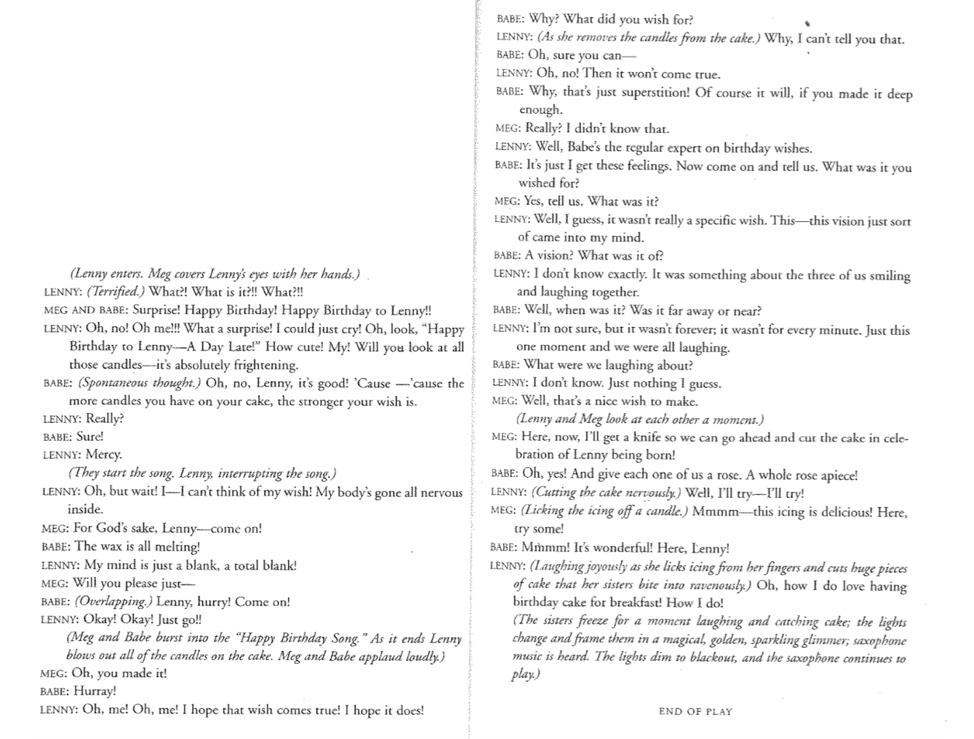
Our text was an excerpt of the play “Crimes of the Heart” by Beth Henley, posted below.

Our prompt was: Write about a wish.

More details on this session are coming soon, so check back!

Participants are warmly encouraged to share what you wrote below (“Leave a Reply”), to keep the conversation going here, bearing in mind that the blog of course is a public space where confidentiality is not assured.

Please join us for our next session: Monday, May 4th at 6pm EDT, with more times listed on our Live Virtual Group Sessions page.

We look forward to seeing you again soon!

Crimes of the Heart, excerpt by Beth Henley

(Lenny enters. Meg covers Lenny’s eyes with her hands.)

LENNY: (Terrified) What!? What is it?!! What?!!

MEG AND BABE: Surprise! Happy Birthday! Happy Birthday to Lenny!!

LENNY: Oh, no! Oh me!!! What a surprise! I could just cry! Oh, look, “Happy Birthday to Lenny– A Day Late!” How cute! My! Will you look at all those candles– it’s absolutely frightening.

BABE: (Spontaneous thought.) Oh, no, Lenny, it’s good! ‘Cause— ’cause the more candles you have on your cake, the stronger your wish is.

LENNY: Really?

BABE: Sure!

LENNY: Mercy.

(They start the song. Lenny, interrupting the song.)

LENNY: Oh, but wait! I— I can’t think of my wish! My body’s gone all nervous inside.

MEG: For God’s sake, Lenny-come on!

BABE: The wax is all melting!

LENNY: My mind is just a blank, a total blank!

MEG: Will you please just—

BABE: (Overlapping.) Lenny, hurry! Come on!

LENNY: Okay! Okay! Just go!!

(Meg and Babe burst into the “Happy Birthday Song. “As it ends Lenny blows out all of the candles on the cake. Meg and Babe applaud loudly)

MEG: Oh, you made it!

BABE: Hurray!

LENNY: Oh, me! Oh, me! I hope that wish comes true! I hope it does!

BABE: Why? What did you wish for?

LENNY: (As she removes the candles from the cake.) Why, I can’t tell you that.

BABE: Oh, sure you can—

LENNY: Oh, no! Then it won’t come true.

BABE: Why, that’s just superstition! Of course it will, if you made it deep enough.

MEG: Really? I didn’t know that.

LENNY: Well, Babe’s the regular expert on birthday wishes.

BABE: lt’s just I get these feelings. Now come on and tell us. What was it you wished for?

MEG: Yes, tell us. What was it?

LENNY: Well, I guess, it wasn’t really a specific wish. This— this vision just sort of came into my mind.

BABE: A vision? What was it of?

LENNY: I don’t know exactly.. It was something about the three of us smiling and laughing together.

BABE: Well, when was it? Was it far away or near?

LENNY: I’m not sure, but it wasn’t forever; it wasn’t for every minute. Just this one moment and we were all laughing.

BABE: What were we laughing about?

LENNY: I don’t know. Just nothing I guess.

MEG: Well, that’s a nice wish to make.

(Lenny and Meg look at each other a moment.)

MEG: Here, now, I’ll get a knife so we can go ahead and cut the cake in celebration of Lenny being born!

BABE: Oh, yes! And give each one of us a rose. A whole rose apiece!

LENNY: (Cutting the cake nervously.) Well, I’ll try— I’ll try!

MEG: (Licking the icing off a candle.) Mmmm—- this icing is delicious! Here, try some!

BABE: Mmmm! It’s wonderful! Here, Lenny!

LENNY: (Laughing joyously as she licks icing from her fingers and cuts huge pieces of cake that her sisters bite into ravenously.) Oh, how I do love having birthday cake for breakfast! How I do!

(The sisters freeze for a moment laughing and catching cake; the lights change and frame them in a magical, golden, sparkling glimmer; saxaphone music is heard. The lights dim to blackout, and the saxophone continues to play.)

END OF PLAY


Live Virtual Group Session: 7pm EDT May 1st 2020

What a wonderful, warm, and far-flung group convened for our session – from around the country (Pittsburgh, the Bronx, Martha’s Vineyard, and beyond) and around the world (Morocco, Greece, India at 4:30 am!).

Our text for this session was “The Trees” by Philip Larkin, posted below. We discussed the poem, which in true Larkin fashion, reveals itself, with close reading, to be far more complex than one first imagines. And so our collective reading revealed the layers of this wonderful piece – like the trees’ “rings of grain.”. Our discussion was energetic and far-reaching. Participants pointed to the poem’s language, drawing a connection between Larkin’s “greenness” as a “kind of grief” to the opening lines of TS Eliot’s “The Wasteland:”

April is the cruelest month, breeding
Lilacs out of the dead land, mixing
Memory and desire…

 We discussed the complexity of man’s relationship to nature – in that we turn to it for solace and reassurance, finding only confirmation of our solitude and our mortality. One participant pointed to the “Russian doll”-like nature of the poem, the ways in which layers of meaning are embedded in its three short stanzas. And a comment about the end of the poem itself being a beginning – “afresh afresh afresh” – not only affirmed this notion but also echoed, with its sonorous repetition, in our participants’ subsequent writing.

We offered the prompt: Write about what roots you. And the pieces it inspired were indeed as multifaceted as the poem itself. Our participants shared generously, and many have posted here. (Thank you!) We look forward to gathering again with you soon.

Participants are warmly encouraged to share what you wrote below (“Leave a Reply”), to keep the conversation going here, bearing in mind that the blog of course is a public space where confidentiality is not assured. If you chose to draw, your are welcome to share as well, simply email your visual file to narrativemedicine@columbia.edu and we will add and credit it to the post here.

Please join us for our next session: Sunday, May 3rd at 3pm EDT, with more times listed on our Live Virtual Group Sessions page.

We look forward to seeing you again soon!

The Trees 
By Philip Larkin

The trees are coming into leaf
Like something almost being said;
The recent buds relax and spread,
Their greenness is a kind of grief.

Is it that they are born again
And we grow old? No, they die too,
Their yearly trick of looking new
Is written down in rings of grain.

Yet still the unresting castles thresh
In fullgrown thickness every May.
Last year is dead, they seem to say,
Begin afresh, afresh, afresh.

from The Collected Poems (Faber, 1993), by permission of the publisher, Faber & Faber Ltd.


Live Virtual Group Session: 12pm EDT April 29th 2020

Thank you to everyone who attended our session. We were fortunate to have participants from all across the globe — Germany, Italy, Portugal, UK, India, USA, and Bahrain!

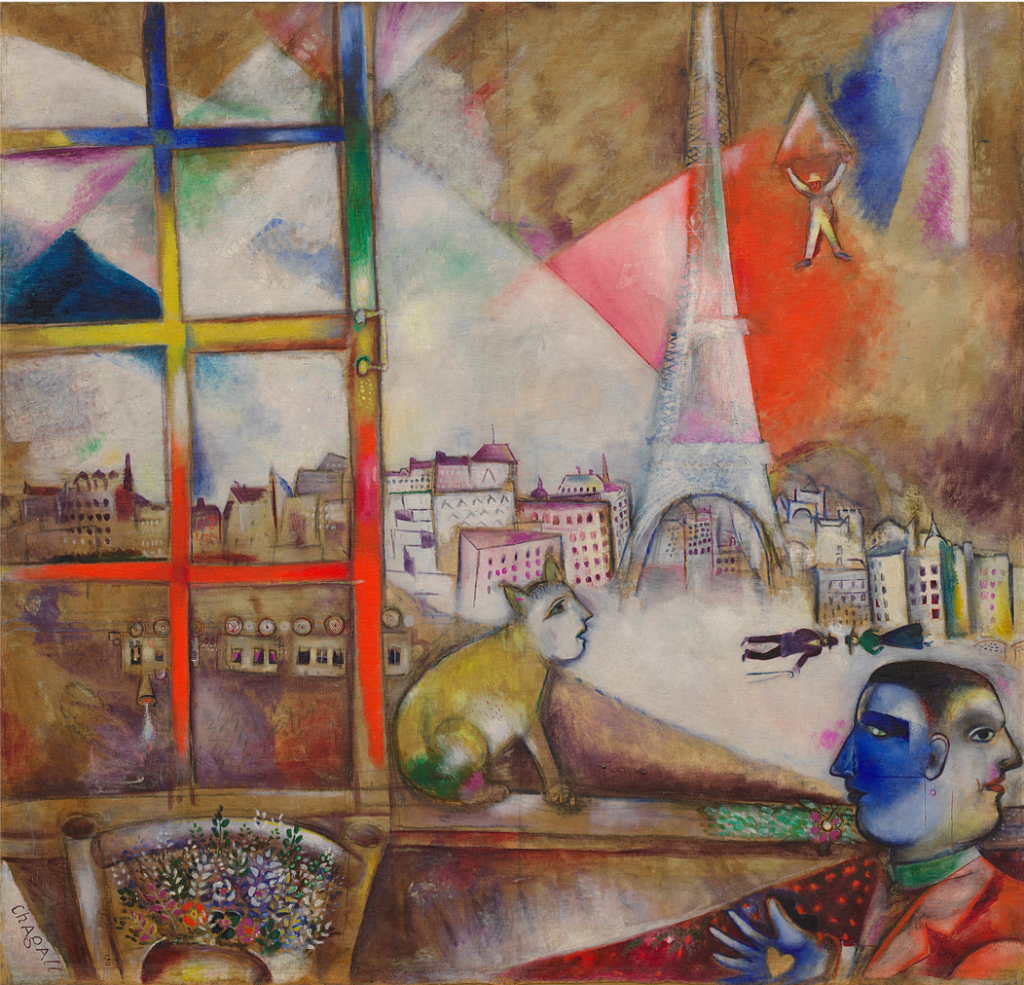
This week, we discussed Marc Chagall’s painting “Paris through the window” (1913) (posted below). Our discussion was dynamic and multi-faceted, with a wonderful amalgamation of  perspectives. Participants spoke of the binaries present in the painting — between reality and fantasy, the waking state and the dream-like, the world outside and inside, the past and future, the dark and light. Others called attention to the vibrant colors, the caricature of the human-faced cat, the upside-down train, the flowers growing forth from the chair, and the two-faced “Janus” figure. We noticed how that figure and the cat were together yet looking elsewhere, and we wondered what the Janus figure was seeing, crowded down in the corner. We also considered the meaning of the horizontal figures. People connected the chaotic, otherworldly nature of the image to our current situation, and we considered the artist’s flight from Russia, as well.

Our prompt was: Write about looking through a window. In response to our prompt, participants spoke about seeing the future through the window as well as gleaning reminders of the past. Participants spoke of imagining people congregating again in groups, offering optimism and hope for our own future. We also heard about the window itself — its form, its movement or lack thereof, and how our perspective can change as we look through it. Other noticed the positioning of the body in experience and space, or spoke of the window as an “incomprehensible other”— something that we find ourselves engaging with more often these days. The responses we heard seemed to be prose, compared to the poetry that has dominated many past sessions.

Participants are warmly encouraged to share what you wrote below (“Leave a Reply”), to keep the conversation going here, bearing in mind that the blog of course is a public space where confidentiality is not assured. If you chose to draw, your are welcome to share as well, simply email your visual file to narrativemedicine@columbia.edu and we will add and credit it to the post here.

Please join us for our next session: Friday, May 1st at 7pm EDT, with more times listed on our Live Virtual Group Sessions page.

We look forward to seeing you again soon!

ARTIST
Marc Chagall b. 1887, Vitebsk, Russia; d. 1985, Saint-Paul-de-Vence, France
TITLE
Paris through the Window
DATE
1913
MEDIUM
Oil on canvas
DIMENSIONS
53 9/16 x 55 7/8 inches (136 x 141.9 cm)
CREDIT LINE
Solomon R. Guggenheim Museum, New York, Solomon R. Guggenheim Founding Collection, By gift
COPYRIGHT
© 2018 Artists Rights Society (ARS), New York/ADAGP, Paris

Live Virtual Group Session: 6pm EDT April 27th 2020

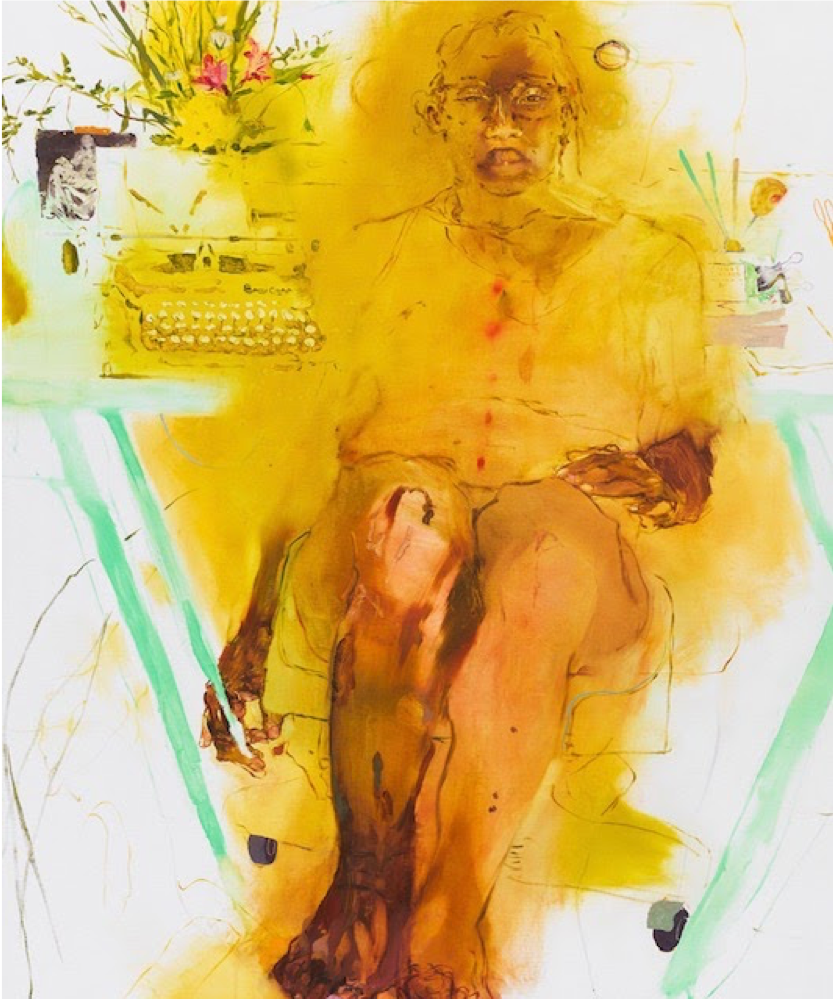
Forty-five people (from Canada, Mexico, Morocco, the United Kingdom, and the United States) participated in exploring Jennifer Packer’s  2017 painting: “April, Restless.” The first observations involved the color yellow, its brightness emanating off our screens. One person said yellow is his favorite color; another liked the “daffodil” color of spring, the way the dominant color echoed the flowers in the upper left corner; another said yellow causes feelings of friction

While keen observers took in objects such as a typewriter, a photograph of the Pietà, a clipboard and scissors, pens or brushes, a table that is there/not there, and the casters under the chair that the central figure occupies, the presence of a person seated (some said “like a monument”) and looking directly at the viewer, prompted the most discussion. Is it a self-portrait? Does it represent a man, woman, elderly, young age? Because we began without revealing the artist, title, or medium, and participants were asked to “bring new eyes” and slow-look, differing perspectives emerged from the encounters between what oil-on-canvas was visible on our screens and what each person brought to the painting (the beholder’s share).

Repeatedly people brought questions of identity: what shading and skin tones, markings on the legs, and the shape of the feet in the foreground could tell us.

There were comments on what appeared to be the sitter’s discomfort. Some participants (especially from professions in healthcare) were aware that they tended to “medicalize” the stillness, the posture, the left eye open and the right closed or drooping, the position of both hands, and considered possible diagnoses or illnesses that the sitter may live with. One person saw a writer turned away from her typewriter and unable to continue working. When the facilitators showed the slide with the title “April, Restless” many felt confirmed that what appeared as stiffness and stillness, perhaps immobility, reflected the sitter’s restless wish to move. Our own experiences of limited mobility and prolonged sheltering-in-place, due to the COVID-19 pandemic, was also present, and we wondered what we projected onto the painting. NM thrives on these moments of intersubjectivity, when we are able to include ourselves in the knowing and unknowing of a text and others’ points of view.

Our prompt was: “Draw or write about restless April.”

In response to the prompt many participants turned to their April, 2020 and wrote about what they see through the window or walking in nature. Poets, reading aloud what they had written in four minutes, echoed the colors in the painting–not only with forsythia’s bright blooms but also with a robin’s breast, recalling the red spots, on the sitter’s chest, which some viewers had seen as blood and others as red buttons. 

Participants are warmly encouraged to share what you wrote below (“Leave a Reply”), to keep the conversation going here, bearing in mind that the blog of course is a public space where confidentiality is not assured. If you chose to draw, your are welcome to share as well, simply email your visual file to narrativemedicine@columbia.edu and we will add and credit it to the post here.

Please join us for our next session: Wednesday, April 29th at 12pm EDT, with more times listed on our Live Virtual Group Sessions page.

We look forward to seeing you again soon!

April, Restless
(2017) Oil on Canvas
48’’ x 36”
 Jennifer Packer


Narrative Medicine Book Club: Special Guest Laura Marris May 3rd on Zoom!

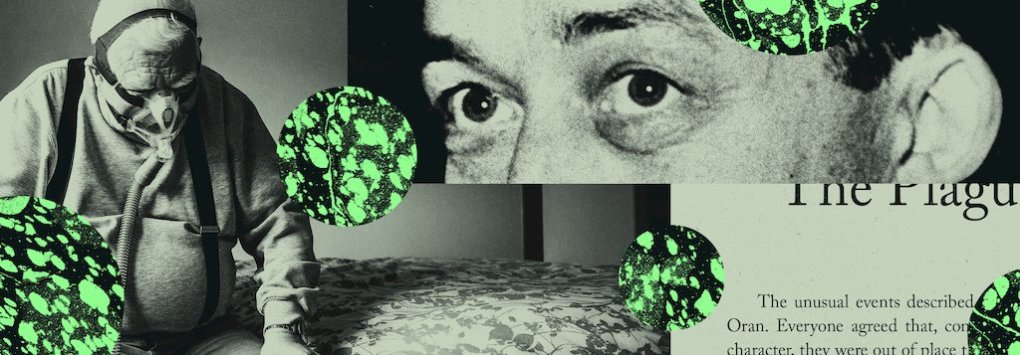
Please join us for our last book club group meeting to discuss Albert Camus’ The Plague on May 3rd. We will be joined by a very special guest, Laura Marris, poet and translator working on a new translation of The Plague, forthcoming from Knopf. She recently published this OpEd,  “Camus’s Inoculation Against Hate,” in The New York Times. We are excited she will join us!


PLEASE SUBMIT ANY QUESTIONS FOR LAURA IN THE COMMENTS BELOW. 


All are welcome to attend the Zoom session, even if you haven’t read along so far! See you Sunday! 

Image Credit: Joan Wong/NY Times