Live Virtual Group Session: 12PM EST December 20th 2023

Thank you to everyone who joined us for this session!

For this session we read a poem “Bluebird” by Charles Bukowski, posted below.

Our prompt was:ย โ€œWrite about the bluebird in your heart.โ€

More details will be posted on this session, so check back again!

Participants are warmly encouraged to share what you wrote below (โ€œLeave a Replyโ€), to keep the conversation going here, bearing in mind that the blog of course is a public space where confidentiality is not assured.

Also, we would love to learn more about your experience of these sessions, so if youโ€™re able, please take the time to fill out a follow-up survey of one to two quick questions!

Please join us for our next session Monday January 8th at 6pm EST, with more times listed on our Live Virtual Group Sessions.


“Bluebird” by Charles Bukowski

there’s a bluebird in my heart that
wants to get out
but I’m too tough for him,
I say, stay in there, I’m not going
to let anybody see
you.
there’s a bluebird in my heart that
wants to get out
but I pour whiskey on him and inhale
cigarette smoke
and the whores and the bartenders
and the grocery clerks
never know that
he’s
in there.

there’s a bluebird in my heart that
wants to get out
but I’m too tough for him,
I say,
stay down, do you want to mess
me up?
you want to screw up the
works?
you want to blow my book sales in
Europe?
there’s a bluebird in my heart that
wants to get out
but I’m too clever, I only let him out
at night sometimes
when everybody’s asleep.
I say, I know that you’re there,
so don’t be
sad.
then I put him back,
but he’s singing a little
in there, I haven’t quite let him
die
and we sleep together like
that
with our
secret pact
and it’s nice enough to
make a man
weep, but I don’t
weep, do
you?

This was published in Bukowski’s book “The Last Night of the Earth Poems” circa 1992ยฉ by owner.


Live Virtual Group Session: 6PM EST December 18th 2023

Thank you to everyone who joined us for this session!

For this session we read a poem “The Traveling Onion” by Naomi Shihab Nye, posted below.

Our prompt was: โ€œWrite about a small forgotten miracle.โ€

More details will be posted on this session, so check back again!

Participants are warmly encouraged to share what you wrote below (โ€œLeave a Replyโ€), to keep the conversation going here, bearing in mind that the blog of course is a public space where confidentiality is not assured.

Also, we would love to learn more about your experience of these sessions, so if youโ€™re able, please take the time to fill out a follow-up survey of one to two quick questions!

Please join us for our next session Wednesday December 20th at 12pm EST, with more times listed on ourย Live Virtual Group Sessions.


“The Traveling Onion” by Naomi Shihab Nye

โ€œIt is believed that the onion originally came from India. In Egypt it was an 
object of worship โ€”why I havenโ€™t been able to find out. From Egypt the onion
entered Greece and on to Italy, thence into all of Europe.โ€ โ€” Better Living Cookbook

When I think how far the onion has traveled
just to enter my stew today, I could kneel and praise
all small forgotten miracles,
crackly paper peeling on the drainboard,
pearly layers in smooth agreement,
the way the knife enters onion
and onion falls apart on the chopping block,
a history revealed.
And I would never scold the onion
for causing tears.
It is right that tears fall
for something small and forgotten.
How at meal, we sit to eat,
commenting on texture of meat or herbal aroma
but never on the translucence of onion,
now limp, now divided,
or its traditionally honorable career:
For the sake of others,
disappear.

Naomi Shihab Nye, โ€œThe Traveling Onionโ€ from Words Under the Words: Selected Poems. Copyright ยฉ 1995 by Naomi Shihab Nye. Reprinted with the permission of the author.

Encuentros virtuales en vivo: Sรกbado 16 de diciembre, 13:00 EST

Asistimos personas de diferentes lugares: desde Nueva York, Argentina, Tenerife y Bilbao en Espaรฑa.

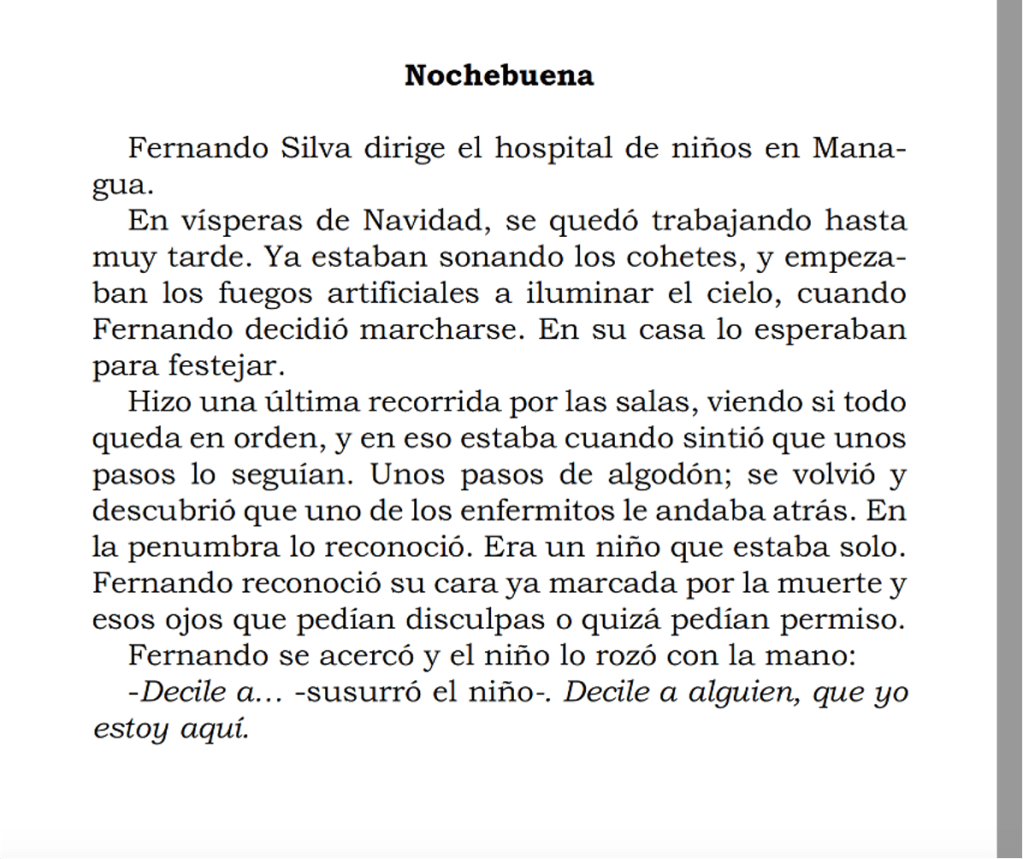
Trabajamos un relato corto, Nochebuena, de Eduardo Galeano que se encuentra en el libro El libro de los abrazos1989.

Una participante notรณ que el texto estรก dividido en dos partesโ€”en una parte, la alegrรญa de las fiestas y alguien que espera a Fernando en la casa, y en la otra parte, estรก el niรฑo en un hospital solo sin ruido, nadie lo estรก esperando. Otra persona dijo que el cuento estรก lleno de oposiciones. Se hablo de como la lectura en voz alta nos deja con el sonido de la โ€œsโ€, una aliteraciรณn que recuerda al susurro del niรฑo y al silencio del hospital.

Hablando de la contraposiciรณn discutimos el significativo de lo que el niรฑo pidiรณ, ser reconocido por alguien. Un participante dijo que รฉl estรก en una soledad absoluta y el chico siempre estรก ignorado y desea ser reconocido. 

Vimos en contraste que el niรฑo no tiene nombre, pero el doctor se llama Fernando Silva. Fernando no reconoce el niรฑo por un nombre sino por el niรฑo que estรก solo y la cara estรก marcada por la muerte. Alguien mencionรณ que para los mรฉdicos los pacientes en el hospital no tienen nombre; son cama 5 o cama 4. Aquรญ vemos que el chico fuerza el conocimiento y fuerza rozarse contra el mรฉdico. El niรฑo estรก terminal y solo y no quiere estar solo. 

Otra persona mencionรณ que el mรฉdico es muy organizado porque querรญa dejar todo en orden. Todo estaba en silencio sino los pasos de algodรณn del chico o no hay nadie o todo mundo estรก durmiendo. Es como si el niรฑo fuera un fantasma. 

Cuando Fernando decidiรณ marcharse, le costรณ irse, aunque es Nochebuena. Afuera se celebra el nacimiento de un niรฑo y aquรญ vemos la muerte de un niรฑo. 

El niรฑo pide contarle a alguien su historia o que el mismo mรฉdico lo vea, lo reconozca. 

La propuesta de escritura fue: โ€œEscribe sobre una despedidaโ€. Todos escribimos en la sombra del texto. Escribimos de despedidas relacionadas con la muerte de seres queridos, tener el honor de presenciar la muerte como clรญnico, la muerte futura y las despedidas recurrentes.

Aquรญ, ahora alentamos a los participantes que, si asรญ lo desean, compartan lo que escribieron a continuaciรณn. Deja tu respuesta aquรญ, si deseas continuar la conversaciรณn sobre parte de los murales exteriores del Nochebuena, de Eduardo Galeano. Pero antes, les recomendamos tener en cuenta que el blog es un espacio pรบblico donde, por supuesto, no se garantiza la confidencialidad.

Por favor, รบnase a nosotros en nuestra prรณxima sesiรณn en espaรฑol: El sรกbado 20 enero a las 13 hrs. o a la 1 pm EST. Tambiรฉn, ofrecemos sesiones en inglรฉs. Ve aย nuestra pรกgina deย sesiones grupales virtuales en vivo.


Live Virtual Group Session: 12PM EST December 15th 2023

Thank you to everyone who joined us for this session!

For this session we read a poem “Orlando” by Megan Fernandes, posted below.

Our prompt was:ย โ€œWrite about a road not taken.โ€

More details will be posted on this session, so check back again!

Participants are warmly encouraged to share what you wrote below (โ€œLeave a Replyโ€), to keep the conversation going here, bearing in mind that the blog of course is a public space where confidentiality is not assured.

Also, we would love to learn more about your experience of these sessions, so if youโ€™re able, please take the time to fill out a follow-up survey of one to two quick questions!

Please join us for our next session Monday December 18th at 6pm EST, with more times listed on our Live Virtual Group Sessions.


"Orlando" byย Megan Fernandes

The few weeks I was pregnant, whenever people asked
how are you, meg? Iโ€™d answer, oh ya knowโ€ฆ with child
which I thought was dead funny. I donโ€™t think about it now
except sometimes in a fitness class surrounded by women
trying to shed baby weight and I make the calculations,
(heโ€™d be about fourteen by now) and then I look at myself
in the class mirror while women squat and lift their legs
and think, wow!, I look so good for having a fourteen
year old and then Iโ€™d think again, how if he was a reality,
Iโ€™d say it all the time and embarrass him in front of his
school friends and for some reason, I think heโ€™d be
a drummer and wear green. I have no regrets,
but I wonder if heโ€™s waiting in the sky somewhere
or doing blow in another dimension where heโ€™s a rocker
and very much flesh. I donโ€™t believe in kin by blood,
but I believe poems can give form to the formless,
that one can resurrect roads not taken in a line
and give it a name. Itโ€™s a novel by Virginia Woolf, Iโ€™d say
and rattle on and heโ€™d wave me off but maybe read it
one day in college and think about his young mother
who wanted to be a writer and what she might have had
to give up in order to raise him at twenty-three.
Heโ€™d write me a song. Heโ€™d title it with my name.

Credit: Megan Fernandes. The Nation

Live Virtual Group Session: 12PM EST December 8th 2023

Thank you to everyone who joined us for this session!

For this session we read a poem “The Mountains” by D’Arcy McNickle, posted below.

Our prompt was: โ€œWrite about what is seen in the half-night.โ€

More details will be posted on this session, so check back again!

Participants are warmly encouraged to share what you wrote below (โ€œLeave a Replyโ€), to keep the conversation going here, bearing in mind that the blog of course is a public space where confidentiality is not assured.

Also, we would love to learn more about your experience of these sessions, so if youโ€™re able, please take the time to fill out a follow-up survey of one to two quick questions!

Please join us for our next session Friday December 15th at 12pm EST, with more times listed on our Live Virtual Group Sessions.


"The Mountains" by D'Arcy McNickle

There is snow, nowโ€”
A thing of silent creepingโ€”
And day is strange half-night . . .
And the mountains have gone, softly murmuring something . . .

And I remember pale days,
Pale as the half-night . . . and as strange and sad.

I remember times in this room
When but to glance thru an opened window
Was to be filled with an ageless crying wonder:
The grand slope of the meadows,
The green rising of the hills,
And then far-away slumbering mountainsโ€”
Dark, fearful, oldโ€”
Older than old, rusted, crumbling rock,
Those mountains . . .
But sometimes came a strange thing
And theirs was the youth of a cloudlet flying,
Sunwise, flashing . . .

And such is the wisdom of the mountains!
Knowing it nothing to be old,
And nothing to be young!

There is snow, nowโ€”
A silent creeping . . .

And I have walked into the mountains,
Into canyons that gave back my laughter,
And the lover-girlโ€™s laughter . . .
And at dark,
When our skin twinged to the night-wind,
Built us a great marvelous fire
And sat in quiet,
Carefully sipping at scorching coffee . . .

But when a coyote gave to the night
A wail of all the bleeding sorrow,
All the dismal, grey-eyed pain
That those slumbering mountains had ever knownโ€”
Crept close to each other
And close to the fireโ€”
Listeningโ€”
Then hastily doused the fire
And fled (giving many excuses)
With tightly-clasping hands.

Snow, snow, snowโ€”
A thing of silent creeping

And once,
On a night of screaming chill,
I went to climb a mountainโ€™s cold, cold body
With a boy whose eyes had the ancient look of the mountains,
And whose heart the swinging dance of a laughter-child . . .
Our thighs ached
And lungs were fired with frost and heaving breathโ€”
The long, long slopeโ€”
A wind mad and raging . . .
Thenโ€”the top!

There should have been . . . something . . .
But there was silence, onlyโ€”
Quiet after the windโ€™s frenzy,
Quiet after all frenzyโ€”
And more mountains,
Endlessly into the night . . .

And such is the wisdom of mountains!
Knowing how great is silence,
How nothing is greater than silence!

And so they are gone, now,
And they murmured something as they wentโ€”
Something in the strange half-night . . .

Credit: Dโ€™Arcy McNickle. poets.org